Vehicle sales are recovering from Egypt’s currency-driven market collapse, but imported models are gaining ground faster than local assembly, testing the country’s ambitions to build a competitive automotive manufacturing industry.
CAIRO, Egypt’s vehicle sales rose nearly 26% during the first eight months of 2026, extending a recovery from the country’s automotive market collapse. Yet almost 70% of the additional vehicles sold were imported, raising questions about how much of the rebound is translating into domestic manufacturing.
Sales reached 135,445 vehicles between January and August, up from approximately 107,700 a year earlier, according to Automotive Marketing Information Council (AMIC) figures reported by Egyptian business publications this week.
The expansion brings Egypt closer to a market exceeding 200,000 annual sales for the first time since 2021. But a closer examination reveals two contrasting trends: consumer demand is recovering, while imports are gaining market share faster than locally assembled vehicles.
From 290,000 Vehicles to Market Collapse
Egypt’s automotive market entered its downturn after sales reached 290,846 vehicles in 2021.
Foreign-currency shortages, restrictions on imports, difficulties sourcing components and sharply higher prices subsequently disrupted the industry. Sales fell to 184,771 vehicles in 2022 before collapsing to 90,359 in 2023, according to historical AMIC reports.
The recovery began in 2024, when sales rose 13% to 102,249 vehicles. It accelerated in 2025, with sales jumping almost 70% to 173,763 vehicles.
Despite that improvement, last year’s volume remained approximately 40% below the 2021 level.
The latest figures therefore represent a continuing recovery rather than a return to the market’s earlier scale. They also suggest that improving vehicle availability and price competition have helped restore demand, although sales statistics alone cannot establish the contribution of individual factors.
Passenger Cars Lead, but August Signals Slower Growth
Passenger cars accounted for the largest share of the 2026 expansion, with sales rising 22% to 101,492 vehicles during January–August.
Bus sales increased 78.5% to 12,101 vehicles, the strongest percentage growth among the three principal categories, while commercial truck sales climbed 22.7% to 21,852 units.
Growth across private and commercial vehicles points to a broader recovery in transport demand, although the data do not distinguish replacement purchases from fleet expansion.
The latest monthly results were less encouraging.
August sales increased just 5.6% year on year to 18,576 vehicles, compared with 15.6% growth in July. Passenger-car sales rose 7.8% and bus sales increased 35%, but truck sales declined approximately 16%.
The slowdown suggests that the recovery is becoming less uniform, particularly in commercial transport, even as the cumulative eight-month figures remain strong.
Imports Capture Nearly 70% of Additional Sales
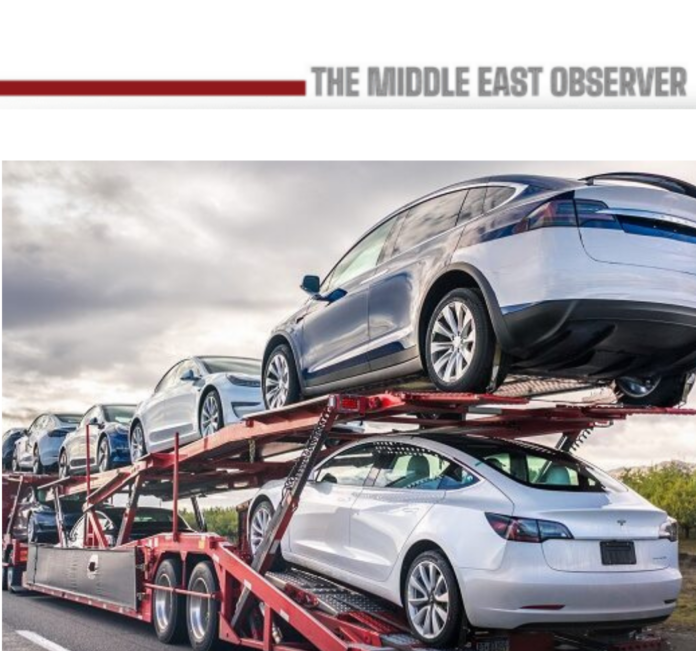
The most significant structural change is the growing contribution of fully imported vehicles.
AMIC figures published by Al Mal on 13 October show that sales of imported vehicles climbed 42.6% to 64,923 units during the eight months, while locally assembled vehicles increased 13.4% to 70,522.
Imports consequently accounted for approximately 70% of the market’s additional sales, lifting their share of the reported total from around 42% to 48%.
Locally assembled vehicles nevertheless retained a narrow majority of the market, particularly in commercial transport. Approximately 79% of buses and 86% of trucks sold during the period were assembled domestically.
The greater import dependence is concentrated in passenger cars, where imported models account for most sales.
This distinction matters. Domestic assembly is expanding in absolute terms, but not as quickly as imported vehicle sales. Moreover, locally assembled vehicles frequently contain imported components, meaning that assembly volumes alone cannot establish how much value is being created within Egypt.
Imports also bring commercial benefits through wider consumer choice, stronger price competition and opportunities for distributors, financing companies and service providers. Their economic cost depends on vehicle values, imported content and the wider balance of trade.
Industrial Investment Faces the Test of Production Scale
Egypt introduced its automotive industrial strategy in 2022 and launched the National Automotive Industry Development Programme in November 2023. The revised programme received final approval in May 2025 and entered into force that July.
The initiative seeks to increase local value added to 60%, raise domestic industrial-component content above 35% and encourage production volumes capable of supporting competitive manufacturing.
According to the Industrial Development Authority, conventional vehicle manufacturers seeking incentives must initially meet minimum production and local-content requirements, with higher thresholds over the programme’s seven-year period. Investment, environmental performance and export potential also influence incentives.
The government reviewed implementation again in March and April 2026, focusing on manufacturers’ requirements, investment incentives and opportunities to attract international producers.
Private investment is advancing. On 28 September, Bank NXT and Ezz Elarab Elsewedy Investments signed an EGP 2.1 billion financing agreement supporting factory expansion and a new automotive paint plant.
The project illustrates the shift required from relatively basic assembly towards more integrated manufacturing. However, a financing commitment is not itself proof of completed production capacity or higher local content.
Commercial constraints remain considerable.
In August, Automobile Traders Association president Osama Abu El Magd told EnterpriseAM that importers could turn over capital in approximately three months, compared with five months for local assembly. He also identified fragmented demand across numerous brands as an obstacle to achieving economical production volumes.
For manufacturers, competitiveness depends on predictable demand, investment costs, reliable component supplies and sufficient production runs to spread fixed costs. Building an export market could help factories achieve scale beyond what Egypt’s domestic market alone can support.
A 200,000-Vehicle Year Is Within Reach
Egypt would need to average approximately 16,140 vehicle sales monthly from September through December to reach 200,000 units in 2026, below August’s reported sales volume.
Two historical comparisons provide a basis for assessing the outlook.
If sales in the final four months merely match the corresponding period of 2025, full-year sales would reach approximately 201,500 vehicles, an increase of 16% over last year.
If fourth-quarter-period demand instead follows the 25.7% growth recorded during January–August, annual sales could approach 218,500 vehicles, roughly 26% above 2025.
These are conditional scenarios, not industry forecasts. The weaker August growth rate, vehicle financing costs, exchange-rate movements, shipping disruptions and consumer purchasing power could affect the outcome.
Even the higher scenario would leave annual sales approximately 25% below the 2021 level.
The market’s recovery is therefore substantial but incomplete.
For Egypt, the more consequential question extends beyond the number of vehicles sold. Sustained economic gains will depend on whether demand supports competitively priced domestic production, stronger component supply chains, higher local value added and exports capable of generating foreign-currency earnings.
The recovery in vehicle sales is measurable. The next test is how much of that recovery Egypt can manufacture competitively at home.
Related News:
Bank NXT’s EGP 2.1bn Facility Deepens Ezz Elarab Elsewedy’s Auto Manufacturing Push
Financing for factory expansion and a new paint plant illustrates Egypt’s move towards more integrated automotive manufacturing.
Africa Puts Deadlines Behind Investment Ambitions at Inaugural Alamein Forum
The El Araby–Malben automotive-components agreement creates a potential route towards Egyptian–South African industrial supply chains.
Read Also:
Egypt, South Korea Forge Strategic Partnership Centred on Industry and Investment
Cooperation in automotive manufacturing, technology and clean energy could support Egypt’s localisation strategy.
El-Sisi’s Malaysia Visit Opens New Industrial Investment Prospects as Bilateral Trade Surges 75%
New industrial investment discussions highlight the opportunity for Asian manufacturing partnerships in Egypt.