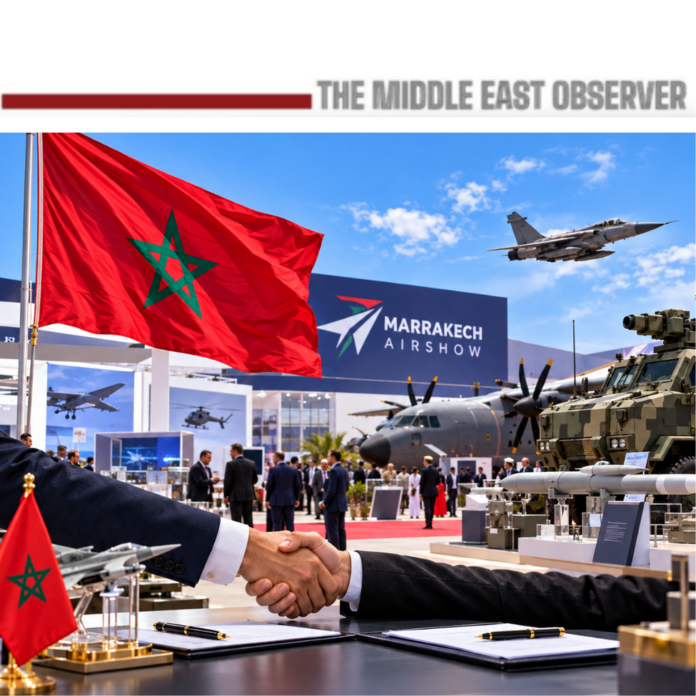
Morocco secured 26 aerospace and defense agreements at the Marrakech Airshow, including industrial projects targeting more than 1,000 jobs, as the kingdom seeks to expand beyond aircraft-component manufacturing into advanced engineering, military technology and higher-value exports.
The four-day exhibition, held from October 7 to 10, brought together international aircraft manufacturers, defence contractors and technology companies to establish production partnerships, strengthen domestic supply chains and develop Morocco’s emerging defence industry.
The organisers’ post-event assessment, reported by Hespress on October 12, counted 26 agreements spanning aircraft manufacturing, engine components, maintenance, military drones, precision weapons, industrial research and land allocations for defence factories.
The commercial significance varies considerably. The agreements include a confirmed weapons procurement contract, investment plans with disclosed capital and employment targets, industrial-site arrangements and exploratory memoranda without firm production commitments.
Four civilian aerospace projects account for the clearest quantified investments: €32 million, approximately $16.5 million and 160 million Moroccan dirhams, targeting a combined 1,055 direct jobs. The figures reflect announced plans rather than completed expenditure and do not represent the total value of the exhibition’s agreements.
Global Manufacturers Build Morocco’s Industrial Research Base
The exhibition opened with the formal establishment of the consortium supporting the African Centre of Manufacturing Excellence (ACME), bringing together Airbus, Boeing, Lockheed Martin, Safran Nacelles and CETIM Maroc with Morocco’s Industry Ministry, National Defence Administration, OCP Group and Mohammed VI Polytechnic University.
Based near Casablanca, the initiative will support industrial research, advanced materials, composite manufacturing, robotics, additive manufacturing and specialist training.
According to Safran’s October 12 assessment of the exhibition, the research platform is intended to strengthen Morocco’s engineering capabilities and deepen the integration of local suppliers into international aerospace production networks.
The same day, Safran announced a new industrial operation through Safran Oil Systems Maroc, producing components for aircraft-engine lubrication and fluid-management systems at Nouaceur.
Specialist publication Aeronautique.ma reported a planned investment of 160 million dirhams and approximately 100 jobs, although initial reports had put the investment at 120 million dirhams.
Safran said the new facility would support increasing production of LEAP aircraft engines from 2027, connecting Morocco’s industrial expansion directly to global engine-manufacturing programmes. It will also increase Safran’s Moroccan industrial footprint to 13 sites.
The investment is significant because engine systems demand greater technical precision, specialist materials and certification than many conventional component-assembly activities.
Royal Air Maroc separately signed a framework agreement with the Industry Ministry to increase procurement from Moroccan manufacturers and service providers.
The programme aims to connect the national carrier’s growing purchasing requirements with domestic suppliers, creating opportunities for recurring orders and potential access to international aviation markets.
French Drone Partnership Extends into Advanced Defence Technology
Morocco also signed two separate arrangements with French defence-technology company Harmattan AI on October 7.
The first establishes a framework for an integrated industrial platform covering research, engineering, production, systems integration and testing of autonomous defence and counter-drone technologies.
The second, a letter of intent with the National Defence Administration, concerns the proposed acquisition, development and domestic production of the IRIFI long-range unmanned strike system.
Reuters reported on October 8 that the proposed system could undertake missions reaching up to 2,000 kilometres.
No final procurement value, aircraft quantities, production allocation or delivery timetable has been disclosed.
The arrangements nevertheless indicate Morocco’s intention to combine defence equipment acquisition with engineering and manufacturing activities at home. The extent of technology transfer, access to proprietary systems and domestic production remains subject to further agreements.
Industrial Investment Targets 950 Jobs
The exhibition’s second day produced the clearest evidence of prospective industrial investment.
Morocco’s Industry Ministry signed three protocols with Matis Aerospace, APS Coating and Mecapole Industries, initially identifying approximately 950 direct jobs across electrical wiring, surface treatment and precision machining.
Matis Aerospace, a joint venture involving Boeing and Safran Electrical & Power, announced approximately $16.46 million to expand electrical-wiring production at Nouaceur.
The Industry Ministry said the project targets 750 direct jobs by 2030, accounting for the largest share of the exhibition’s disclosed employment commitments.
APS Coating agreed to develop an €18 million aircraft-component treatment facility at Midparc, targeting 120 jobs and operations beginning in the first quarter of 2028.
The facility would provide specialist surface treatment, finishing and inspection processes, potentially reducing the need for Moroccan manufacturers to send components abroad for essential production stages.
Mecapole Industries proposed a precision-machining operation supplying aircraft and helicopter manufacturers.
The ministry initially announced €10 million and 80 jobs. A subsequent Midparc agreement, reported on October 9 by Aeronautique.ma, described a €14 million project targeting 85 jobs.
The later figures are used in the post-show industrial assessment, but the different announcements should not be treated as two independent investment projects without confirmation that their scopes are separate.
Together with Safran Oil Systems, the four quantified aerospace projects target approximately 1,055 jobs. Matis accounts for roughly 71% of that total.
Employment numbers, however, are only one measure of industrial value. Engine components, precision machining and advanced surface treatment may employ fewer workers while contributing specialist expertise, technical certification and greater domestic value added.
That distinction matters for Morocco’s ambition to become more than a low-cost component-production centre.
South Korea, Poland and Canada Expand Industrial Relationships
The second day also broadened Morocco’s international industrial partnerships.
Korea Aerospace Industries (KAI) signed a memorandum with the Moroccan Agency for Investment and Export Development and industry association GIMAS to explore aerospace investment, supply-chain development and future manufacturing cooperation.
KAI separately reached an agreement with Maintenance Aero Maroc and SABCA Maroc covering prospective industrial and maintenance activities, including potential support for its T-50 trainer aircraft family.
Neither arrangement constitutes a confirmed Moroccan order for military aircraft.
In defence mobility, US-based ND Defense, Morocco’s MZ Automotive and Poland’s Demarko agreed to cooperate on specialised military vehicles, equipment integration and heavy-logistics solutions.
The partners did not disclose a production timetable, investment value or confirmed manufacturing capacity.
Civil aviation agreements added a services dimension to the exhibition.
Royal Air Maroc reached an agreement with Boeing to refurbish seven Boeing 787-8 Dreamliners, upgrading passenger cabins, entertainment and connectivity systems.
Swedish manufacturer Trelleborg Aerospace signed with Midparc to expand its Moroccan aerospace sealing-systems operation from approximately 5,200 square metres to more than 10,000 square metres.
The expansion follows the inauguration of its Moroccan facility in June 2026, demonstrating how an earlier exhibition agreement progressed into operating industrial capacity.
Morocco’s WAGA International and Canada’s Canwest Aerospace also agreed to develop a helicopter maintenance, repair and overhaul centre at Benslimane.
That project could establish recurring engineering and maintenance revenue while serving domestic operators and potentially neighbouring African markets.
UAE’s EDGE Signs Weapons Contract and Localisation MoU
Defence procurement took centre stage on October 9 when UAE defence group EDGE signed a contract with Morocco’s National Defence Administration to equip Moroccan combat drones with precision-guided weapons.
The agreement covers Desert Sting 16 guided-glide weapons and Thunder P-31 guidance systems, together with aircraft modifications, software integration and operational support.
EDGE’s announcement, carried by the Emirates News Agency, confirmed the procurement arrangement but did not disclose its financial value, weapons quantities or delivery timetable.
The UAE group signed a separate memorandum exploring domestic manufacturing of small arms and aircraft engines.
Its subsidiaries CARACAL and POWERTECH would provide the relevant small-arms and propulsion expertise, with cooperation potentially involving Moroccan industrial partners.
Unlike the weapons purchase, the manufacturing memorandum does not establish binding investment, an operational production line or a confirmed technology-transfer programme.
The distinction illustrates the different stages of Morocco’s defence-industrial strategy: importing capabilities immediately while negotiating the conditions under which more production and engineering may be undertaken locally.
Defence Electronics and Seven Industrial-Zone Agreements
The October 9 proceedings also saw Morocco’s Melint, India’s Tonbo Imaging and Slovenia’s DAT-CON sign three memoranda establishing the International and Moroccan Defence Electronics Consortium, CIMED.
The consortium intends to develop local maintenance, assembly, integration, testing and upgrading of military electronic and electro-optical systems.
Potential activities include thermal imaging, night-vision systems, surveillance technologies and associated electronics.
The three agreements were reported collectively, without separate public descriptions of each instrument’s financial or operational obligations.
Another seven agreements concerned industrial land for future defence-related manufacturing.
Morocco’s Defence Industrial Zones Management Company, SGZID, signed arrangements involving Arquus, Marcotec, MKU, INKAS Aerospace & Defense, ABA Technology, IGG/Bal Teq Defense Industries and Harmattan AI.
According to MEDZ, the agreements provide a framework for mobilising land within Morocco’s planned defence industrial zones.
They create opportunities for investment in military vehicles, protection equipment, electronics and unmanned systems, but do not independently demonstrate that seven financed factories are ready for construction.
MEDZ also reported a letter confirming interest in the DRONEX project. Its status within the organisers’ 26-agreement tally remains unresolved and should not be counted as an additional signed investment without clarification.
Morocco’s $5 Billion Aerospace Export Ambition
The agreements come as Morocco seeks to increase the sophistication and export contribution of its aerospace industry.
Reuters reported on October 8 that the sector generates approximately $3 billion in annual exports, employs 25,000 people and comprises around 160 companies supplying international manufacturers including Airbus, Boeing and Safran.
Mohammed Bellatig, head of industry association GIMAS, said annual aerospace exports could reach $5 billion within three years as production shifts towards more complex systems and higher-value manufacturing.
Achieving that ambition would require an increase of roughly two-thirds from the reported $3 billion baseline.
The exhibition’s investment announcements offer several potential routes to that growth.
New engine-component, machining and surface-treatment facilities would broaden Morocco’s domestic production capabilities. Research and training partnerships could support more sophisticated manufacturing, while maintenance and aircraft-services projects could generate recurring commercial revenue.
Defence industrialisation represents a parallel opportunity, but its economic effects are less certain.
A locally assembled defence product does not necessarily imply access to its underlying software, designs or intellectual property. Export authorisations, proprietary technology, security requirements and customer restrictions may continue to limit domestic manufacturing autonomy.
The stronger measure of progress will therefore be the share of production value retained in Morocco, rather than the number of products carrying a local manufacturing label.
From Signed Agreements to Operating Factories
Marrakech Airshow 2026 demonstrated Morocco’s ability to attract established global manufacturers alongside emerging defence-technology companies.
It also highlighted the different degrees of commercial maturity behind the announcements.
The quantified civilian investment plans provide measurable targets. Their implementation can be assessed against factory construction, machinery installation, supplier qualification, employment, production and exports.
The defence agreements require a different test.
EDGE’s weapons contract establishes procurement, but its manufacturing memorandum remains exploratory. Harmattan AI’s proposed industrial activities require more detailed implementation commitments, while the defence-zone agreements must progress from allocated land to financed construction and production.
Morocco’s ability to secure a larger share of aerospace and defence value will depend on specialised workforce development, local supplier certification, industrial financing and long-term commercial orders.
There is also a wider regional implication. By combining aerospace exports with military technology partnerships, Morocco is positioning itself to compete for manufacturing investment that might otherwise be directed towards European or other emerging industrial centres.
The immediate achievement at Marrakech was the breadth of commercial engagement: 26 reported agreements connecting industrial research, civilian aviation, military procurement and prospective local production.
The more consequential achievement would be converting those arrangements into an integrated manufacturing base capable of supplying increasingly sophisticated products to international markets.
With aerospace exports already near $3 billion annually, Morocco’s industrial progress will ultimately be judged by the production value retained domestically, the strength of its local suppliers and the export orders generated—not the number of agreements signed.
Related news:
Morocco Eyes Growth Above 5.3% as Tourism, Industry and Diaspora Transfers Drive Economic Expansion
Morocco Overtakes South Africa in Industrial Competitiveness Ranking
Read also:
Egypt Maps 50 Industrial Opportunities as Europe Recasts Its Supply Chains
Egypt, South Korea Forge Strategic Partnership Centred on Industry and Investment