

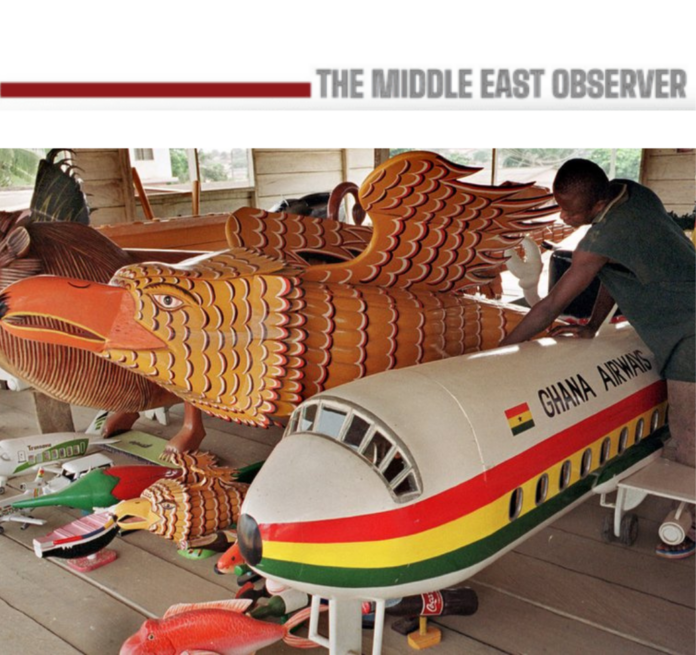
A Ga funerary tradition designed to disappear underground is developing a second life in museums and collections abroad, creating two very different markets for the same Ghanaian craft.
Ghana’s sculpted “fantasy coffins” are moving increasingly between two economies: a domestic funeral market where they typically sell for about 10,000 Ghanaian cedis ($900) and an international art market willing to pay substantially more for pieces built to survive for decades in museums and collections.
The contrast has come into sharper focus this year. In July, New Mexico’s Museum of International Folk Art opened The Art Underground: Fantasy Coffins of Ghana, assembling more than 20 works linked to the celebrated Kane Kwei workshop. The exhibition, which runs until September 2027, traces how a highly localised funerary practice entered international contemporary-art circulation.
Known among the Ga communities of coastal Ghana as abebuu adekai, the coffins are carved into fish, aircraft, cars, Bibles, tools and other forms reflecting the profession, status or aspirations of the deceased. A fisherman might be buried in a fish or canoe; a teacher in a pen; a musician in a guitar. Recent funerals around Accra show that the tradition remains a functioning part of local burial culture rather than merely an art-market export.
Its modern development is closely associated with Seth Kane Kwei, whose Teshie workshop popularised figurative coffins in the 1950s and trained craftsmen including Paa Joe. Claims that Kwei simply “invented” the form require more caution: Smithsonian research records competing oral histories involving earlier Ga craftsmen. What is better established is that Kwei built the workshop tradition that helped spread and internationalise the craft.
One Craft, Two Pricing Systems
The economic shift came as museums, galleries and collectors began commissioning pieces intended never to be buried.
These versions require more durable materials and finishing than coffins made for funerals. Current Ghanaian makers say exhibition pieces therefore command higher prices, while previous reporting has placed international commissions at as much as £10,000, depending on materials, complexity and client.
The secondary art market provides another measure of the transition. Sotheby’s offered Paa Joe’s full-size Eagle Coffin in London in 2023 with an estimate of £2,000-£3,000, demonstrating that the objects now circulate not only as commissioned cultural pieces but as recognised contemporary artworks.
International recognition is not new. Figurative coffins began reaching foreign museums and collections during the 1970s, while their inclusion in the landmark Magiciens de la Terre exhibition in Paris in 1989 gave the tradition an important place in the international contemporary-art conversation.
The result is an unusual form of cultural value creation. A coffin commissioned locally derives its value from ritual, craftsmanship and the identity of the deceased — and ultimately disappears underground. An exhibition piece draws on the same skills but acquires additional value from scarcity, permanence, provenance and international artistic recognition.
The Next Constraint Is Skills
That international demand can support Ghanaian workshops beyond the inherently unpredictable cycle of funeral commissions. Overseas orders from museums and collectors have already helped expand the trade, while modern equipment and more reliable supplies of wood have improved production.
But the craft remains heavily dependent on skills transferred through families and apprenticeships. That makes transmission of knowledge as important to its future as international demand.
Ghana’s fantasy coffins have therefore achieved something unusual: a funerary product created to vanish has become an exportable cultural asset whose economic value can increase precisely because it stays above ground.
The next test is whether international recognition can preserve not only the objects themselves, but the Ghanaian workshops and craftsmen capable of producing them.
Related news:
Dubai Flight Disruptions Force Ghana to Rethink Gold Export Routes
Africa’s Next Chapter: Building Self-Sufficiency and Global partnerships
Read also:
Why Global Pharmaceutical Companies Continue Expanding Manufacturing Across MENA
Artificial Intelligence Is Reshaping Healthcare Across Egypt and the Middle East