
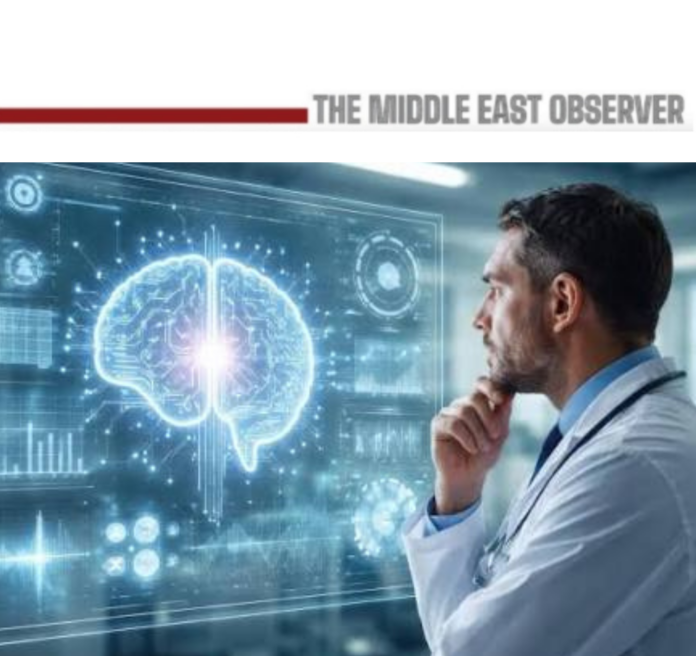
Artificial intelligence is rapidly changing how healthcare is delivered—not by replacing physicians, but by transforming how medical information is generated, interpreted and acted upon. Across Egypt and the Middle East, AI is moving from experimental pilots to an increasingly important component of national healthcare systems. From helping patients understand symptoms to supporting doctors in diagnosing disease and enabling governments to manage population health more effectively, AI is becoming a strategic pillar of healthcare modernization.
As countries confront rising healthcare costs, ageing populations and an increasing burden of chronic diseases, artificial intelligence is emerging not only as a medical innovation but also as an economic tool capable of improving efficiency, expanding access to care and strengthening long-term health system resilience.
AI as a New Healthcare Assistant
Generative AI has rapidly become one of the most accessible sources of health information for the public. Modern AI systems can explain complex medical terminology, summarize laboratory reports, organize treatment information and answer general health questions in language that patients can more easily understand.
Research suggests these tools can significantly improve patient communication when used appropriately. A widely cited 2023 study published in JAMA Internal Medicine found that healthcare professionals preferred chatbot-generated responses to physicians’ written replies in nearly four out of five evaluations of patient questions, with AI responses receiving higher ratings for both quality and empathy. The researchers emphasized, however, that AI should complement—not replace—clinical judgment.
That distinction has become increasingly important as millions of people worldwide turn to AI for health advice.
A 2025 systematic review published in JAMA Network Open found considerable variation in how researchers evaluate the accuracy, safety and clinical usefulness of large language models in healthcare. The review concluded that standardized methods for validating medical AI remain limited, highlighting the need for stronger clinical evaluation before widespread adoption.
Unlike physicians, generative AI does not reason through medical problems using clinical experience. Instead, it predicts responses based on patterns learned from vast datasets, meaning it can occasionally produce highly confident but inaccurate information—a phenomenon often described as “hallucination.” In medicine, where decisions directly affect patient safety, such errors reinforce the need for continuous human oversight.
From Medical Imaging to Precision Medicine
Within hospitals, AI is increasingly functioning as an additional set of expert eyes rather than a virtual physician.
Machine-learning algorithms now assist clinicians in interpreting CT scans, MRI examinations, mammograms and digital pathology slides, helping prioritize urgent cases while identifying subtle abnormalities that may otherwise be overlooked. AI is also supporting clinical decision-making by identifying potential drug interactions, predicting patient deterioration, estimating disease risk and recommending evidence-based treatment pathways.
Beyond diagnosis, artificial intelligence is transforming precision medicine. By analysing genomic data, identifying disease biomarkers and predicting treatment responses, AI is helping clinicians tailor therapies to individual patients while accelerating clinical trial matching and pharmaceutical research. As genomic medicine expands across the region, these capabilities are expected to play an increasingly important role in personalized healthcare.
Administrative automation is emerging as another major source of value. Hospitals are deploying AI to generate clinical documentation, produce discharge summaries, improve medical coding accuracy, optimize appointment scheduling and streamline insurance claims processing. By reducing routine administrative workloads, healthcare professionals can devote more time to direct patient care while improving operational efficiency.
A Growing Healthcare Industry
The commercial opportunity surrounding healthcare AI is expanding rapidly. Global investment in AI-powered healthcare solutions is projected to grow at double-digit annual rates over the coming decade as hospitals, insurers and pharmaceutical companies adopt intelligent systems to improve diagnostics, optimize workflows, accelerate drug discovery and enhance patient outcomes. Across the Middle East, governments increasingly view digital healthcare infrastructure and artificial intelligence as long-term strategic investments supporting both economic diversification and healthcare sustainability.
Egypt’s AI Healthcare Strategy
Egypt is steadily integrating artificial intelligence into its broader healthcare modernization agenda.
At Africa Health ExCon in Cairo in 2025, Dr. Ahmed El-Bassiouny, Head of the Stroke Unit at Ain Shams University Hospitals, highlighted AI applications across stroke diagnosis, treatment planning and rehabilitation, demonstrating how intelligent decision-support systems can accelerate clinical intervention in time-critical emergencies.
Medical education is evolving alongside these technological advances. Dr. Hossam Salah, Dean of Cairo University’s Faculty of Medicine, has emphasized that artificial intelligence should become an integral component of modern medical practice rather than a substitute for physicians. Reflecting this approach, Cairo University established a dedicated Office for Artificial Intelligence in Medicine to promote clinical research, education and data-driven healthcare innovation.
These developments align closely with Egypt’s National Health Strategy 2024–2030, which identifies artificial intelligence, telemedicine, electronic health records and digital clinical decision-support systems as central pillars of healthcare transformation. The strategy aims to strengthen early diagnosis, personalize treatment recommendations and improve healthcare delivery through greater use of digital technologies.
As electronic health records expand and telemedicine services mature, the volume of high-quality clinical data available for AI applications is expected to increase significantly, further enhancing predictive analytics, disease surveillance and population health management under Egypt’s Universal Health Insurance transformation.
AI at Scale Across the Gulf
Across the Gulf Cooperation Council (GCC), governments are embedding artificial intelligence within national healthcare strategies as part of broader digital transformation programmes.
Dubai Health Authority’s EJADA AI platform analyses healthcare claims data covering approximately four million insured individuals and more than 360 million patient activities, diagnoses and clinical records. By identifying individuals at elevated risk of chronic disease, the platform supports earlier intervention while helping improve healthcare planning, resource allocation and expenditure management.
Saudi Arabia has similarly accelerated AI adoption. During the 2025 Global Health Exhibition, the Ministry of Health introduced an AI Physician virtual experience designed to enhance diagnostic accuracy alongside a digital health adviser integrated into the Sehhaty application. These initiatives complement the Kingdom’s broader investments in smart hospitals, precision medicine and integrated digital health platforms under Vision 2030.
Across the Gulf, artificial intelligence is increasingly viewed not simply as a clinical technology but as essential digital infrastructure capable of improving healthcare quality, strengthening preventive medicine and supporting long-term system sustainability.
Building Trust Through Governance
As AI becomes more deeply integrated into healthcare, governance is becoming just as important as technological capability.
Patients increasingly share sensitive information—including symptoms, laboratory results, medications and medical histories—with AI-powered platforms. Protecting patient privacy, ensuring transparency in algorithmic decision-making and maintaining strong clinical oversight have therefore become major regulatory priorities.
The World Health Organization has called for robust governance frameworks emphasizing human oversight, transparency, accountability, data privacy and rigorous clinical validation before AI systems are deployed at scale.
Egypt has adopted a similarly cautious approach. In December 2025, the Ministry of Health warned against relying on AI applications for independent medical diagnosis, citing risks including misdiagnosis, delayed treatment and inappropriate medication use. The guidance reinforces the principle that AI should support—not replace—qualified healthcare professionals.
As hospitals become increasingly connected through electronic health records and cloud-based digital platforms, cybersecurity has become an equally important priority. Protecting healthcare systems from cyberattacks, safeguarding patient data and ensuring the integrity of AI-assisted clinical decisions are now fundamental components of digital health governance.
Future regulation is expected to focus increasingly on explainable AI, algorithm bias, interoperability standards, cybersecurity and continuous clinical validation as healthcare systems become more digitally connected.
The Future of Healthcare
Artificial intelligence is unlikely to replace physicians. Instead, it is reshaping how healthcare information is generated, interpreted and delivered across the entire healthcare ecosystem.
Its greatest value lies in augmenting clinical expertise—helping patients better understand their health, enabling physicians to make faster and more informed decisions, and allowing governments to manage increasingly complex healthcare systems through predictive analytics and population-level insights.
For Egypt and the wider Middle East, the countries that benefit most from artificial intelligence will not necessarily be those deploying the most advanced algorithms, but those capable of combining trusted clinical expertise, secure digital infrastructure, high-quality health data and effective governance. As healthcare systems face growing demand, rising costs and an increasing burden of chronic disease, AI’s greatest contribution may prove not to be replacing physicians, but enabling healthcare systems to deliver safer, more efficient and more accessible care with finite resources.
Related news:
A Common Arab Strategic Vision in an Era of Regional Blocs
Egypt Accelerates Digitization of Arab World’s Largest Broadcast Archive
Read also:
Cuba Faces Deepening Power Crisis as Fuel Shortages Trigger Blackouts and Localized Protests
Egypt’s Mobile Manufacturing Sector Raises Local Content Amid Rising Costs