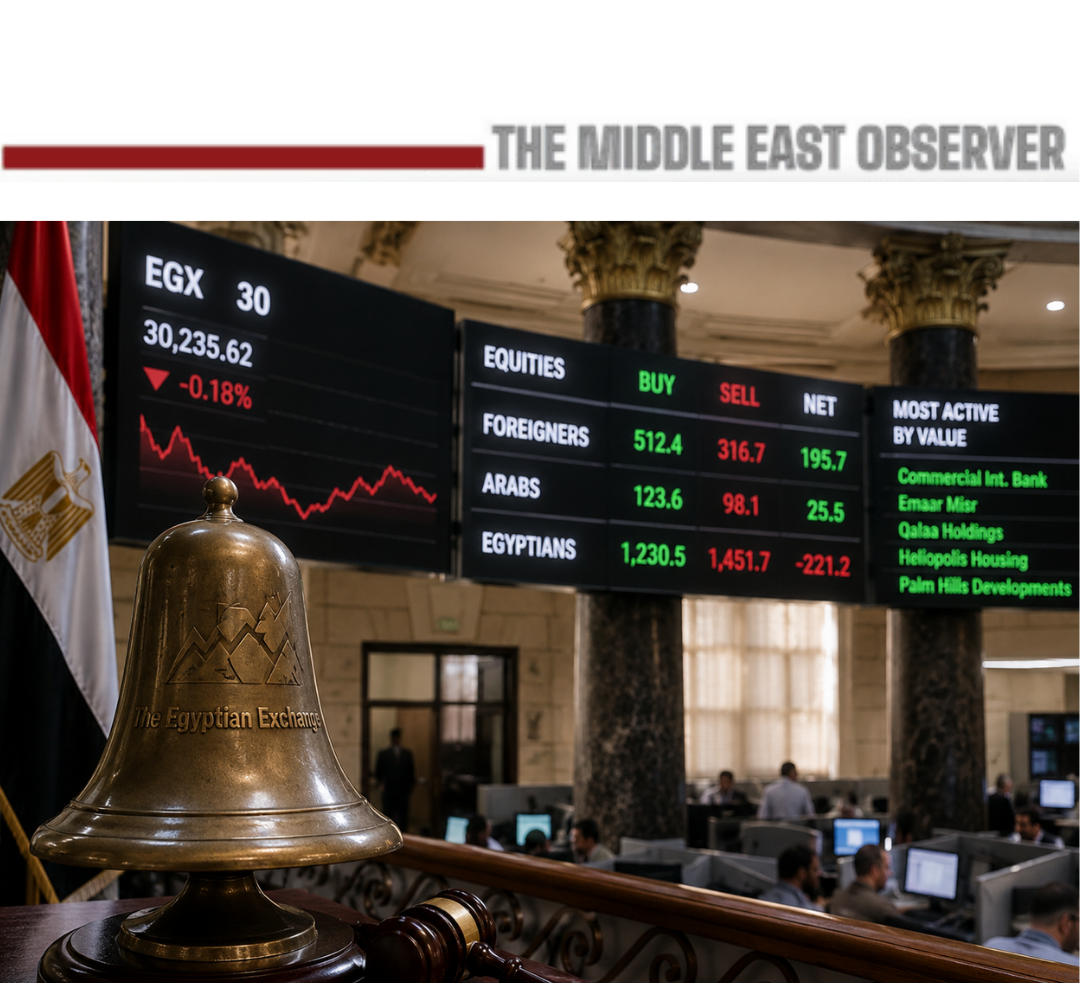
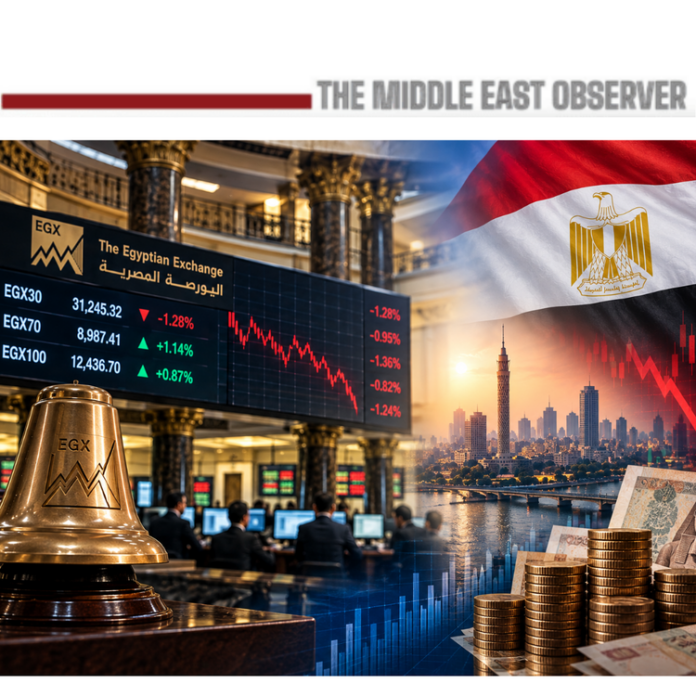
Egyptian equities delivered a second session of underlying stabilisation on Wednesday even as the benchmark slipped, with smaller stocks advancing and market capitalisation rising. The more important pressure remained outside equities: foreign investors returned to selling Treasury bills, while the pound weakened further beyond EGP52 to the dollar.
The EGX30 edged down 0.16% to 54,822.66 points, while EGX70 rose 0.15% to 20,744.89 and EGX100 gained 0.27% to 27,252.91. Market capitalisation increased by about EGP17bn to EGP 4.321 tn, despite the benchmark decline, while turnover eased to roughly EGP10bn.
The divergence was more constructive than the EGX30 alone suggests: broader shares continued recovering from Monday’s sell-off even as large caps remained under pressure.
Correction Stabilises, but the Week Remains Negative
Wednesday extended the pattern that began Tuesday: the market has stopped falling indiscriminately, but it has not recovered the losses accumulated earlier in the week.
Since last Thursday, EGX30 is down about 2.6%, EGX70 3.1% and EGX100 2.7%, while roughly EGP87bn of market capitalisation has been erased.
The sequence is increasingly clear: Sunday broadened the correction, Monday accelerated it, Tuesday produced the first rebound and Wednesday showed further internal stabilisation without a benchmark recovery.
That is progress, but not confirmation that the correction has ended.
Domestic Buyers Continue to Cushion Equity Selling
Wednesday’s listed-equity flows were modest compared with the much larger sovereign-debt transactions reported elsewhere.
Egyptian investors bought a net EGP245.1mn of shares, while Arabs sold EGP 141.8mn and non-Arab foreigners sold EGP103.3mn. Egyptians accounted for more than 91% of trading, with individuals representing about 80%.
Across the first four sessions of the week, Egyptians have absorbed roughly EGP541mn of net equity selling, against foreign net sales of about EGP237mn and Arab sales of roughly EGP303mn.
That confirms the continuing importance of domestic participation — but the week’s losses also demonstrate that liquidity alone cannot guarantee higher prices.
Treasury-Bill Flows Turn Negative Again
The sharper volatility remains in sovereign debt.
Foreign and Arab investors recorded $289.8mn of net government-debt sales on Wednesday, reversing Tuesday’s $463.5mn inflow. Almost all Wednesday’s selling came from foreign investors and was concentrated in Treasury bills.
The week-to-date sequence has been volatile: modest selling on Sunday, $418.8mn of outflows Monday, $463.5mn of inflows Tuesday and $289.8mn of renewed selling Wednesday.
That leaves foreign and Arab investors at roughly $246mn of net sovereign-debt sales for the week so far.
The pattern does not yet establish a durable direction. Instead, short-duration portfolio capital appears increasingly sensitive to global rates, currency risk and geopolitical volatility.
Pound Weakness Becomes the Harder Signal
The CBE’s average dollar rate rose to EGP52.1447 for buying and EGP 52.2837 for selling on Wednesday, extending the pound’s decline from around EGP51.31/51.44 on Sunday.
The currency has therefore weakened by roughly 1.6% in three sessions, despite Tuesday’s substantial Treasury-bill inflow.
That divergence is important.
Renewed sovereign buying did not immediately stabilise the pound, confirming that portfolio flows are only one component of broader dollar demand.
For equities, continued depreciation raises the hurdle for hard-currency returns and increases the earnings divide between exporters, import-dependent businesses and companies carrying foreign-currency liabilities.
Fed Tightening Raises the External Hurdle
After the Egyptian market closed, the Federal Reserve raised its benchmark rate by 25 basis points to 3.75%-4.00%.
Higher US rates increase the relative attractiveness of dollar assets and can raise the return international investors demand from Egyptian debt and equities.
That makes Wednesday’s sovereign outflows more relevant.
The immediate test is whether Egypt’s high nominal yields remain sufficient to compensate investors for currency volatility while domestic equities simultaneously justify their valuations through earnings growth.
IPOs and Dual Listings Offer a Structural Counterweight
Against the near-term volatility, the EGX continues trying to broaden its investable universe.
Chairman Omar Radwan said the exchange expects Banque du Caire to be offered before year-end, followed by Misr Life Insurance, while discussions are advancing on dual listings.
A London Stock Exchange delegation is due in Cairo next week to explore potential cross-listings and depositary-receipt programmes, alongside broader discussions with regional exchanges.
These initiatives are structural rather than immediate trading catalysts.
But they address a central weakness of the market: a rapidly expanding investor base requires a larger and more diversified supply of listed assets.
Breadth Is Healing; the Cross-Asset Test Is Harder
Wednesday was therefore more constructive than the 0.16% EGX30 decline implies.
Smaller shares rose. Market capitalisation increased. Domestic investors absorbed external equity selling.
But sovereign debt and FX sent the more difficult signal.
Foreign Treasury-bill selling resumed, the pound weakened further, and the Fed raised US rates.
The equity correction is beginning to stabilise, but the external financing environment is becoming more demanding.
The clearest confirmation of a sustainable recovery would now require three signals to align: broader equity gains, renewed institutional participation and stabilisation in both sovereign flows and the pound.
Until then, the EGX is showing improved internal resilience — but against a materially tougher cross-asset backdrop than the one that carried it to record highs earlier this month.
Related news:
Modi Urges Indians to Cut Fuel Consumption to Protect Foreign Exchange Reserves
Egypt’s Monetary Stability Strengthens as Reserves Rise and Energy Dues Cleared
Read also:
Foreign outflows pressure EGX benchmark despite broader gains
COMESA’s Digital Investment Map: From Project Listing to Regional Capital Architecture