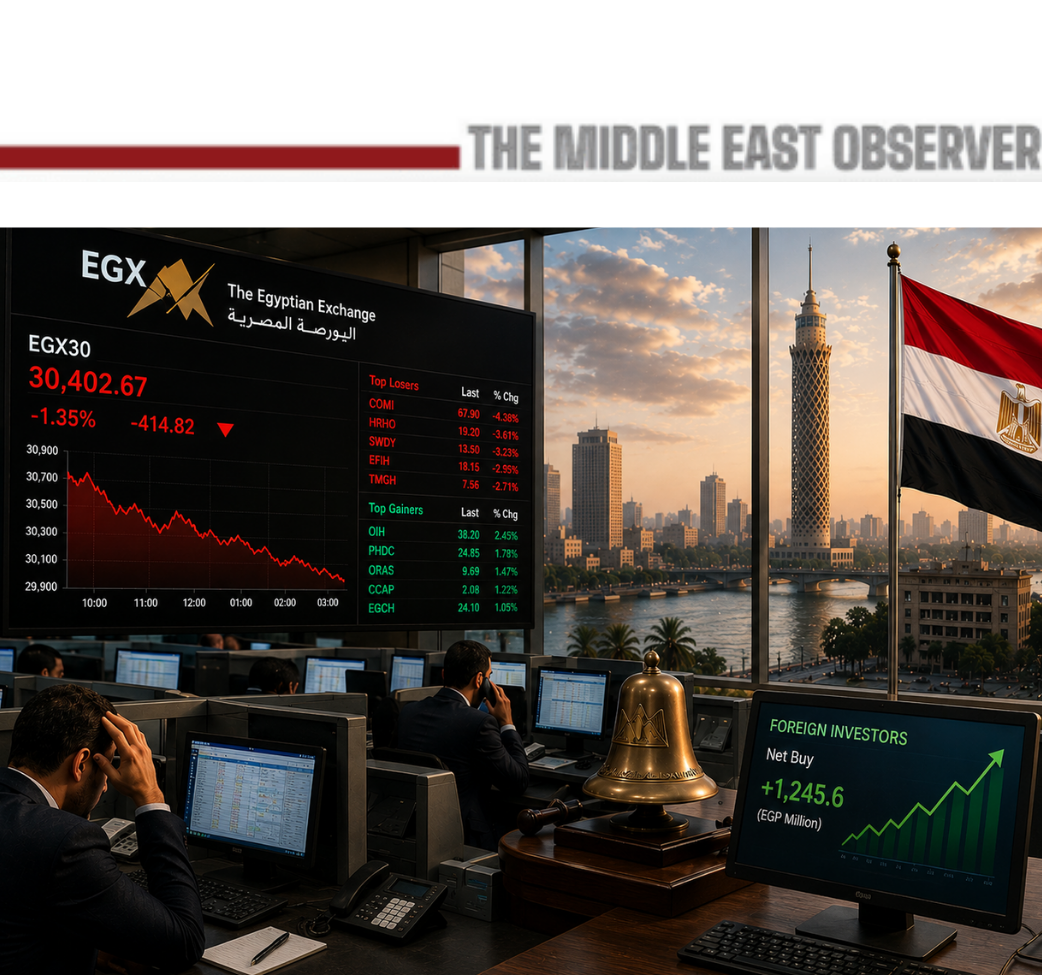
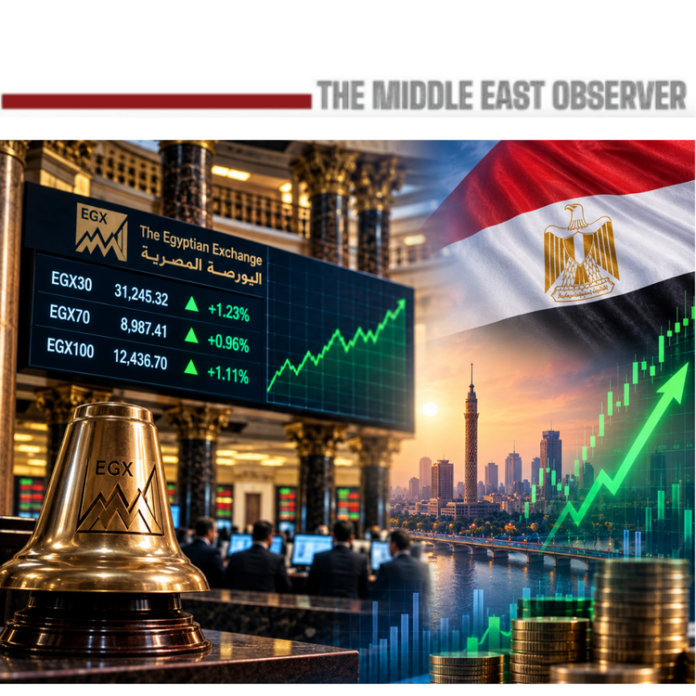
Egyptian equities ended the week with their strongest session since the correction began, as broad gains and substantial foreign institutional buying lifted the EGX30 by 1.23%. Yet the rebound did not erase the week’s losses, while continued sovereign-debt outflows and a weaker pound showed that pressure had shifted from equities towards carry and foreign exchange.
The EGX30 rose to 55,498.72 points on Thursday, while EGX70 climbed 1.52% to 21,061.13 and EGX100 gained 1.57% to 27,681.98. Market capitalisation jumped about EGP75.3bn to EGP 4.397 tn.
Breadth was decisively positive, with roughly 151 shares advancing against 58 decliners.
After Tuesday and Wednesday merely stabilised the market, Thursday delivered the first session in which large caps, smaller shares and overall participation improved together.
Foreign Equity Buying Drives the Rebound
The strongest signal came from investor flows.
Foreign institutions alone bought roughly EGP1.5bn of shares on Thursday, helping drive the broad rebound.
That also changed the weekly picture.
After excluding deals, foreigners ended the week as net buyers of about EGP1.24bn of listed equities, while Arab investors sold roughly EGP496mn.
This reverses one of the central concerns earlier in the week.
Foreign investors finished the week increasing Egyptian equity exposure even while reducing sovereign-debt positions.
That is not a broad capital flight. It is asset selection.
Thursday Repairs the Market — but Not the Week
The late rebound substantially reduced the damage from Sunday and Monday without eliminating it.
For the full week, EGX30 fell 1.39%, EGX70 lost 1.60% and EGX100 declined 1.13%. Market capitalisation slipped only around EGP 11.6bn, or 0.26%, to EGP 4.397 tn, after Thursday recovered about EGP75bn in a single session.
The sequence is clear:
Sunday broadened the correction. Monday accelerated it. Tuesday and Wednesday stabilised breadth. Thursday produced the first convincing rebound.
The market has therefore repaired momentum without yet returning to its record-setting trajectory.
Sovereign Debt Tells the Opposite Story
The government-debt market moved in the opposite direction.
Foreign and Arab investors sold a net $267.6mn of secondary-market government securities on Thursday, following another $289.8mn of selling Wednesday.
Across the week, published daily figures imply roughly $514mn of net sovereign-debt sales, despite Tuesday’s temporary return to Treasury bills.
The cross-asset signal is unusually clear:
foreign investors bought Egyptian equities over the week while reducing short-duration sovereign exposure.
That suggests investors were not simply cutting Egypt risk. They were differentiating between corporate equity and sovereign carry exposed to currency and global-rate volatility.
Pound Weakness Confirms the Harder External Backdrop
The pound ended Thursday around EGP52.09 per dollar for buying and EGP 52.19 for selling, compared with roughly EGP51.27/51.37 a week earlier — depreciation of about 1.6%.
The currency strengthened slightly on Thursday itself despite continued Treasury-bill selling, reinforcing the point that daily sovereign flows are only one component of FX demand.
Over the week, however, the direction remained clear.
The Federal Reserve’s 25-basis-point rate increase to 3.75%-4.00% also increased the relative attractiveness of dollar assets and can raise the return international investors demand from emerging-market positions.
For Egyptian equities, that makes currency stability increasingly important to sustaining foreign participation.
A Better Finish, but a Different Market
Thursday materially improved the market’s technical and behavioural picture.
Breadth broadened, small and mid caps outperformed, and foreign institutions bought aggressively.
But the week also exposed a more important distinction in international capital allocation.
Foreign money returned to equities while retreating from Treasury bills, even as the pound weakened.
That makes the next test more sophisticated than whether EGX30 can simply revisit 57,000.
A durable advance now requires continued broad participation, sustained institutional equity demand and sufficient currency stability to preserve investor confidence.
The strongest signal from the week is therefore not Thursday’s 1.23% rebound alone. It is that international investors were willing to buy Egyptian corporate equity while simultaneously reducing sovereign carry — evidence that the market is moving from broad country-risk positioning towards more selective asset allocation.
Related news:
Engineering Export Excellence Awards Highlight Egypt’s Shift Towards Smarter Manufacturing
Bonds, Inflation and the New Price of Money Across MENA
Read also: