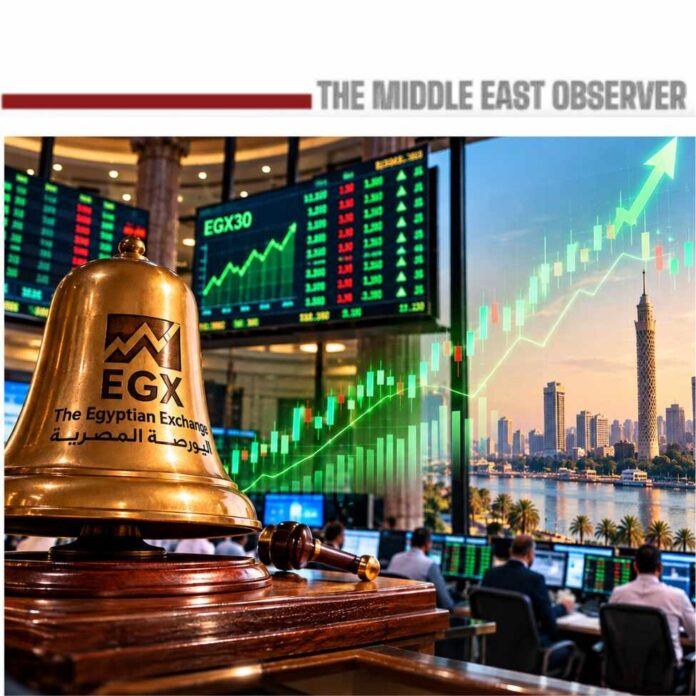
CAIRO — The Egyptian Exchange strengthened its recovery from September’s correction on Sunday, Oct. 4, with the EGX30 rising 1.61% to 53,911.10, the EGX70 EWI jumping 3.04% to 19,952.98 and the EGX100 EWI advancing 2.77% to 26,366.99.
Market capitalisation increased about EGP78bn to EGP 4.263 tn, taking the two-session recovery in listed equity value to roughly EGP207bn.
Breadth Confirms the Recovery
Small- and mid-cap stocks continued to lead. EGX70 has gained about 7.1% over the past two sessions, against approximately 3.9% for EGX30, showing that the recovery extends beyond index heavyweights.
Breadth remained exceptionally strong, with 178 stocks advancing against 33 decliners and 12 unchanged. That compares with only 40 gainers against 175 decliners on Sept. 28, when liquidation was at its most indiscriminate.
The rally was also sectorally broad. Almost all sectors advanced, with energy the notable exception, while CIB fell 0.6% despite being EGX30’s largest-weight constituent. The benchmark’s 1.61% gain despite weakness in CIB provides further evidence that Sunday’s advance was not dependent on its dominant heavyweight.
Equity trading value reached approximately EGP10.3bn, with about 2bn shares changing hands through more than 286,000 transactions.
Institutional Buying Strengthens the Signal
The most important new development came from investor flows.
Egyptian investors remained the sole nationality group of net buyers, purchasing approximately EGP302mn, while foreign investors sold around EGP 222.5mn and Arabs approximately EGP79.4mn.
Crucially, the domestic buying was no longer exclusively retail-led.
Egyptian individuals bought a net EGP 207.4mn, while Egyptian institutions added another EGP94.4mn. By contrast, foreign institutions sold approximately EGP 212.9mn, while Arab institutions were also net sellers. Institutions accounted for 24.76% of overall activity against 75.23% for individuals.
That marks an important change from Thursday, when Egyptian individuals drove the rebound while domestic institutions remained marginal net sellers.
The recovery has therefore progressed from retail-led reversal to locally supported institutional follow-through.
Foreign institutional participation remains missing, however, preventing the flow picture from providing full confirmation of a sustained new uptrend.
54,000 Becomes the Next Test
EGX30 crossed 54,000 intraday, reaching around 54,100 before retreating to 53,911 at the close.
The benchmark has therefore moved beyond the 53,000 resistance that frustrated earlier rebound attempts but encountered its first meaningful selling pressure above 54,000.
The 54,000–54,500 area now becomes the immediate technical test. Market analysts similarly identify a sustained break above roughly 54,500 as important confirmation that the correction has ended.
FX and Bonds Turn More Supportive
Cross-asset signals also improved.
The dollar eased around three piastres, with the CBE rate ending Sunday at approximately EGP52.22 buying and EGP 52.36 selling, reducing some of the currency pressure that accompanied Thursday’s equity rebound.
Government debt also strengthened modestly: the EGX Treasury Bond Index rose 0.18% to 2,671 points. Trading in Treasury bills through the exchange reached approximately EGP17.03bn across 35 issues.
Monetary conditions nevertheless remain restrictive, with the CBE’s overnight deposit rate at 19%, leaving high domestic fixed-income returns as a demanding alternative to equity risk.
Recovery Moves Beyond the Bounce
The market’s progression is now clearer: Monday’s indiscriminate liquidation gave way to Wednesday’s absorption, Thursday’s reversal and Sunday’s broader, institutionally supported follow-through.
Two consecutive advances, EGX70 leadership, breadth of 178:33, rising trading activity and approximately EGP207bn of recovered market capitalisation make the recovery increasingly difficult to dismiss as short covering.
Sunday added something Thursday lacked: Egyptian institutions joined domestic individuals on the buy side.
The remaining tests are equally clear. EGX30 encountered selling above 54,000, foreign institutions continue to reduce exposure, and high domestic yields remain formidable competition for capital.
The question is therefore no longer whether the rebound can survive. It is whether domestic institutional buying can persist, carry EGX30 through 54,000–54,500 and ultimately attract foreign institutions back to the buy side — the combination that would provide stronger confirmation that the correction has given way to a sustained advance.
Related news:
The Egyptian App Economy: Who Controls the Digital Gateway?
EGX Correction Deepens as Offshore Debt Inflows Continue
Read also:
EGX Extends Recovery as Foreign Investors Rebuild Egyptian Positions