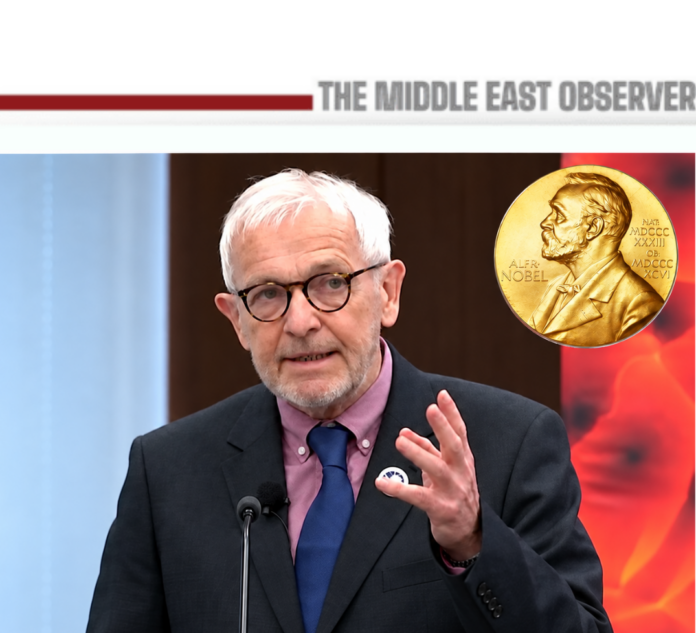
Belgian-born physicist Francis Halzen has won the 2026 Nobel Prize in Physics for the discoveries that established high-energy neutrino astronomy as a new way of observing the universe.
The Royal Swedish Academy of Sciences recognised Halzen for his decisive contributions to the IceCube Neutrino Observatory and the discovery of high-energy neutrinos of astrophysical origin.
Halzen, a professor at the University of Wisconsin–Madison, was the driving scientific force behind IceCube, which transformed roughly one cubic kilometre of Antarctic ice into a giant particle detector. Its 5,160 optical sensors on 86 strings, deployed as deep as about 2.5 kilometres beneath the South Pole, record flashes of light produced when neutrinos interact with matter.
The breakthrough came in 2013, when IceCube reported compelling evidence that extremely energetic neutrinos were reaching Earth from beyond the Solar System.
Because neutrinos carry no electric charge, they travel across cosmic distances without being deflected by magnetic fields, giving scientists a powerful new method of tracing some of the universe’s most extreme particle accelerators.
Subsequent observations have linked high-energy neutrinos with active galaxies powered by supermassive black holes and strengthened the emerging field of multi-messenger astronomy, which combines neutrinos, electromagnetic radiation and gravitational waves.
The Nobel recognizes more than one discovery: it marks the arrival of a new astronomical instrument capable of probing violent cosmic environments that conventional telescopes cannot fully reveal.
Related news:
Beyond Hotel Rooms: MENA’s Tourism Race Shifts to Visitor Value
Egypt’s Abdullah Hassouna Turns Physics into a Wrestling Masterclass