
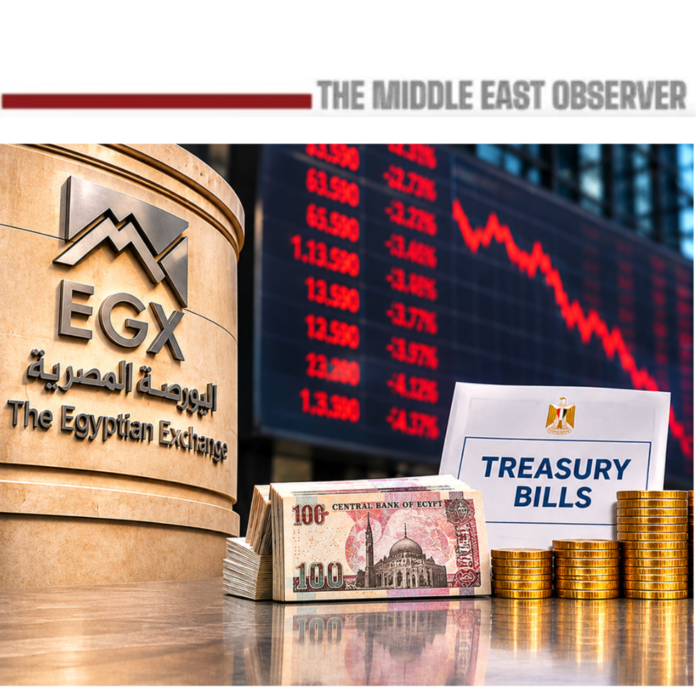
Egyptian stocks shed EGP105bn in a week as smaller companies suffer the steepest losses. Foreign investment favours government debt over equities, while Sunday’s renewed selling casts doubt on an early recovery.
CAIRO, Egypt’s equity-market correction intensified at the start of the new trading week on Sunday, following losses of EGP105.3 billion in market capitalisation during the five sessions ended Thursday, November 19, even as foreign investors recorded net purchases of EGP45.36 billion ($849 million) in Treasury bills on the secondary market.
The benchmark EGX30 lost 1.09% over the week to close Thursday at 51,458.04 points, while the EGX70 small- and mid-cap index plunged 5.51% to 17,505.78. The broader EGX100 fell 4.42% to 23,412.35.
Total market capitalisation declined 2.52% to EGP4.063 trillion from EGP4.168 trillion, according to the Egyptian Exchange’s weekly statistics.
Smaller Stocks Lead the Correction
The week’s most significant development was the widening performance gap between heavyweight stocks and smaller companies, exposing the weakness of buying demand beyond the market’s largest constituents.
Thursday offered little reassurance. The EGX30 briefly advanced to around 51,692 points before reversing to close 0.17% lower. The EGX70 lost 0.33%, the Shariah-compliant EGX33 fell 0.46%, and the EGX100 slipped 0.19%. Only the low-volatility EGX35-LV edged higher, gaining 0.04%.
Foreign equity investors sold EGP185.3 million net during the session, while Egyptians purchased EGP171.9 million and Arab investors EGP13.4 million.
Trading turnover reached EGP6.24 billion, approximately 44% below its 90-day average, while falling shares continued to outnumber gainers.
Weekly listed-equity turnover declined 22.7% to EGP43.18 billion from EGP55.87 billion, indicating reduced market participation rather than a convincing recovery in demand.
Foreign Capital Prefers Government Debt
Foreign investors purchased EGP45.36 billion net of Egyptian Treasury bills in secondary-market transactions during the week, according to exchange statistics. Arab investors, meanwhile, recorded approximately EGP10.33 billion in net government-debt sales.
The equity market presented a different picture. Foreigners sold EGP35.1 million net of listed shares, excluding block transactions, while Arab investors purchased EGP153.6 million.
A separate institutional breakdown, including block transactions, showed foreign institutions selling EGP54.6 million net of equities, partly offset by EGP19.4 million in purchases by foreign individuals. Egyptian institutions recorded net equity sales of EGP265.4 million.
Government securities accounted for approximately 92% of total exchange turnover, with debt trading reaching EGP497.15 billion against EGP43.18 billion in listed-equity transactions.
These figures reflect different asset classes and transaction categories. Secondary-market Treasury-bill purchases do not necessarily represent an equivalent amount of fresh foreign currency entering Egypt, nor do they establish that investors directly transferred capital from equities into debt.
Nevertheless, the divergence demonstrates stronger foreign demand for Egyptian sovereign securities than for listed companies.
High Interest Rates Sustain the Divide
The Central Bank of Egypt’s October monetary tightening left overnight deposit and lending rates at 20% and 21%, respectively, making fixed-income securities a formidable competitor to equities.
Urban annual inflation eased to 12.7% in October from 13.9% in September, but elevated interest rates continue to affect corporate financing costs and the relative attractiveness of equity valuations.
The Egyptian pound remained broadly stable over the week, with the central bank’s average dollar quotations ending Thursday at approximately EGP53.76 for buying and EGP53.86 for selling.
Dollar interbank transactions reportedly fell 35.2% to $1.38 billion from $2.13 billion the previous week, although lower transaction volumes alone cannot establish an improvement in foreign-exchange liquidity.
Meanwhile, the International Monetary Fund announced a staff-level agreement with Egypt on November 18, potentially releasing approximately $2.3 billion under its financing arrangements, subject to Executive Board approval.
The agreement provided a constructive macroeconomic signal but failed to generate a sustained equity-market recovery before Thursday’s close.
Sunday’s Selling Challenges the Stabilisation Thesis
The correction intensified again when trading resumed on Sunday, November 22.
The EGX30 was down 2.56% at 50,140.5 points shortly after the opening, while the EGX70 lost 4.24% and the EGX100 declined 4.15%, according to market reports published at 10:34 a.m. A subsequent report at 11:17 a.m. showed the EGX30 recovering part of its early losses but still down 1.95% at approximately 50,452 points.
These were intraday observations, not final closing figures.
The renewed decline substantially weakens the argument that Thursday’s slowing losses marked the beginning of a sustained recovery. It also reinforces the evidence that selling pressure has spread beyond smaller companies to the broader market.
The next meaningful recovery test will be whether the EGX30 can regain the 51,458–51,700-point region around Thursday’s close and failed morning advance, supported by stronger turnover, improving market breadth and renewed institutional equity purchases.
Egypt is attracting foreign investment into its government securities, but that demand has yet to restore confidence across its equity market. Until buying broadens and institutional flows improve, the correction remains unresolved.
Related Articles:
Egypt Stocks Show Signs of Stabilisation as Selling Eases
Egypt Stocks Lose EGP56bn as Domestic Institutional Selling Hits Blue Chips
Read Also:
Egypt Stocks Gain 1.7% as Foreigners Buy Debt, Sell Equities