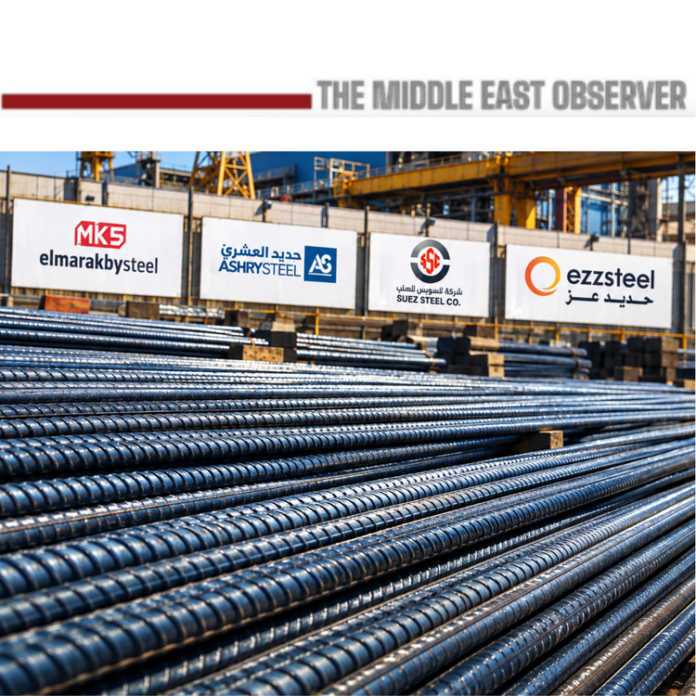
CAIRO — Near-simultaneous price increases by three major Egyptian steelmakers are raising competition and export-pricing questions despite weak demand, lower protection on imported billet and no uniform increase across other major production costs.
Ezz Steel will raise rebar by EGP1,000 to EGP40,850 per tonne from Oct. 1. El Marakby increased its price by EGP1,800 to EGP39,800, while El Garhy raised its price by about EGP1,100 to EGP39,200. Other producers remain spread across a substantially wider price range.
From Sept. 14, Egypt’s safeguard duty on imported billet — the semi-finished steel used to produce rebar — fell to 12% of import value, subject to a minimum $64 per tonne, from 13.12% and a $70 minimum. Where the minimum applies, the saving is $6 per tonne, or roughly EGP300 at prevailing exchange rates.
Other cost pressures are mixed. Imported scrap and regional billet prices have firmed, while the pound weakened in mid-September before recovering by Sept. 23. Energy remains expensive after natural-gas prices for iron and steel producers were raised to $7.75 per million British thermal units in May, but there has been no fresh September increase.
Financing conditions have also not tightened. The Central Bank of Egypt has kept overnight deposit and lending rates at 19% and 20% since February. Ahead of its Sept. 24 meeting, 11 of 12 economists surveyed by Reuters expected both rates to remain unchanged, extending the pause for a fifth consecutive meeting.
The evidence therefore shows cost pressure, but not a uniform September shock sufficient on its own to explain increases of EGP1,000-EGP1,800 per tonne across producers with different business models.
Competition Question
Parallel pricing does not establish unlawful coordination. The companies imposed different increases and ended at different prices.
Their production structures, however, differ. Ezz is vertically integrated and produces much of its steelmaking feedstock internally, leaving it less exposed to imported billet than conventional rolling mills. Weak demand also means published list prices may differ materially from realised prices after discounts and payment facilities.
The relevant question is therefore whether each producer set prices independently, and whether future prices, discounts, output or dealer terms were communicated or coordinated.
That inquiry falls principally to the Egyptian Competition Authority, while the Ministry of Investment and Foreign Trade, through its Trade Remedies Sector, separately administers the billet safeguard and reviews its market impact quarterly. Egypt’s competition, trade and industrial authorities consequently have distinct but overlapping responsibilities in assessing the current market.
Export Pressure Adds a Second Test
The increases also followed a major external development.
On Sept. 18, the US imposed definitive antidumping orders on Egyptian rebar after the Commerce Department calculated a 34.20% dumping margin for Ezz. El Marakby and Suez Steel received 52.73% rates based on adverse facts available. Separate countervailing measures also apply.
Those findings concern earlier transactions and cannot be altered by September’s Egyptian price changes. Future realised prices, however, could matter in later reviews.
A higher Egyptian list price alone would not resolve an antidumping problem. Foreign authorities generally compare export prices with a domestic benchmark or another measure of “normal value.” If domestic realised prices rise while export prices remain unchanged, the measured dumping gap can widen.
Any pricing reset intended to narrow that relationship would therefore generally require export prices to rise alongside domestic realised prices.
No public evidence reviewed so far establishes that the latest increases represent such a strategy. The critical next indicator will be whether Egyptian export quotations and actual realised export prices move materially higher.
Government Faces a Three-Way Balance
The policy response spans three institutions.
The Egyptian Competition Authority must protect independent domestic price-setting. The Ministry of Investment and Foreign Trade, through its Trade Remedies Sector, must assess whether billet protection remains proportionate while managing Egypt’s exposure to foreign trade-remedy cases. The Ministry of Industry and Industrial Development Authority must deliver localisation by expanding domestic billet supply and competition.
IDA has already offered eight billet-production licences with a combined annual capacity of 2.8mn tonnes, specifically aimed at supplying rolling mills, reducing import dependence, conserving foreign currency and strengthening industry competitiveness.
The balance matters beyond steel.
Rebar feeds directly into housing, infrastructure and industrial investment, making price stability particularly important while Egypt continues to manage elevated inflation. Localising billet can reduce import dependence and foreign-currency demand, but its economic value depends on additional capacity creating genuine competition rather than replacing foreign dependence with concentrated domestic pricing power.
Exports complete the equation. A larger steel industry needs foreign markets to absorb capacity, earn foreign currency and sustain efficient plant utilisation, but those sales must withstand increasingly aggressive trade-defence scrutiny.
Egypt’s steel challenge is therefore to localise without weakening competition, preserve price stability without suppressing investment, and expand exports without recurring trade penalties.
Getting that balance right will determine whether steel localisation reduces the economy’s structural costs — or merely shifts them from the border to the domestic market.
Related news:
Egypt’s Stabilisation Drive Gains Momentum as External Buffers Strengthen
Egypt Codifies Consumer-Credit Rules as FRA Tightens Oversight
Read also:
Egypt’s Next Industrial Push Points to Grids, Machinery and Advanced Manufacturing