

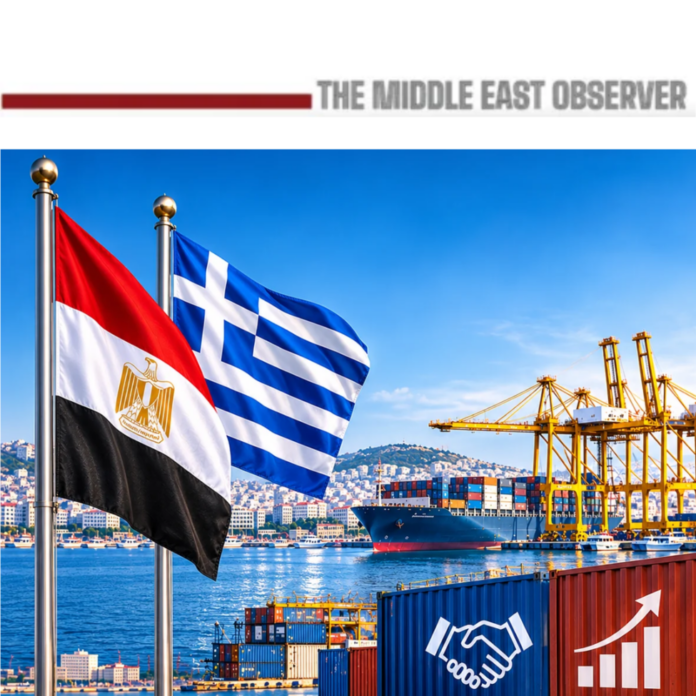
Regional declaration, renewed bilateral agreement and energy and shipping initiatives seek to strengthen Egypt’s investment links with Europe.
ATHENS — The second Euro-Mediterranean Economic and Business Forum concluded on November 19, 2026, with the Piraeus Declaration, committing regional institutions and businesses to closer cooperation on trade, investment, industrial integration and connectivity. Egypt used the two-day summit to promote its manufacturing and energy potential as a gateway between Africa, the Middle East and Europe.
The November 18–19 gathering brought together more than 600 government, institutional and business representatives. Its declaration endorsed stronger private-sector participation in the EU’s Pact for the Mediterranean, designating the Association of Mediterranean Chambers of Commerce and Industry (ASCAME) as a bridge between European institutions and regional businesses.
Egypt was represented by Alaa Ezz, secretary-general of the Confederation of Egyptian European Business Associations, and Yasser Abbas, deputy chief executive of the General Authority for Investment and Free Zones.
Ezz highlighted Egypt’s nearshoring opportunities and access to more than €23bn in regional financing instruments, including grants, concessional loans and guarantees. The figure represents potential multilateral support, not new funding committed to Egypt.
Egypt–Greece Agreement and Investment Opportunities
In a parallel November 19–20 bilateral business programme, an Egyptian delegation led by Finance Minister Ahmed Kouchouk secured a renewed cooperation memorandum between the Egyptian Junior Business Association and the Athens Chamber of Commerce and Industry.
The agreement covers nine economic areas, including energy, construction, manufacturing, tourism, pharmaceuticals, logistics, technology and financial services. It provides for trade missions, business matchmaking and investment information exchanges, with a Greek delegation expected to visit Egypt within 12 months.
Bilateral merchandise trade reached €1.45bn in 2025, including €920mn in Greek imports from Egypt and €533mn in exports to Egypt, according to the Athens Chamber. By 2023, some 215 Greek companies had invested approximately $255mn in Egypt.
Kouchouk called for doubling bilateral trade and investment, while Suez Canal Economic Zone Chairman Mostafa Shaikhoun promoted industrial and port investment opportunities. Egyptian and Greek officials also discussed a feasibility study for a direct shipping connection between their ports.
Energy cooperation centred on GREGY, the proposed 3-gigawatt undersea electricity interconnector that would carry Egyptian renewable power to Greece and onward to European markets. Greek Finance Minister Kyriakos Pierrakakis reaffirmed support for the project, identifying financing as the next critical step.
Discussions also covered development-bank financing, credit guarantees and joint industrial investment.
The meetings produced a renewed business agreement and a regional policy declaration, but no newly quantified Egyptian investment contracts were publicly confirmed.
The economic test now lies in implementation: converting business contacts into joint ventures, securing finance for GREGY and developing commercially viable shipping and industrial projects that expand Egypt’s access to European markets.
Related Articles:
Egypt and Greece Advance 3 GW Power Link to Europe
Suez Canal Authority Courts Greek Maritime Investment
Read Also:
Egypt, Greece and Cyprus Build a Mediterranean Bridge to Europe
