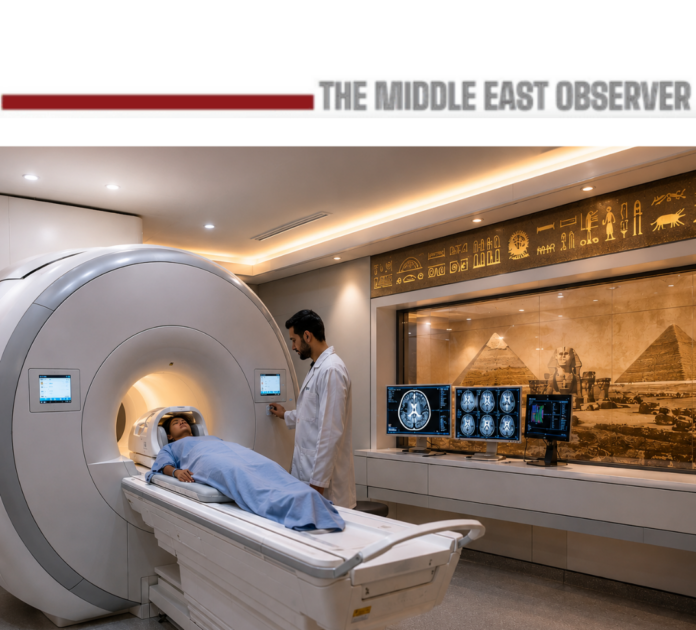
Healthcare is increasingly shifting from treating disease to predicting, preventing and personalising care. At the heart of this transformation is medical imaging, with magnetic resonance imaging (MRI) evolving from a diagnostic tool into a critical enabler of precision medicine. By helping physicians detect disease earlier, tailor treatments and monitor patient outcomes more accurately, MRI is becoming increasingly central to modern healthcare. As Egypt expands its Universal Health Insurance System and invests in specialised hospitals and advanced diagnostic infrastructure, demand for high-performance imaging technologies continues to grow.
1.5 Tesla MRI systems remain the backbone of diagnostic imaging in Egypt, providing high-quality, radiation-free examinations of the brain, spine, joints and internal organs. Their balance of image quality, clinical versatility and operational efficiency ensures they remain the preferred platform for most routine diagnostic applications.
Growing demand for greater diagnostic precision, however, is accelerating the adoption of 3 Tesla MRI scanners. Their stronger magnetic field delivers higher-resolution images in shorter examination times, improving the assessment of neurological disorders, musculoskeletal injuries, prostate disease and cardiovascular conditions, while enhancing planning for complex surgical procedures.
MRI has also progressed far beyond producing anatomical images. Advanced techniques—including functional MRI (fMRI), diffusion-weighted imaging (DWI), MR perfusion and MR spectroscopy—allow clinicians to evaluate brain function, blood flow and tissue metabolism alongside anatomy. These capabilities support rapid stroke diagnosis, more accurate tumour characterisation and safer neurosurgical planning, while reducing the need for multiple or more invasive diagnostic procedures.
Another important advance is Whole-Body MRI, whose role continues to expand in oncology. By examining multiple organs during a single, radiation-free scan, it enables physicians to detect, stage and monitor cancer more effectively, particularly for patients requiring repeated imaging throughout long-term treatment.
The integration of PET-MRI represents one of the most sophisticated developments in medical imaging. Combining MRI’s exceptional anatomical detail with PET’s ability to visualise cellular activity, the hybrid system provides a comprehensive assessment of both disease structure and biological behaviour in a single examination. Egypt was among the first countries in Africa and the Arab region to introduce this technology, strengthening its capabilities in oncology, neurology and selected cardiovascular applications.
Artificial intelligence is now driving the next phase of MRI innovation. AI-powered image reconstruction shortens scan times while improving image quality, helping increase patient throughput and reduce examination times. Machine-learning algorithms are also assisting radiologists by automating routine measurements, prioritising urgent cases and identifying subtle abnormalities that may otherwise be overlooked, supporting greater diagnostic consistency as imaging volumes continue to rise.
MRI is likewise becoming increasingly quantitative rather than purely visual. New imaging techniques can measure biomarkers such as tissue composition, liver fat, fibrosis, brain atrophy and tumour cellularity, providing objective indicators for disease progression and treatment response. These quantitative insights are strengthening MRI’s role as a cornerstone of precision medicine and personalised clinical decision-making.
For Egypt, these technological advances extend beyond improved diagnostics. The continued expansion of specialised healthcare facilities, digital health initiatives and advanced imaging infrastructure is creating the foundations for more efficient, data-driven healthcare delivery. As the country seeks to strengthen its position as a regional medical hub, investment in next-generation imaging technologies will support not only better clinical outcomes but also medical research, specialist training and healthcare competitiveness.
As healthcare increasingly prioritises early intervention, personalized treatment and evidence-based decision-making, advanced imaging is becoming strategic infrastructure rather than simply diagnostic equipment. MRI’s evolution—from producing anatomical images to generating functional, metabolic and quantitative insights—illustrates how technology is reshaping modern medicine. For Egypt, continued investment in advanced imaging will be instrumental in delivering more precise, efficient and patient-centred healthcare while reinforcing its ambition to become a regional leader in medical innovation.
Related news:
Tatweer Medical Plans $100m Investment to Expand Egypt’s Medical Technology Manufacturing
Egypt Genome Project Uncovers Millions of New Genetic Variants
Read also:
Kuwait Joins Global Race to Finance AI Infrastructure
Houthi Threat Opens Second Front in Regional Shipping Crisis