

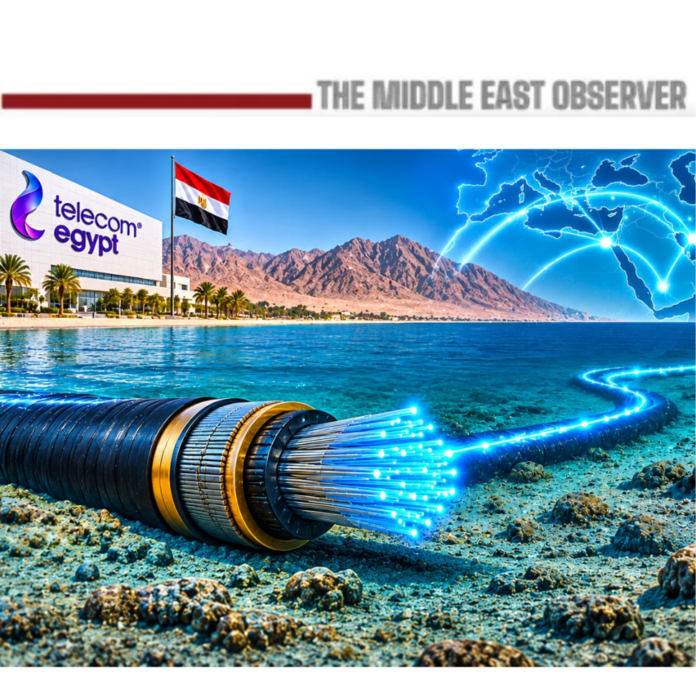
Telecom Egypt is developing a 200-kilometre subsea cable between Sharm El Sheikh and Taba with a design capacity of approximately five petabits per second, targeting commercial operation in the fourth quarter of 2027. Under a construction agreement with Greece-based Power Sub Link (PSL) announced in September 2026, the project will strengthen Egypt’s Eastern Digital Corridor through Sinai. A technical industry report published on November 29 highlighted the system’s integration with infrastructure serving Jordan and planned connections with Saudi Arabia, supporting international demand for cloud computing and artificial intelligence connectivity.
The cable will extend Telecom Egypt’s Red Sea Subsea Festoon Cable System to Taba, establishing a continuous subsea connection linking Suez, Zafarana, Ras Ghareb, Sharm El Sheikh and Taba. Its high-fibre-count architecture will operate without submerged optical amplifiers, with a design capacity equivalent to 5,000 terabits per second.
Through the Internet Corridor of Egypt (ICE), the system will connect with Mediterranean and Red Sea infrastructure supported by more than 14 terrestrial routes and over 14 subsea landing points, according to the industry report.
At Taba, the system will connect with Coral Bridge, a 15-kilometre subsea cable jointly owned by Telecom Egypt and Jordan’s NaiTel. Operational since August 2025, Coral Bridge incorporates 48 fibre pairs and has a design capacity exceeding one petabit per second.
Together with the planned Medusa cable extension from Port Said across Sinai to Taba, the infrastructure will provide Jordan’s Aqaba Digital Hub with additional high-capacity connections towards the Mediterranean and Red Sea.
The eastern corridor is designed to reduce dependence on existing transit routes by providing international telecommunications operators with alternative paths through Sinai. Planned subsea connections with Saudi Arabia would further extend regional connectivity options for global carriers, cloud service providers and hyperscale data centre operators.
The project complements Telecom Egypt’s broader international infrastructure expansion, including the 45,000-kilometre 2Africa cable system. In January 2025, the company launched a Mediterranean connection linking Port Said with Marseille via Genoa, supporting growing international data transmission requirements.
The Sharm El Sheikh–Taba agreement was signed by Telecom Egypt Managing Director and CEO Tamer El Mahdi and PSL Managing Director Byron Skaftouros in the presence of Communications and Information Technology Minister Raafat Hendy.
El Mahdi said the project forms part of the company’s strategy to expand its international infrastructure business and diversify transmission routes. Skaftouros highlighted the importance of alternative Red Sea connectivity in strengthening the continuity of international communications.
Telecom Egypt’s updated corporate strategy also encompasses the separation of its consumer and enterprise business units and the establishment of a dedicated hyperscale and AI data centre entity, according to the November industry report.
The expansion comes amid improving financial performance, with first-half 2026 revenue rising 17.4% year on year, earnings before interest, taxes, depreciation and amortisation increasing 20%, and net profit growing 47%.
The company has not disclosed the Sharm El Sheikh–Taba project’s investment value, initial operational capacity or projected commercial revenues.
Related News:
Egypt Is Building a Second Digital Corridor Through Sinai
Telecom Egypt Adds Sinai Route to Its Global Data-Corridor Network
Read Also:The Internet Has a Physical Economy: Who Will Build Egypt’s Next Digital Highway?
Telecom Egypt Bets on Data Centres as First-Half Profit Jumps 47%