President Abdel Fattah El-Sisi has reaffirmed the government’s commitment to delivering Egypt’s flagship transport and logistics projects on schedule as the country prepares to launch trial operations of its first high-speed railway linking the Red Sea and the Mediterranean, a cornerstone of its strategy to transform into a regional trade and logistics hub.
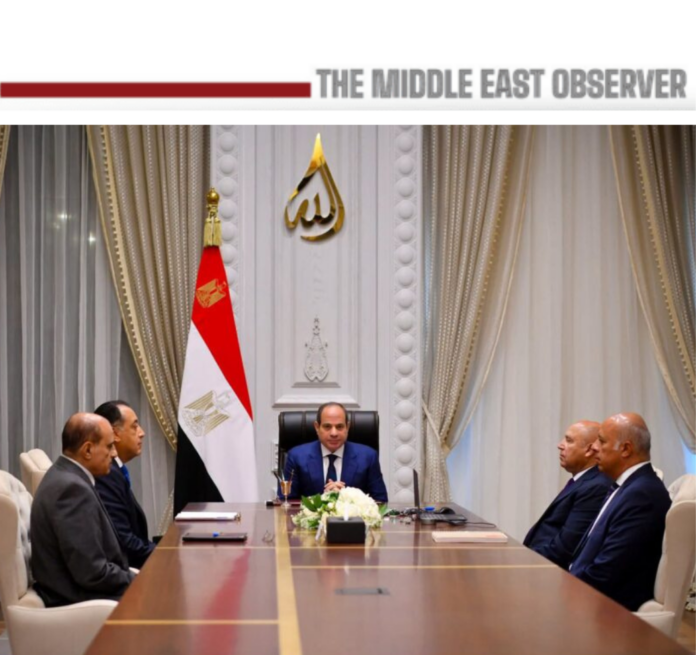
Meeting in New Alamein City with Prime Minister Mostafa Madbouly, Deputy Prime Minister for Industrial Development and Minister of Transport and Industry Kamel El-Wazir, and Presidential Adviser for Urban Planning Amir Sayed Ahmed, El-Sisi reviewed progress on strategic port, railway and mass-transit projects. He directed officials to adhere to implementation schedules while maintaining the highest quality standards, underscoring the role of modern transport infrastructure in strengthening Egypt’s trade integration with Arab and African markets.
Rather than viewing these investments as individual infrastructure projects, the government is increasingly positioning them as components of an integrated logistics network linking ports, industrial zones, dry ports, logistics centres and newly developed urban and agricultural areas. The strategy aims to improve freight efficiency, lower transport costs and reinforce Egypt’s role as a gateway connecting Africa, the Middle East and Europe.
High-Speed Railway Enters Operational Phase
The meeting confirmed that trial operations of the first line of Egypt’s high-speed electric railway will begin in September 2026 and continue for six months before commercial services commence.
Stretching approximately 660 kilometres, the first corridor links Ain Sokhna on the Red Sea with Alexandria, New Alamein and Marsa Matrouh on the Mediterranean. Designed for both passenger and freight services, the line forms the backbone of what officials have described as a “Suez Canal on rails”—not as a substitute for the canal, but as a complementary domestic transport corridor capable of moving cargo efficiently between Egypt’s eastern and northern ports while reducing reliance on long-haul trucking.
Its significance extends beyond transportation. By directly connecting industrial zones, logistics centres, agricultural production areas and export terminals, the railway is expected to shorten supply chains, improve export competitiveness and enhance resilience across Egypt’s domestic freight network. When fully completed, the three-line network will extend to around 2,000 kilometres, making it among the world’s largest high-speed rail systems under development.
The second and third railway lines will connect Greater Cairo with Upper Egypt and Abu Simbel, while extending eastward to Hurghada and Safaga, integrating mining, tourism and agricultural production with both Red Sea and Mediterranean ports.
Ports at the Centre of Egypt’s Logistics Strategy
The meeting reviewed development work at Greater Alexandria, Ain Sokhna, Damietta and Greater Safaga ports, each serving a distinct role within Egypt’s expanding maritime network.
Alexandria remains Egypt’s principal commercial gateway, handling the majority of the country’s foreign trade. Ongoing expansion projects—including deeper navigation channels, longer quays and modern container terminals—are designed to accommodate larger vessels, improve cargo-handling efficiency and support rising trade volumes.
Ain Sokhna is evolving into Egypt’s primary Red Sea logistics gateway within the Suez Canal Economic Zone (SCZone). Supported by major international terminal operators and industrial investments, the port is becoming an integrated manufacturing and export platform linking Asian, African and European shipping routes. Its connection to the high-speed railway is expected to strengthen multimodal freight movements between factories, logistics centres and maritime terminals.
Greater Safaga Port is also assuming greater strategic importance. Beyond serving tourism along the Red Sea coast, it is being developed as a gateway for mining exports, phosphate shipments and industrial cargo from Upper Egypt, complementing broader plans to establish new industrial and logistics corridors across southern Egypt.
Damietta Demonstrates Operational Resilience
The meeting took place only days after a security incident involving two liquefied natural gas vessels at Damietta Port drew attention to the resilience of Egypt’s maritime infrastructure.
While investigations into the drone-related incident remain ongoing, commercial operations across the wider port continued uninterrupted. Authorities confirmed that container handling, bulk cargo operations, vessel movements, pilotage and towing services proceeded according to schedule, reflecting the port’s ability to maintain trade flows despite localized disruption.
Operational statistics released shortly after the incident showed continued vessel arrivals and departures, alongside robust container and cargo throughput, highlighting Damietta’s importance as one of Egypt’s fastest-growing commercial ports. During the 2025/26 financial year, the port handled a record 46.4 million tonnes of cargo, underscoring its expanding role in regional trade and transshipment.
The incident nevertheless reinforced the strategic importance of maritime security as regional tensions continue to affect shipping routes across the Red Sea and the wider Middle East. Together with the Suez Canal and the SUMED pipeline, Egypt’s Mediterranean ports have become increasingly significant in maintaining the continuity of regional energy and commercial supply chains.
Expanding Multimodal Transport
The meeting also reviewed progress on the East and West Nile monorails, the Bus Rapid Transit (BRT) network along Cairo’s Ring Road, the Western Desert Road linking Giza with Abu Simbel, the dualisation of the Aswan–Berenice corridor and rehabilitation works on the 6th of October Bridge.
The 43.8-kilometre West Nile Monorail, connecting 6th of October City with Mohandessin, remains scheduled to enter service in 2027, while the second phase of the BRT system is ready for operation, supporting Egypt’s broader transition towards sustainable urban mobility.
Building an Integrated Trade Platform
Egypt’s transport agenda is increasingly shifting from constructing individual projects to creating an integrated national logistics platform. Ports, high-speed rail, highways, dry ports and industrial zones are being designed to operate as interconnected assets supporting manufacturing, exports and regional supply chains.
The coming trial operations of the Red Sea–Mediterranean railway will therefore represent more than the launch of a new transport system. They will provide an early test of Egypt’s ability to translate unprecedented infrastructure investment into faster freight movement, lower logistics costs and greater competitiveness as a regional gateway linking Africa, the Middle East and Europe.
Related news:
Egypt and Madagascar Sign Five Agreements to Expand Trade, Investment and Strategic Cooperation
Egypt Looks to Tanzania to Deepen East African Trade Links
Read also: