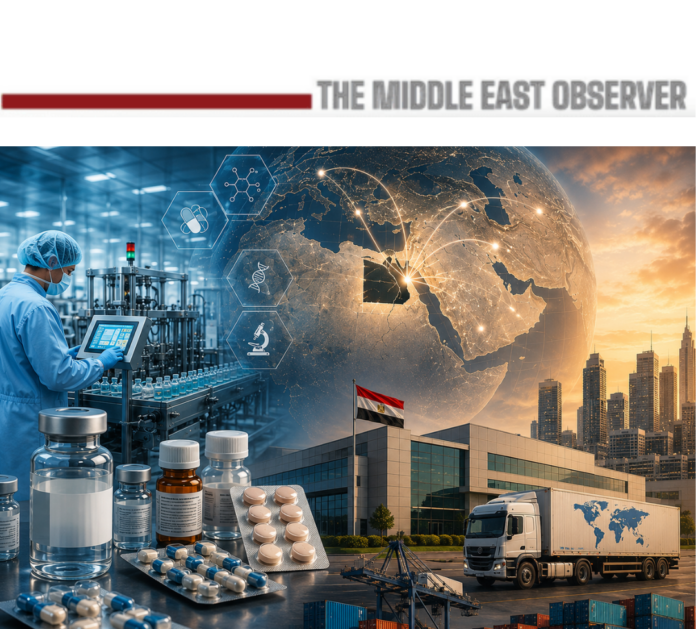
Egypt is seeking to convert its large domestic medicines industry into a manufacturing and export platform serving the Middle East and Africa. Its success depends on reducing exposure to imported ingredients, moving into higher-value therapies and ensuring that industrial expansion strengthens medicine security at home.
For millions of Egyptians living with chronic disease, access to treatment depends on more than pharmacies and hospitals. It increasingly rests on whether the country can secure the raw materials, technology and investment required to keep its pharmaceutical industry operating when international supply chains are disrupted.
Pharmaceutical manufacturing was once viewed principally as a public-health necessity, measured by a country’s ability to supply medicines to its own population. It has since become a strategic industry associated with economic security, advanced manufacturing, skilled employment and export growth.
The Covid-19 pandemic exposed the vulnerability of internationally fragmented supply chains. Shortages of medicines, active pharmaceutical ingredients and medical products prompted governments to reassess their dependence on a limited number of overseas suppliers and to prioritise domestic capacity, diversified sourcing and strategic reserves.
Across the Middle East and North Africa, countries are consequently competing to establish pharmaceutical hubs combining manufacturing, technology transfer, scientific research and access to export markets.
Egypt enters this race with substantial advantages: one of the region’s most established pharmaceutical industries, a population exceeding 110mn, a large domestic market and an increasingly credible regulatory system. Yet its international ambitions begin with a more immediate test—whether patients can obtain essential medicines consistently and affordably.
Industrial Scale, Persistent Vulnerabilities
According to the Egyptian Drug Authority, locally manufactured medicines meet about 91 per cent of domestic demand. The sector operates approximately 810 production lines across more than 170 manufacturing facilities, while the pharmaceutical market exceeded EGP422bn in 2025.
This scale provides a degree of resilience. When an imported brand becomes unavailable, pharmacists can often recommend a locally manufactured product containing the same active ingredient, dosage strength and pharmaceutical form.
For patients receiving long-term treatment for hypertension, diabetes and other widespread chronic conditions, such alternatives can limit the impact of temporary shortages.
But high domestic production of finished medicines does not amount to complete pharmaceutical self-sufficiency. Manufacturers remain dependent on imported active pharmaceutical ingredients, specialised chemicals, packaging materials and production equipment.
Global shipping delays, supplier interruptions, foreign-currency pressures and regulatory procedures can therefore affect the availability of selected medicines. Imported and highly specialised treatments are generally the most exposed.
Dr Abdel Rahman Hedia, a pharmacist, says shortages are often linked to supply-chain and production constraints rather than an absence of domestic manufacturing capacity.
“The issue is often related to delays in importing raw materials, manufacturing schedules or pricing and regulatory procedures before products return to the market,” he says.
The distinction is important. A country may formulate, package and distribute most of the medicines it consumes while remaining reliant on international suppliers for the ingredients needed to produce them.
Chronic Medicines Provide the Real Test
The reliability of pharmaceutical supply chains is particularly important for people living with chronic illnesses.
Patients with cardiovascular disease, hypertension, diabetes and other long-term conditions frequently depend on uninterrupted medication to prevent complications. Even a temporary disruption can lead to deterioration, emergency treatment or avoidable hospitalization.
Locally produced therapeutic alternatives are available in many cases. Some specialised cardiovascular, oncology and biological medicines, however, may have fewer appropriate substitutes.
Changing treatments also requires professional judgement. Patients should not switch medicines solely because of price, packaging or brand recognition. The active ingredient, dosage, release mechanism and pharmaceutical form must be assessed by a physician or pharmacist.
Affordability presents an additional challenge. Rising prices may encourage patients to seek cheaper alternatives, reduce doses or discontinue treatment after symptoms improve. Such decisions can undermine chronic-disease management and ultimately raise healthcare expenditure through preventable complications.
Pharmaceutical localisation is therefore not simply about producing more boxes of medicine. It must ensure that clinically appropriate treatments remain available, affordable and consistently supplied.
Localising Active Ingredients
Reducing dependence on imported active pharmaceutical ingredients has become a central element of Egypt’s industrial strategy.
The country has extensive capabilities in formulating, manufacturing and packaging finished medicines. Reliance on imported APIs, however, exposes producers to exchange-rate volatility, freight costs, supplier concentration and external disruptions.
The EDA is seeking to localise the production of the 50 most heavily imported active ingredients, which reportedly account for about 78 per cent of the country’s API imports.
Successful localization could increase domestic value added, improve supply resilience and strengthen the competitiveness of Egyptian exports. It could also reduce the exposure of medicine production to foreign-currency shortages and international transport disruptions.
But API manufacturing is considerably more capital-intensive and technically demanding than conventional pharmaceutical formulation. It requires specialised chemical facilities, rigorous environmental controls, dependable utilities, trained personnel and sufficient production volumes to remain commercially viable.
A selective approach is therefore more credible than attempting to replace every imported ingredient. Authorities and manufacturers need to identify APIs that are strategically important, subject to concentrated global supply and capable of being produced competitively for domestic and regional markets.
Even as local capacity expands, diversified international sourcing remains essential. Pharmaceutical security depends on combining domestic production with multiple external suppliers, stronger inventory management and more reliable procurement systems.
Complete isolation from international pharmaceutical supply chains is neither realistic nor economically desirable.
Regulation as an Industrial Asset
Regulatory credibility is another important component of Egypt’s pharmaceutical ambitions.
The Egyptian Drug Authority has sought to modernise medicine registration, strengthen quality controls and align domestic oversight with international standards. Its recognition by the World Health Organization as a Maturity Level 3 regulatory authority has improved confidence in Egypt’s regulatory system and strengthened its standing with manufacturers and foreign markets.
A credible regulator is essential for any country seeking to become a pharmaceutical hub. Manufacturing scale has limited value if products cannot secure recognition from overseas health authorities, international procurement agencies or multinational partners.
Further digitalisation of registration, licensing and inspection could reduce administrative delays and improve transparency. Pharmaceutical traceability systems may also help authorities identify shortages earlier, monitor distribution and limit counterfeit or improperly circulated products.
The challenge is to combine regulatory rigour with commercial efficiency.
Delayed approvals or lengthy pricing negotiations can contribute to shortages when production costs rise more rapidly than regulated medicine prices. If manufacturers cannot recover higher costs, they may delay production or discontinue products that have become economically unsustainable.
Maintaining medicine availability therefore requires a balance between affordability for patients and commercial viability for producers.
Climbing the Pharmaceutical Value Chain
Gypto Pharma, one of the Middle East’s largest pharmaceutical manufacturing complexes, represents a central element of Egypt’s industrial strategy.
Built on approximately 180,000 square metres and equipped with about 15 production lines, the facility was designed to expand domestic capacity and support the localisation of strategically important treatments.
Its long-term importance, however, depends less on its physical scale than on its ability to maintain high utilisation, attract sustained technology-transfer agreements and secure product registrations in foreign markets.
Egypt is seeking to expand beyond conventional generic medicines into oncology treatments, biological products, vaccines and other complex therapies. This transition is commercially and strategically significant.
Generics remain essential to public-health systems because they provide established treatments at lower cost. They are also likely to remain the industry’s principal volume driver. But biologics, biosimilars, vaccines and complex injectables generally contain more technological value and offer stronger export and revenue potential.
Biotechnology is becoming particularly important as healthcare systems increase their use of targeted treatments and as patents expire on major biological medicines. Demand for more affordable biosimilars is likely to rise across emerging markets, creating opportunities for manufacturers able to meet demanding production and regulatory standards.
Entering these segments requires sophisticated manufacturing systems, specialised laboratories and more stringent quality controls. It also depends on scientists, pharmacists and engineers with expertise in molecular biology, bioprocessing, clinical research, chemical engineering and international regulatory affairs.
Egypt’s future position will therefore be determined not only by factory capacity but also by the strength of its scientific institutions and its ability to connect research with commercial production.
The Investment Case
Pharmaceutical manufacturing can generate broader economic benefits than many conventional industries because it combines advanced production, skilled employment, scientific research, intellectual property and export potential.
Successful localisation can also create supply chains extending into chemicals, packaging, logistics, laboratory services, clinical research and digital health.
Yet the economics vary considerably between product categories.
Conventional generics operate in competitive markets where regulated prices and rising input costs can place pressure on margins. Higher-value products may offer stronger returns but require greater capital expenditure, more complex technology and longer approval processes.
The strategic opportunity lies in building a balanced industry: generics that support affordable public healthcare, alongside advanced products capable of attracting investment and generating higher-value exports.
International pharmaceutical companies considering manufacturing partnerships assess more than labour costs or market size. They also examine regulatory predictability, intellectual-property protection, access to finance, workforce quality, infrastructure and the ability to supply several countries from one production base.
Egypt’s large domestic market gives it an important advantage, but market size alone cannot compensate for administrative complexity or uncertainty over access to imported inputs.
Exports as the Next Growth Driver
Exports are expected to support the next stage of the industry’s development.
Pharmaceutical exports reached an estimated $1.3bn in 2025, while the EDA is targeting $3bn by 2030. Achieving that objective requires more than increasing factory output.
Manufacturers must register products in foreign markets, comply with different regulatory regimes, maintain international quality certifications and build durable distribution networks.
Africa presents a significant opportunity. Many countries remain heavily dependent on imported medicines, while population growth, urbanisation and the increasing prevalence of chronic disease are raising demand.
Egypt’s geographic position, established production base and transport links offer potential advantages. Its membership of the Common Market for Eastern and Southern Africa and the African Continental Free Trade Area may also support market access.
African pharmaceutical markets, however, remain fragmented. Registration requirements, procurement practices, payment risks and pricing conditions vary considerably between countries.
Egyptian producers therefore need long-term commercial strategies rather than dependence on occasional export orders. Partnerships with distributors, hospitals, health authorities and regional procurement organizations are likely to be essential.
The country can also compete as a manufacturing partner rather than solely as a seller of finished medicines. Contract manufacturing, product licensing, packaging, laboratory testing and technology transfer could become important sources of revenue.
Competition for Regional Leadership
Egypt is not pursuing its ambitions in isolation.
Saudi Arabia is accelerating pharmaceutical localisation under Vision 2030, using procurement policy, investment incentives and international partnerships to attract manufacturers. It is also investing in biotechnology and advanced therapeutics.
The United Arab Emirates is developing a life-sciences ecosystem centered on logistics, research, specialized investment zones and access to international markets.
Jordan has built a highly export-oriented pharmaceutical industry despite its smaller domestic market, while Morocco is strengthening its position as a manufacturing and distribution base serving North and West Africa.
Egypt’s model differs from those of its regional competitors.
Unlike Jordan, where pharmaceutical growth has been strongly export-led, or Saudi Arabia, where localisation is supported by the purchasing power of the state and large healthcare institutions, Egypt combines a substantial domestic market with decades of manufacturing experience.
That allows producers to serve local demand while developing regional export operations. It also provides a large patient and healthcare base capable of supporting clinical research and the introduction of new therapies.
But scale can become a disadvantage when regulation is slow, finance is expensive or access to imported inputs is interrupted. The country must therefore match the size of its market with faster administrative processes, more predictable access to foreign currency and a stable environment for long-term investment.
From Manufacturing Capacity to Competitiveness
Egypt’s pharmaceutical strategy increasingly connects two objectives that were once treated separately: protecting domestic medicine security and building an export-oriented industrial sector.
Investments that reduce the likelihood of shortages—API production, strategic reserves, diversified sourcing and improved supply-chain monitoring—can also strengthen the competitiveness of exporters.
In turn, export growth can support larger production runs, improve economies of scale and attract technology partners.
The next stage is not simply about constructing more factories. It is about increasing utilisation, developing advanced products, strengthening research partnerships and ensuring that Egyptian medicines can compete on quality, price and regulatory compliance in international markets.
The coming decade will determine whether Egypt remains primarily one of the region’s largest pharmaceutical markets or evolves into one of its leading centres for advanced manufacturing and pharmaceutical security.
The foundations are largely in place. Translating industrial scale into reliable patient access, scientific innovation and sustained global competitiveness is the more difficult task.
Related news:
Health 2035: Can Egypt Become the Middle East’s Next Healthcare and Food Production Hub?