
As scarcity intensifies, Egypt is moving to make water productivity part of industrial planning — potentially reshaping where factories are built and how efficiently they use a scarce resource.
Egypt’s industrial ambitions increasingly face a constraint that cannot be solved simply by building more factories: water.
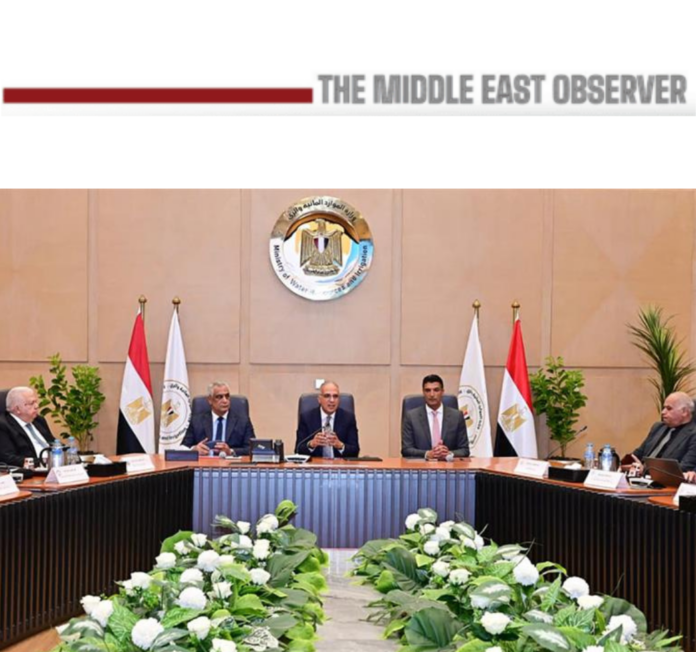
The country faces an annual water deficit of about 23.2bn cubic metres, according to Water Resources and Irrigation Minister Hani Sewilam. In August, the ministries responsible for irrigation, industry and military production agreed to develop an integrated framework embedding water efficiency into industrial planning, including project-site selection, water-demand assessments, treatment and recycling requirements, and mechanisms for licensing and compliance.
The initiative builds on plans to introduce water-footprint standards assessing consumption alongside economic value added. That raises a more consequential question than how much water Egyptian industry consumes: how much economic value does it generate from every cubic metre?
From Wastewater to Industrial Input
For manufacturers, water is more than a utility bill. It must often be pumped, heated, cooled, filtered and treated. Inefficient consumption can therefore increase both water and energy costs.
Egypt’s environmental framework already encourages factories to reduce consumption, treat industrial wastewater and reuse it in production, including zero-liquid-discharge systems where technically and economically feasible.
Sika Egypt provides a practical example. The construction-materials group says a zero-liquid-discharge wastewater system at its Egyptian operations reduced annual admixture liquid waste from 1,700 cubic metres to 170 cubic metres, while recycling wash water into production saves about 1,500 cubic metres of distilled water each year.
The volumes are modest against Egypt’s national requirements, but the principle is significant: wastewater can become a production input rather than simply an environmental liability.
The economics could become more compelling at the level of industrial zones. Shared treatment and recycling infrastructure can spread costs across multiple manufacturers while reducing dependence on freshwater. Future industrial zones could therefore increasingly be designed around water productivity, alongside electricity, logistics and market access.
The Economics Will Decide
Technology alone will not determine whether this transition succeeds. Expanding wastewater reuse requires viable pricing, regulation and financing as well as treatment infrastructure.
Nor is maximum recycling automatically economically efficient. Advanced treatment requires capital, while technologies such as zero-liquid discharge can carry significant energy costs.
The relevant measure is therefore not simply how little water a factory consumes. It is the economic value generated per unit of water after accounting for the cost of achieving that efficiency.
That calculation is increasingly relevant to factory location. Where reliable water supplies are constrained, manufacturers may have to weigh access to water and recycling infrastructure alongside land, electricity, transport and labour when selecting sites.
For policymakers, the calculation runs in the opposite direction: scarce water raises the question of which industries generate the greatest economic return from the resource.
If water-footprint standards become more deeply embedded in investment planning, industries generating greater exports, employment, technological content or domestic value added from scarce water resources could become relatively more attractive. Water-intensive production generating comparatively little economic value could face greater scrutiny.
The government’s emerging framework does not yet amount to a fully implemented national system determining industrial investment according to water intensity. But its direction is significant. If extended into broader investment policy, water productivity could influence what Egypt manufactures, where factories are built and which industrial investments make economic sense.
For decades, industrial competitiveness has largely been judged by labour costs, energy, logistics, land and market access. In an increasingly water-stressed economy, another variable is entering the calculation.
Egypt cannot manufacture more freshwater. But it can generate more economic value from the water it already has.
Its next industrial advantage may therefore not come from having more water than its competitors. It may come from learning how to need less.
Related news:
Water Innovation Becomes Agriculture’s New Competitive Advantage
Egypt Expands Water Partnership with South Sudan Through 28 Solar-Powered Groundwater Stations
Read also:
Africa’s Cybercrime Losses Rise 152% as AI Expands Criminal Reach
Ezz Elarab Elsewedy, Chery Deepen Egypt Manufacturing Push with EGP5bn Investment