China’s first regular Arctic container service could cut weeks from some Asia-Europe journeys, but its larger significance lies in testing whether geopolitical risk has made companies willing to pay more for alternative trade routes.
A Chinese container ship has left Ningbo for Britain on the first regular commercial service through Russia’s Arctic waters, as Beijing tests whether a seasonal shortcut can become a viable alternative for selected Asia-Europe trade.
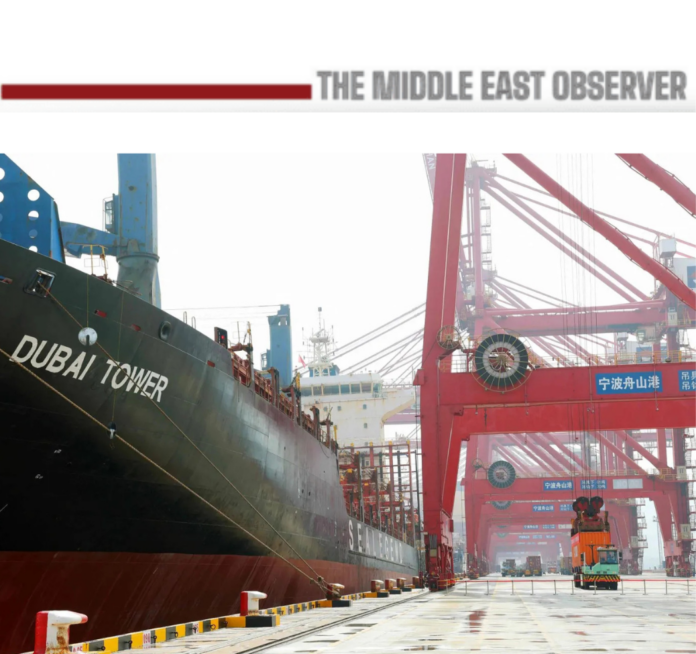
Sea Legend Shipping plans eight sailings during the 2026 Arctic navigation season. Its inaugural Dubai Tower, with capacity of about 1,740 twenty-foot equivalent units (TEU), departed Ningbo for Felixstowe in August, following a trial voyage last year that completed the journey in about 20 days.
The service marks a step beyond experimental Arctic container voyages. But its significance lies less in present volumes, which remain negligible beside established shipping corridors, than in whether the Northern Sea Route (NSR) can develop into a commercially credible additional link between Chinese manufacturing centres and European markets.
Shorter Does Not Mean Cheaper
The NSR’s geographic advantage is obvious. Its economic advantage is not.
Sea Legend is targeting transit times of roughly 20 days between China and northern Europe, potentially cutting weeks from some conventional services. That can benefit higher-value or time-sensitive cargoes: lithium batteries, photovoltaic equipment and other Chinese manufactured goods have already travelled along the route.
Shorter journeys can reduce fuel consumption and working capital tied up in inventories at sea. But distance is only one component of freight economics.
Arctic operations can require ice-class vessels, specialist crews and, depending on conditions, Russian icebreaker support. Insurance is more expensive, emergency and repair infrastructure is limited, and the navigation season remains constrained by ice and unpredictable weather.
Scale is another disadvantage. At about 1,740 TEU, the Dubai Tower carries only a fraction of the containers transported by the largest vessels serving established Asia-Europe routes.
Nor is container shipping simply a race between two endpoints. Conventional services generate revenue by collecting and discharging cargo across networks of intermediate ports and transshipment hubs. The sparsely populated Arctic offers few comparable markets along the way.
The commercial equation is therefore considerably more complicated than the shorter distance suggests: the Arctic can be substantially faster without necessarily being cheaper.
China Diversifies Its Dependencies
The strategic case may prove more compelling.
China’s trade and energy flows remain exposed to several maritime chokepoints. Conflict around the Middle East has again demonstrated how quickly disruption can affect shipping schedules, insurance premiums, energy prices and supply chains.
The Strait of Hormuz is principally an energy artery rather than a China-Europe container route, meaning the Arctic passage is not a direct substitute. For container trade with Europe, instability around Bab al-Mandeb and the Red Sea — and the resulting diversion around the Cape of Good Hope — is more directly relevant.
The NSR nevertheless fits Beijing’s wider effort to build alternatives around vulnerable trade arteries.
But it does not eliminate geopolitical dependence. It changes its geography.
Most of the route follows Russia’s Arctic coastline, leaving large-scale commercial use dependent on Russian regulation, ports, navigation services and icebreaker capabilities.
Moscow has its own incentive to expand the corridor as Western sanctions accelerate its economic pivot towards Asia. Seven Russian crude cargoes carrying about 6mn barrels were already heading east through the NSR by early August, according to Reuters, nearly half the volume transported over the route during the whole 2025 navigation season. China remains the principal destination.
The partnership is mutually useful: Russia gains Asian demand and greater utilisation of its Arctic infrastructure, while China gains another connection to markets and Russian resources.
The strategic trade-off is equally clear. China can reduce its exposure to some traditional maritime chokepoints only by increasing its reliance on a corridor largely controlled by Russia.
Beijing is not eliminating geopolitical dependency. It is diversifying it.
The Suez Question
For Egypt, the distinction between diversification and displacement is crucial.
The Northern Sea Route remains nowhere close to challenging the scale of the Suez Canal. Arctic transit traffic is still measured in only dozens of voyages, while Suez in normal conditions sits at the centre of a global maritime network carrying containerised goods, energy and bulk commodities between multiple regions.
The comparison is therefore not one-for-one: Suez is a global maritime system; the Northern Sea Route remains a seasonal niche corridor.
The challenge to Suez is not displacement but diversification.
Repeated disruptions — from the pandemic and the Ever Given blockage to Red Sea insecurity and wider Middle East conflict — have demonstrated the financial consequences of dependence on individual transport arteries. Shipping companies increasingly have alternatives: Suez, the Cape of Good Hope, Eurasian land corridors and, for selected cargoes during part of the year, the Arctic.
The Arctic’s importance for Egypt therefore lies less in the traffic it might divert today than in what it says about how shipping companies increasingly price resilience.
Suez also competes as part of a maritime network rather than simply as a passage between China and northern Europe. Its economic proposition includes Mediterranean and Red Sea ports, transshipment, regional market access and a growing ecosystem of logistics, bunkering, ship repair and industry around the Suez Canal Economic Zone — advantages a largely point-to-point Arctic service cannot readily replicate.
That shifts the competitive question for Egypt from geography alone towards the quality of the platform built around it.
Reliability, security, competitive transit costs and turnaround times will remain important. But expanding logistics, maritime services and industrial capacity around the canal can increase the economic value captured from each ship and cargo flow, reducing dependence on transit fees alone.
The Arctic does not remove Egypt’s geographic advantage. It strengthens the case for turning that geography into a deeper logistics and industrial advantage.
The Economics of Redundancy
The route carries an environmental contradiction. Arctic warming is reducing sea ice and potentially extending navigation seasons, improving prospects for shipping while increasing risks to one of the world’s most fragile ecosystems. Shorter voyages may save fuel compared with long diversions around Africa, but spills, accidents and black-carbon emissions are particularly difficult to manage in remote Arctic waters.
Those constraints reinforce why predictions of an imminent transformation of global shipping remain premature.
What is changing more clearly is the economic value attached to alternatives.
For decades, supply chains were optimised primarily for efficiency: low freight costs, predictable schedules and lean inventories. Pandemic disruption, wars, sanctions and repeated interruptions to shipping have made resilience another part of the calculation.
The Northern Sea Route does not need to replace Suez to have strategic value. It needs only to provide a credible additional option for selected cargoes when established corridors become congested, expensive or insecure.
That distinction also defines the challenge for existing gateways. The competition ahead is unlikely to be decided simply by which line on the map is shortest. It will increasingly depend on which transport networks can combine efficiency with reliability when geopolitical conditions deteriorate.
China is testing whether a more diversified trade network can make disruption at any single maritime choke point less damaging.
For global shipping, the emerging question is no longer only which route is shortest, but how much customers are prepared to pay for resilience.
Related news:
Iran War Costs Global Companies Over $25 Billion as Energy and Shipping Pressures Intensify
Saudi Arabia Seeks Multinational Maritime Coalition to Protect Red Sea Shipping
Read also:
Egypt Launches Saqqara Infrastructure Upgrade to Expand Cultural Tourism
Egypt Prepares to Launch Its First Virtual Hospital in Ismailia