Egyptian equities fall for a second session after Sunday’s strong advance; weaker breadth shifts attention from headline foreign flows to the durability of the August rally
CAIRO — Egyptian equities extended their retreat on Tuesday, with losses spreading beyond large caps to the broader market even as reported non-Arab foreign buying remained unusually strong.
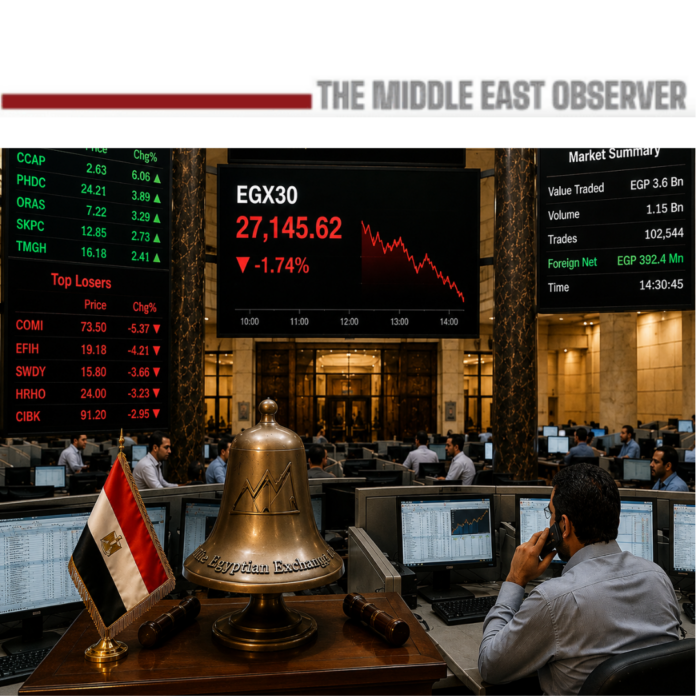
The EGX30 fell 0.25% on August 18 to 55,276.78 points, following Monday’s 0.79% decline. The EGX33 Shariah Index lost 0.45% to 6,606.93, while the EGX35-LV slipped 0.18% to 6,869.81. Official exchange data confirm the Shariah index close, while market data corroborate the EGX30 level.
Unlike Monday, when smaller stocks advanced despite benchmark weakness, Tuesday’s selling was broad. The EGX70 Equal Weight Index declined 0.48% to 21,667.02, while the EGX100 fell 0.54% to 27,953.58.
Decliners also comfortably outnumbered advancers, reinforcing evidence that selling had spread beyond the largest companies.
Market capitalisation nevertheless edged about EGP3.9bn higher to EGP 4.292 tn, according to the supplied session data. The divergence reflects differences between index composition and the wider universe of listed securities rather than a positive overall session.
From Rotation to Broader Consolidation
The distinction between Monday and Tuesday is important.
On Monday, the EGX30 fell 0.79% while the EGX70 rose 0.63%, suggesting profit-taking was concentrated among larger companies. Tuesday removed that cushion as all the principal indices declined.
The magnitude of the pullback nevertheless remains contained. The EGX30 has surrendered roughly 1% from Sunday’s close, leaving it close to Thursday’s 55,251.59 level. The benchmark also remains within about 1.5% of its August all-time high of 56,101.69.
The first three sessions are therefore better characterised as consolidation after a rapid advance rather than, so far, a reversal of the broader trend. But Tuesday’s weaker breadth raises the test for the rally: support beneath the benchmark is becoming less uniform.
Foreign Buying Remains Large — but Requires Context
According to the supplied session flow data, non-Arab foreign investors recorded net purchases of approximately EGP10.68bn on Tuesday, while Egyptian and Arab investors were net sellers of EGP6.57bn and EGP4.11bn respectively.
That followed Monday’s reported EGP13.27bn of foreign net purchases, taking the reported two-session figure to almost EGP24bn.
The scale deserves attention, but it should not automatically be interpreted as a comparably sized directional allocation by international portfolio managers. Monday included a EGP2.46bn CIB block trade, while large negotiated and transaction-specific trades can materially influence aggregate flow statistics.
Tuesday nevertheless provides further evidence of substantial foreign participation. Yet the fact that all major indices fell despite EGP10.68bn of reported foreign net buying makes the composition of those flows as important as their headline size.
Three Sessions Show Changing Leadership
The week has produced three contrasting sessions.
On Sunday, the EGX30 rose 1.09%, substantially outperforming the EGX70’s 0.21% gain. Monday reversed that relationship, with the EGX30 down 0.79% and the EGX70 up 0.63%. Tuesday brought losses across both.
The progression — blue-chip leadership, rotation into smaller stocks, then broader consolidation — suggests the immediate question has shifted from which part of the market will lead the rally to whether earnings and liquidity can sustain current price levels.
The broader backdrop remains positive despite the pullback. Egyptian equities were still up about 3% over the seven days through August 18, although performance varied substantially by sector.
Individual Stocks Remain Volatile
Sharp single-stock moves persisted despite the broader decline.
North Cairo Flour Mills gained 20% to EGP229.62, while Lotus for Agricultural Investments and Development and Cairo Educational Services rose almost as much. Wadi Kom Ombo Land Reclamation, by contrast, dropped 9.46%.
The dispersion shows how headline indices can mask substantial volatility among smaller securities, increasing the importance of liquidity, free float and company fundamentals when assessing whether individual gains are sustainable.
The Bigger Test Is Market Depth
Tuesday’s consolidation comes as Egypt seeks to translate a larger stock market into a deeper one.
September’s EGX30 reshuffle and prospective state offerings could generate benchmark-driven flows and add investable supply, but their longer-term significance will depend on whether they broaden institutional participation rather than simply redistribute existing liquidity.
That distinction matters for a market approaching EGP4.3tn in capitalisation. Higher market values alone do not necessarily translate into greater market depth; additional free float, liquid large-cap listings and broader institutional participation are needed to turn appreciation into durable capital formation.
A roughly 1% retreat from Sunday’s level remains modest, but Tuesday’s weaker breadth raises the test for the rally. The immediate question is whether earnings and liquidity can stabilise prices after August’s rapid advance; the longer-term challenge is whether Egypt can convert higher market values into deeper institutional participation, new investable supply and durable capital formation.
Related news:
DBS Expansion Intensifies Race for Wealth Seeking a Second Safe Haven
Egypt Is Undergoing a Structural Transformation in How It Generates Foreign Exchange
Read also:
EGX30 Rallies Following CIB Results as Foreign Equity Buying Contrasts with Debt Outflows
Egypt Builds a New Investment Architecture as Africa’s Top FDI Destination