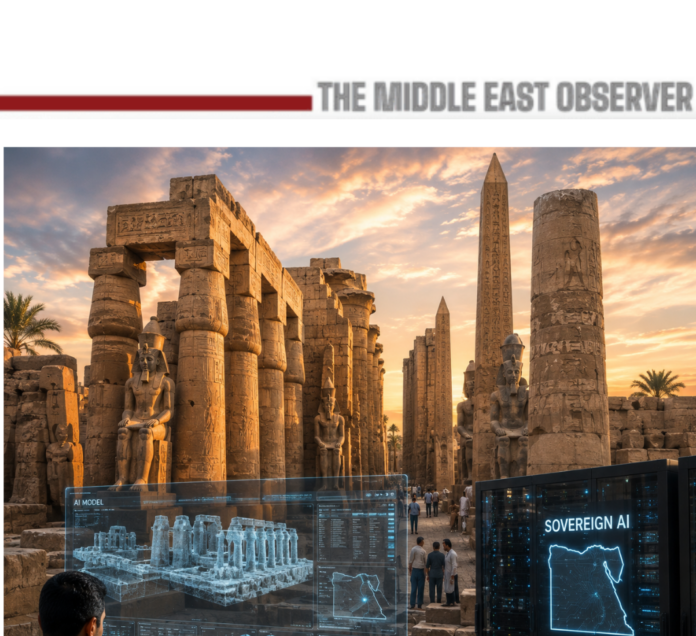
Egypt has launched an Arabic-focused national language model as part of its drive for AI sovereignty. The harder test is whether greater control over models, data and deployment can translate into productivity, companies and exports.
Egypt wants Karnak to reduce its dependence on foreign artificial intelligence. Yet the national model itself is built on foreign architecture — exposing both the logic and the limits of sovereign AI.
Unveiled on February 11, Karnak sits within Egypt’s 2025–2030 National AI Strategy, which calls for national foundation models alongside stronger computing infrastructure, data governance, Arabic datasets and domestic talent.
The publicly released Karnak-40B, developed by the Applied Innovation Center and available through its Hugging Face repository, is an approximately 40bn-parameter Arabic-English model built on Alibaba’s Qwen3-30B-A3B-Instruct architecture. Egyptian developers extended and further trained the model, including for Arabic capabilities.
Sovereign AI, in other words, is not the same as technological self-sufficiency. Karnak represents an attempt to control more of the AI layer between global foundational technology and Egyptian users rather than to build the entire technology stack domestically.
From Model to Infrastructure
Egypt is already turning that strategy into applications.
The government says SIA, a personalised tutor supporting Arabic and Egyptian history education, and a legal and regulatory assistant are powered by Karnak.
Egypt has also presented AcQua, a system designed to analyse interactions with the Digital Egypt call centre, alongside Torgoman for specialised translation, BelMasry for colloquial Arabic and locally trained healthcare systems supporting the detection of diabetic retinopathy, macular oedema and breast cancer.
Not all these systems have been publicly identified as Karnak-powered. Agriculture is also a priority under Egypt’s AI strategy, but there is not yet a similarly documented Karnak-branded deployment. That makes the sector a useful test of whether sovereign AI can generate value beyond ministries and technology showcases.
Egypt has demonstrated that it can develop and adapt AI systems around local requirements. It has yet to demonstrate that they can operate reliably across the economy at national scale.
Karnak Versus Jais
The regional comparison is the UAE’s Jais 2, developed by Inception, Mohamed bin Zayed University of Artificial Intelligence and Cerebras.
Jais 2 includes 8bn- and 70bn-parameter models, with the larger model trained from scratch and designed around Arabic language and cultural knowledge. Karnak takes a different route, adapting an existing architecture for locally relevant Arabic-English applications, with an emphasis on government and specialised use cases.
The comparison should not be reduced to which model wins a benchmark.
Nor does Karnak need to outperform the largest systems from OpenAI, Google or other frontier developers. The more important economic question is whether locally controlled AI can compete where language, regulation, workflow, cost, institutional knowledge and data sovereignty matter more than raw model capability.
Where Sovereign AI Could Win
Local deployment offers structural advantages in data control, customisation and regulatory alignment. What remains unproven is whether those advantages can outweigh the performance, convenience and economies of scale offered by frontier systems.
For Egyptian organisations, locally adapted AI could offer particular value in Egyptian Arabic, specialist terminology and Arabic-English code-switching. Banks, hospitals, government agencies and companies could also retain greater control over sensitive information and customise models around proprietary data.
The commercial proposition ultimately comes down to performance and cost: whether local models can reduce dependence on foreign APIs and pricing while remaining good enough for specialized tasks.
Local models can reduce dependence on foreign software platforms, but they cannot eliminate exposure to global hardware supply chains.
A sustainable AI industry requires not only model sovereignty, but data and compute sovereignty — control over the information used by models and sufficient computing infrastructure to train, fine-tune and operate them.
Compute may prove the harder constraint. Like most countries outside the leading technology powers, Egypt remains dependent on imported advanced processors and international technology supply chains. The practical objective is therefore greater control over strategically important parts of the stack, not technological autarky.
The Scaling Problem
Potential advantages are not the same as successful deployment.
Public evidence of Karnak’s performance at scale remains limited. Egypt has not disclosed government-wide adoption or operating costs, while independent Egyptian-dialect evaluations and large-scale evidence of factual reliability remain scarce.
Healthcare AI faces a higher evidentiary threshold: benchmark accuracy cannot be equated with better patient outcomes without appropriate clinical validation and regulatory approval where required. Agriculture likewise remains more visible as a strategic priority than as a documented Karnak deployment producing measurable results.
Scaling a national platform also requires continuously maintained data, retrieval systems capable of grounding responses in authoritative sources, and evaluation frameworks designed for Egyptian conditions — from regional dialects and Arabic-English code-switching to noisy call-centre audio and differing levels of digital literacy.
These are the tests separating a successful demonstration from dependable national infrastructure.
The Industrial-Policy Test
Egypt already has an economic base from which to pursue that ambition. Digital exports reached $4.8bn in 2025, double their 2022 level, while more than 240 offshoring companies operate in the country. Egypt is now seeking to move further up the technology value chain into AI-enabled services, software development, engineering R&D and semiconductor design.
That makes Karnak potentially relevant to an existing export industry rather than simply a standalone government technology project.
Egypt’s AI strategy targets 30,000 AI specialists and more than 250 successful AI companies by 2030, while seeking to raise the ICT sector’s contribution to GDP to 7.7%.
Those are better measures of success than model size.
Karnak becomes industrial policy if it lowers development costs for Egyptian companies, builds Arabic datasets and engineering expertise, raises public-sector productivity and produces exportable applications across Arabic-speaking and African markets.
The opportunity cost matters. Capital and scarce engineering talent devoted to a national model could instead support cloud infrastructure, cybersecurity, digital public services or specialised private-sector AI. The policy test is therefore not simply whether Karnak creates value, but whether the ecosystem around it generates sufficient returns on those resources.
Procurement will provide another test: whether ministries and regulated industries adopt locally controlled AI because it is demonstrably cheaper, safer or better suited to their requirements — rather than simply because it carries a national label.
Can Egypt Build Sovereign AI?
If sovereignty means building every layer of AI technology independently, Karnak does not yet meet that test.
If it means controlling how models are adapted and deployed, where sensitive data are processed and how AI is integrated into strategically important services, Egypt has taken a credible step.
The verdict will not come from another benchmark.
It will come from ministries deploying locally controlled AI at scale; independent evaluations demonstrating reliable performance in Egyptian Arabic; hospitals establishing clinically validated outcomes; businesses recording productivity gains; and Egyptian developers exporting applications built around the country’s AI capabilities.
Karnak shows that Egypt can build part of the AI stack. Whether it becomes sovereign infrastructure will depend not on owning a model, but on the capabilities, companies and measurable economic outcomes built around it.
Related news:
Why Global Pharmaceutical Companies Continue Expanding Manufacturing Across MENA
Britain bets on AI to get through its economic challenges
Read also:
El-Sisi Advances Debt-for-Development Vision for Africa’s Economic Future
Artificial Intelligence Is Reshaping Healthcare Across Egypt and the Middle East