The agreement will put Israeli missile-defence technology at the centre of Greece’s military modernisation while Athens seeks to direct roughly €750mn of programme activity towards domestic industry.
Greece and Israel have signed a €3.035 billion agreement to build an integrated national air- and missile-defence network, placing Rafael Advanced Defense Systems and Israel Aerospace Industries at the centre of one of Athens’ largest military modernisation programmes while directing roughly a quarter of the programme towards Greek industry.
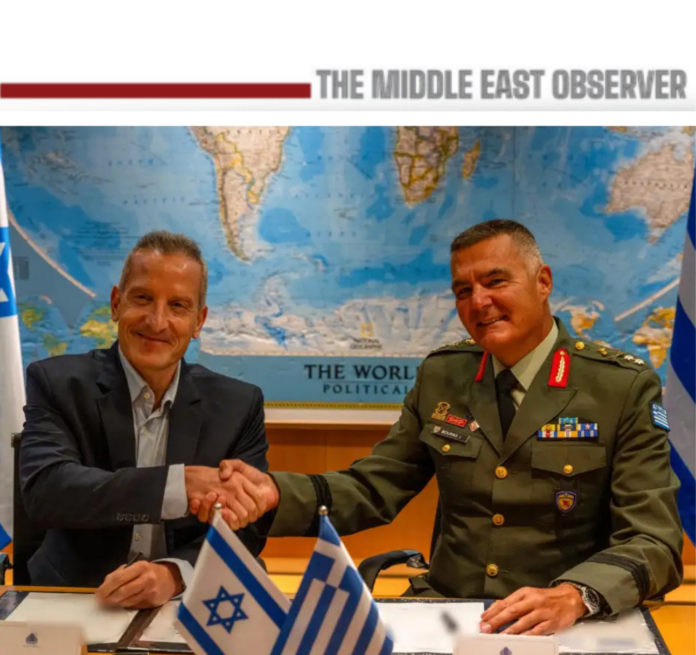
The government-to-government agreement, signed in Tel Aviv on August 31, moves Greece’s Achilles Shield programme into implementation. Israel’s Defence Ministry described it as the largest defence export agreement in Greek-Israeli relations and one of the largest concluded by Israel.
The economic and strategic significance goes beyond the contract value. Greece is not buying a single missile battery. It is seeking to replace a fragmented collection of air-defence assets with a network linking radars, interceptors and command systems against threats ranging from aircraft and drones to cruise and ballistic missiles.
Israeli systems form the new defensive core
The package combines several of Israel’s leading defence platforms.
Rafael will supply David’s Sling, the SPYDER air-defence system and a national command-and-control platform, while Israel Aerospace Industries will provide the BARAK MX family and ELTA MMR multi-mission radars.
A supplementary €26 million agreement was also signed for Rafael’s Drone Dome counter-UAV system. Public announcements do not specify whether that amount is included within Greece’s stated €3.035 billion programme budget.
The Israeli Defence Ministry described the agreement as the first time Israel would provide an overseas customer with a defensive array combining systems across such a broad spectrum.
The command-and-control layer may ultimately prove as important as the missiles themselves.
Rather than operating different batteries largely as independent assets, Athens wants sensors and weapons connected through a common architecture capable of identifying threats, sharing targeting information and allocating the most appropriate defensive system.
Greek Defence Minister Nikos Dendias has described that shift as moving away from an “aggregate of weapons systems” towards network-centric defence connecting ground forces, ships, aircraft, autonomous systems and other sensors.
That makes Achilles Shield primarily an integration and command architecture programme, with missile systems forming its principal defensive tools.
The publicly announced package includes David’s Sling, SPYDER and BARAK MX. It does not include Israel’s Iron Dome or Arrow systems, despite some descriptions of the Greek programme as an Israeli-style “Iron Dome”.
IAI advertises BARAK MX interceptor variants with engagement ranges extending from about 15 kilometres to 150 kilometres, depending on configuration. Neither government, however, has disclosed which variants Greece has ordered, the number of batteries or interceptor inventories.
Published system capability should therefore not be treated as the precise configuration Athens will receive.
Part of a much larger Greek military overhaul
The Israeli contract forms a central part of Greece’s wider Agenda 2030 defence transformation.
Athens plans roughly €28 billion of military modernisation through 2036, encompassing F-35 combat aircraft, naval platforms, upgrades to existing aircraft and ships, drones and other military technologies.
Greece currently operates a mixture of Western and Russian-origin air-defence equipment, including U.S.-built Patriot batteries and ageing S-300 systems.
Achilles Shield is intended to create a digital defensive architecture across that increasingly diverse force.
Dendias has framed the broader concept across five military domains — land, sea, air, cyberspace and space — meaning the €3.035 billion Israeli agreement should be regarded as the air- and missile-defence core of a larger military network rather than the entirety of Achilles Shield.
When parliament approved the procurement in July, Dendias said deliveries would occur progressively and that the system should become fully operational within about 35 months.
If maintained following the August contract signature, that would put full operational capability around mid-2029.
Athens seeks €750mn industrial return
The deal also represents an attempt by Greece to change the economics of its defence procurement.
The Greek Defence Ministry says 19 Greek companies are already participating and puts domestic industrial involvement at roughly a quarter of the programme, or about €750 million.
Athens says the arrangements envisage manufacturing capacity in Greece with the potential to support future exports. Israel has also confirmed that the programme includes knowledge and technology transfer to Greek industry.
The precise allocation of the €750 million remains undisclosed.
That distinction matters economically. Domestic production of software, electronics, sensors and sophisticated subsystems could create significantly more lasting industrial value than assembly, construction or lower-value manufacturing.
The eventual success of the localisation policy should therefore be measured not only by how much spending stays in Greece, but by what Greek companies learn and produce.
Dendias has repeatedly argued that Greece should move away from being a passive importer of defence equipment. His procurement policy has emphasised domestic participation, technology transfer and access to source code, particularly for command-and-control systems.
Neither government’s public statement on the Achilles Shield agreement specifies the extent of intellectual-property or source-code rights Greece ultimately secured.
That will be an important test of whether Athens is merely purchasing Israeli technology or acquiring the capability to modify, maintain and develop parts of the architecture independently.
Greece-Israel ties move beyond individual arms sales
Achilles Shield also marks another step in a rapidly deepening defence relationship.
In April, Greece signed a separate approximately €650 million ($750 million) agreement for Elbit Systems’ PULS precision rocket-artillery system.
Elbit said that contract included launchers, precision-guided rockets, training ammunition and loitering munitions, with deliveries spread over four years followed by a decade of support.
Together, the PULS and Achilles Shield agreements represent roughly €3.7 billion of major Israeli defence contracts with Greece in 2026, before smaller systems and support arrangements are included.
The relationship already extends to an Israeli-supported military flight-training centre in Greece, joint exercises, cybersecurity and counter-drone cooperation.
The pattern increasingly resembles a systems-level defence partnership rather than a conventional buyer-supplier relationship.
Israel is providing not only weapons but important elements of the sensor, command and digital infrastructure through which Greece intends to operate its future military.
A major European foothold for Israel
The agreement comes as Israel’s defence-export industry expands rapidly.
Israeli defence exports reached a record $19.2 billion in 2025, almost 30% higher than a year earlier and more than double their level five years previously, according to Israel’s Defence Ministry.
Missiles, rockets and air-defence systems accounted for 29% of total deal volume, while Europe represented 36% of exports.
Achilles Shield reinforces both trends.
It gives Rafael and IAI a major national reference programme inside both the European Union and NATO and demonstrates Israel’s ability to export an integrated defence architecture rather than individual missile batteries.
Rafael says Greece will become the second European customer for David’s Sling after Finland.
The deal is commercially significant for Rafael and IAI, although neither government has disclosed how the €3.035 billion contract is divided among Israeli suppliers, Greek companies, infrastructure, integration and support.
That prevents a reliable calculation of the eventual revenue or order-backlog contribution for either Israeli manufacturer.
For Israel’s defence industry more broadly, however, large government contracts provide greater production visibility and help justify additional manufacturing capacity. Israel’s Defence Ministry has also linked expanding exports to strengthening domestic production and military stockpiles.
Turkey remains a backdrop, not the stated purpose
Greece’s longstanding strategic rivalry with Turkey is an unavoidable element of the investment calculation.
Athens remains one of NATO’s biggest defence spenders relative to the size of its economy, while disagreements with Ankara over maritime boundaries, airspace and security interests in the Aegean and Eastern Mediterranean persist.
But reducing Achilles Shield to an anti-Turkey programme would miss the larger transformation in military risk.
The wars in Ukraine and the Middle East have demonstrated the disruptive potential of ballistic missiles, cruise missiles and relatively inexpensive attack drones against military installations, infrastructure and cities.
Greece officially presents Achilles Shield as its response to that wider threat environment.
Dendias has also argued that a stronger territorial defence network would allow Greece’s advanced aircraft and naval platforms to perform a broader deterrence role rather than concentrate disproportionately on defending national territory.
The execution test
Significant details nevertheless remain confidential.
Neither government has disclosed the number of David’s Sling, SPYDER or BARAK MX batteries ordered; interceptor inventories; detailed payment schedules; deployment locations; lifecycle-support costs; or the exact division of work between Rafael, IAI and Greek industry.
It is also unclear publicly how Greece’s existing Patriot and Russian-origin systems will eventually interact with the new command architecture or which legacy assets Athens intends to retire.
Those uncertainties shift attention from the signing ceremony towards execution.
Over the next three years, four questions will determine whether Achilles Shield delivers the strategic and economic transformation Athens is seeking: whether the programme remains on schedule; whether multiple systems can operate seamlessly through one command network; how much technological control Greece actually receives; and whether the promised €750 million industrial participation produces high-value domestic capability.
For Athens, the objective is to obtain more than missiles: an integrated national defence architecture and a stronger domestic technology base.
For Israel, the prize extends beyond a €3 billion order: a major EU and NATO showcase for its air-defence industry and a deeper strategic position in the Eastern Mediterranean.
If implementation matches those ambitions, Achilles Shield will mark a significant transition in Greece-Israel relations — from individual weapons purchases towards a long-term defence-industrial and technology partnership.
Related news:
Greece at 205: A Shared Legacy, A Strategic Future with Egypt
Greece’s Gas-Powered Shift: Balancing Economic Aspirations and Climate Commitments
Read also:
Egypt targets pharmaceutical raw materials after decade of manufacturing growth
Sudan Turns to Digital Procurement as War Erodes State Finances