

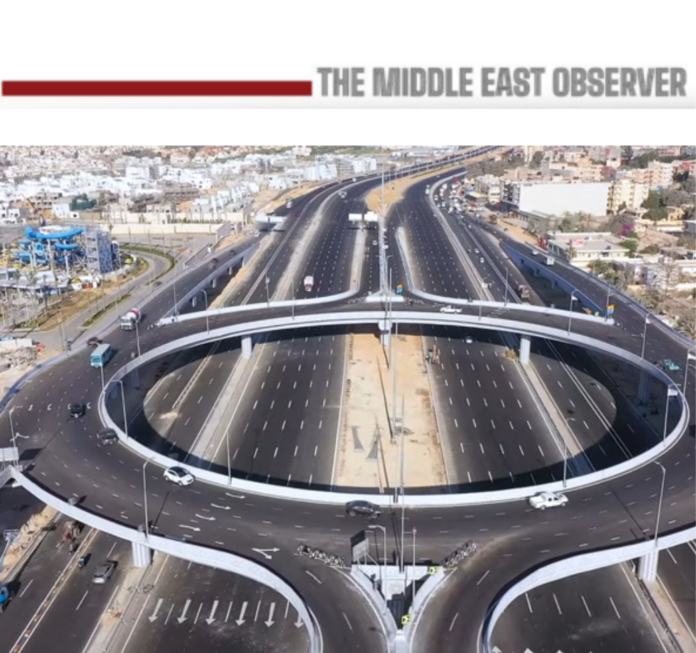
Egypt has largely solved the problem of reaching the North Coast. Its next infrastructure challenge is moving tourists, residents and workers safely and efficiently within it.
Egypt’s North Coast has undergone a structural transformation.
New Alamein, Ras El Hekma and the expanding chain of residential and tourism developments extending west towards Matrouh are turning the Alexandria–Matrouh road from a seasonal intercity highway into the transport spine of a growing urban and tourism economy.
Movement is increasingly taking place not only to the coast but within it — between homes, hotels, beaches, workplaces, hospitals, universities, restaurants and commercial centres.
The infrastructure challenge is therefore shifting from road capacity towards accessibility, public transport and pedestrian safety.
Egypt has invested heavily in widening and upgrading the coastal road, including major expansions around New Alamein. Those investments improved vehicle capacity and helped unlock large-scale real-estate and tourism development.
As development density increases, however, the transport requirement changes fundamentally: from moving cars between cities to moving people between increasingly interconnected urban nodes.
That transition will become more pronounced as the North Coast evolves from a series of largely seasonal resorts into a more permanent Mediterranean development corridor.
Tourism Growth Is Accelerating the Shift
North Coast tourism indicators point to continued expansion in 2026.
Industry estimates placed visitor trips at about 19mn during summer 2025, while operators entered the 2026 season expecting a higher total. Hotel occupancy strengthened during the early summer period, while Alamein International Airport recorded a more measurable expansion in traffic.
Passenger throughput reached about 120,000 between June and August 2026, up roughly 23% from the corresponding period of 2025, while flight movements increased by more than a fifth.
The rise in air traffic is particularly significant because it reflects the gradual expansion of the North Coast beyond a market dominated by domestic second-home owners and motorists arriving from Cairo and Alexandria.
As international connectivity expands, ground transport becomes an increasingly important part of the tourism infrastructure.
Alamein Airport can deliver visitors to the coast. The wider transport system must then connect them efficiently with hotels, residential compounds, restaurants, beaches and neighbouring developments.
The growth of aviation therefore increases the importance of the land-side tourism logistics network.
Road Design Must Follow Urbanisation
Rapid development has also intensified the interaction between high-speed traffic and pedestrian movement.
A cluster of pedestrian fatalities around Alamein this summer highlighted the risks created where residential, hospital, commercial and employment nodes sit on both sides of a high-capacity road.
The incidents occurred under different circumstances, but collectively point to a widening mismatch between the highway’s original transport function and the urban activity now developing around it.
The required response is not a uniform reduction in speed or the indiscriminate installation of traffic-calming measures.
Different sections of the corridor require different engineering treatments.
At major compound entrances, hospitals, hotels, universities and commercial centres, pedestrian demand should determine the location and design of crossings.
Urbanised sections could accommodate pedestrian-activated signals, illuminated crossings, advance warning systems and clearly defined reduced-speed approaches.
Service roads and lower-speed compound approaches may support raised crossings and other traffic-calming measures.
The principal high-speed carriageway requires more carefully engineered interventions. Depending on road geometry, traffic volume and design speed, appropriate measures could include signalised crossings, controlled speed-reduction zones or grade-separated pedestrian links.
The objective should be to align crossing infrastructure with actual pedestrian movement while preserving the principal road’s transport function.
The Missing Layer Is a Coastal Transport Network
Pedestrian infrastructure addresses only part of the emerging mobility gap.
The North Coast also requires a public-transport system structured around movement within the corridor.
Intercity coaches already connect Alexandria, Alamein and Matrouh. The missing layer is a predictable service linking major compounds, hotels, workplaces, hospitals, commercial centres and tourism destinations through designated stops.
A workable system could operate across three complementary tiers.
Express coaches could connect Alexandria, Borg El Arab, Alamein, El-Dabaa, Ras El Hekma and Matrouh, providing longer-distance services suitable for residents, workers and tourists.
A second tier of frequent corridor shuttles or midi-buses could serve shorter journeys between major developments and service clusters.
A third tier could connect Alamein International Airport directly with major resort zones, creating a scheduled alternative to private transfers.
Service frequency could rise during the peak summer season and operate at a lower year-round base as permanent population and employment expand.
Routes could be tendered to private operators under regulated concessions covering vehicle standards, safety, frequency, fares and passenger information.
Such a system would complement private-car use while widening mobility options for tourists, employees and residents.
Compound Gates Should Become Visitor Access Points
The effectiveness of such a network would depend as much on the design of the stops as on the buses themselves.
Major compound entrances could be developed as formal Visitor Access Points, combining off-road bus bays, sheltered and illuminated waiting areas, safe pedestrian connections and direct transfers to internal resort transport.
This would replace informal roadside boarding with controlled and recognisable mobility points.
For international tourists, the system could provide a seamless transition from airport arrival to final destination.
A passenger arriving at Alamein Airport could transfer to a scheduled coastal service, disembark at the designated access point for a development and continue directly into the compound without walking along or crossing the highway.
Within larger developments, electric resort shuttles, including golf-cart-style passenger vehicles, could provide the final connection between compound entrances, homes, hotels, beaches, marinas, restaurants and retail areas.
The resulting mobility chain would be straightforward:
Airport or city → coastal coach → compound Visitor Access Point → electric resort shuttle → final destination.
Transport Can Widen the Tourism Economy
Real-estate and tourism development inevitably generate additional transport demand.
Hotels create guest and employee journeys. Universities generate daily staff and student movement. Residential developments increase demand for retail, entertainment, maintenance and other services.
As density rises, transport becomes an increasingly important component of the economic infrastructure supporting those investments.
Improved mobility can broaden the number of destinations accessible to visitors and help distribute tourism spending beyond individual compounds.
Restaurants and entertainment venues can draw customers from neighbouring developments. Hotels become more accessible to visitors without private cars. Retail centres gain wider catchment areas. Employers can recruit from a larger labour pool.
The result is greater economic permeability between developments.
This is particularly relevant as the North Coast seeks to expand its international tourism base.
Foreign visitors are less likely than domestic second-home owners to arrive with private vehicles. Growth in European, Gulf and other international markets therefore increases the importance of reliable ground transport.
Alamein Airport’s rising passenger traffic demonstrates the expansion of the aviation gateway.
The associated ground-transport network must now develop at a similar pace.
Mobility Is Becoming an Investment Requirement
The North Coast has already attracted substantial real-estate and tourism capital.
The next investment layer is smaller in scale but increasingly important to the performance of those assets: bus fleets, formal stops, illuminated pedestrian crossings, passenger-information systems, internal electric shuttles and professionally designed access points.
These investments could also create commercial opportunities in fleet operation, mobility technology, charging infrastructure, maintenance, station services and tourism logistics.
Developers have a direct economic interest in the outcome.
A compound with reliable connections to Alamein Airport, neighbouring resorts, retail destinations and entertainment districts is more accessible to buyers, tenants and hotel guests and better positioned to support year-round use.
The North Coast’s first development cycle was built around access from Cairo and Alexandria.
Its next phase will depend increasingly on mobility within the coast itself.
A transport system that allows a visitor to land at Alamein, transfer to a scheduled coastal service, reach a compound through a formal access point and complete the final kilometre safely without a private car would represent a significant step in the region’s development.
It would also mark the transition from a chain of largely independent resorts towards a connected Mediterranean urban and tourism economy.
Related news:
From Resort to City: Can Egypt Build Year-Round Tourism Economies?
Egypt Eyes a Bigger Medical Tourism Market on Cost, Care and Tourism Strengths
Read also:
Telecom Egypt Adds Sinai Route to Its Global Data-Corridor Network
Beyond the Red Carpet: Venice Builds a Marketplace for the New Film Economy