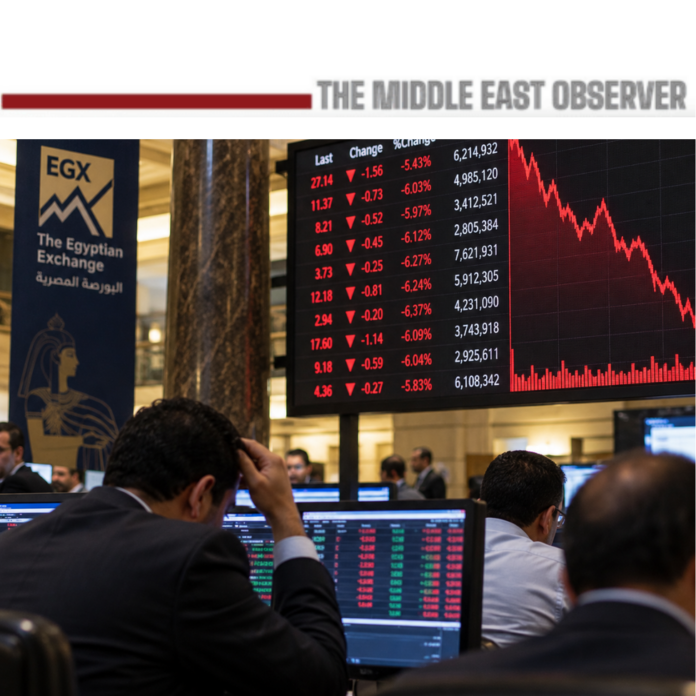
CAIRO — The Egyptian Exchange’s correction broadened sharply on Sunday, with nearly 86% of traded stocks declining and small- and mid-cap shares falling almost three times as much as the EGX30. Yet foreign institutional buying, a firmer pound and gains in the Treasury Bond Index suggest that stress remains concentrated in equities rather than spreading across Egyptian financial assets.
The EGX30 fell 1.39% to 53,031.69 points, extending the uninterrupted decline that began on Sept. 20. The benchmark has lost about 4.4% since the retreat began and nearly 7% from its September intraday peak, while still standing 26.8% higher in 2026.
The deeper deterioration was beneath the benchmark.
The EGX70 EWI plunged 3.87% to 19,067.23 — about 2.8 times the EGX30’s decline — while the EGX100 EWI fell 3.49% to 25,317.49. Of 221 traded shares, 190 declined, only 20 advanced and 11 were unchanged, leaving almost ten losers for every gainer.
The intensity was also reflected in 17 temporary trading suspensions following sharp moves in individual shares. The EGX Treasury Bond Index, by contrast, gained 0.18%.
Market capitalisation fell by about EGP 95.7bn to EGP 4.142tn.
Early Rally Fails
Sunday’s intraday reversal strengthened the negative signal.
The EGX30 rose as high as 54,278.64 before falling to 52,954.38 and closing at 53,031.69 — only about 77 points above its session low. Initial buying therefore failed to withstand selling pressure through the remainder of the session.
That contrasts with Thursday, when the benchmark recovered substantially from its intraday trough.
The implication is increasingly clear: large-cap resilience is weakening while selling pressure continues to spread through the wider market.
Breadth Worsens Without a Volume Surge
The breadth deterioration was not accompanied by unusually heavy trading.
Turnover fell to around EGP 7.7bn, down from EGP 10.2bn on Thursday and roughly one-third below its recent 90-day average. Published market data recorded about 1.8bn securities traded through 234,900 transactions.
That distinction matters.
Sunday produced widespread price weakness without the surge in activity normally associated with broad forced liquidation. The correction is therefore becoming more severe internally, but has not yet developed the volume characteristics of a market-wide liquidity event.
Foreign Institutions Buy Into Weakness
Investor flows provided an important counter-signal.
Foreign investors recorded net equity purchases of about EGP 172.9mn, while Egyptians sold roughly EGP 158mn and Arab investors EGP 14.9mn.
More significantly, published investor breakdowns show that foreign institutions accounted for around EGP 171.7mn of those purchases, with foreign individuals contributing only about EGP 1.2mn.
The scale is insufficient to establish a broad return of offshore equity appetite. But it shows foreign institutions were willing to buy into Sunday’s weakness rather than join the general sell-off.
That is a useful distinction after the substantial foreign institutional selling recorded during the previous week.
Equity Stress Remains Contained
Other Egyptian financial assets showed no corresponding deterioration.
The EGX Treasury Bond Index advanced 0.18%, while the pound strengthened modestly against the dollar from Thursday’s levels. Neither proves that investors have turned more positive on Egypt overall, but together they provide no evidence that the equity correction has developed into wider sovereign or currency-market stress.
The monetary backdrop nevertheless remains demanding for stocks.
The CBE’s decision Thursday to hold its deposit rate at 19% preserves the high-carry environment confronting equities. Recent Treasury-bill auctions cleared at accepted weighted-average yields of approximately 24.55%-25.77%, leaving government securities with a substantial opportunity-cost advantage over riskier listed shares.
Breadth, Not the EGX30, Is Now the Test
Sunday makes the next recovery test clearer.
An EGX30 rebound led by a handful of banks or heavyweight stocks would provide limited evidence that the correction has stabilised. A more convincing recovery would require the EGX70 and EGX100 to stabilise, advancing shares to recover relative to decliners, and stronger turnover to accompany rising rather than falling prices.
Institutional participation will also matter. Sunday’s foreign buying is constructive, but one session is insufficient to reverse the wider deterioration.
For now, the stress is concentrated inside equities rather than across Egyptian financial assets. The next credible recovery signal must therefore come from the equity market itself — and breadth should show it before the headline index does.
Related news:
EGX Correction Deepens as Offshore Debt Inflows Continue
NAZA Raises the Evidence — Will International Law Act?
Read also:
Small-Caps Push EGX Higher as Local Buying Broadens August Rally
Foreign Buying Gives Way to Domestic Buying as (EGX) Ends Week Higher