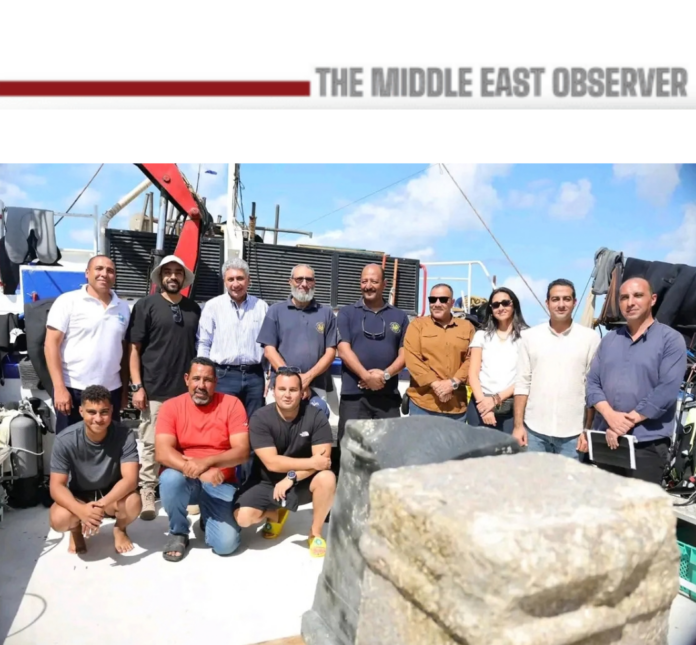
A small bronze seal ring discovered beneath Alexandria’s Eastern Harbour is offering new clues about how the city’s royal quarter may have continued to function after Egypt came under Roman rule.
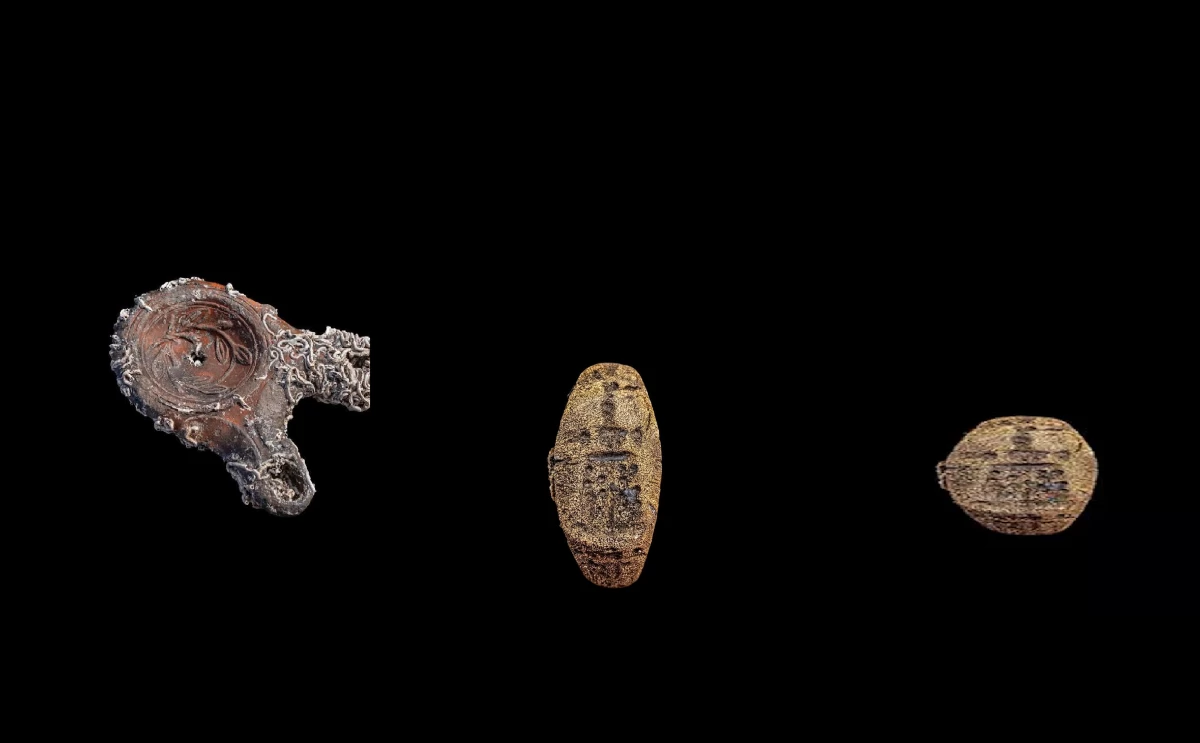
Found at the submerged royal island of Antirhodos, the ring carries an engraved image of the ancient Lighthouse of Alexandria, resembling representations of the monument found on coins dating to the second century AD.
The discovery is significant not only because it is the first known image of the lighthouse found engraved on a seal ring, but also because of what the object may reveal about the role of the royal complex centuries after the Ptolemaic era.
Egyptian archaeologists suggest that the find could indicate that parts of the Antirhodos palace remained in administrative use into the second century AD, potentially including activities connected with the management of the lighthouse.
The evidence does not establish who owned the ring or prove a direct link between its owner and lighthouse administration. But it adds another clue to the possibility that Alexandria’s royal harbour was adapted rather than simply abandoned under Roman rule.
A Lighthouse on a Seal
The lighthouse was one of Alexandria’s most important pieces of maritime infrastructure, helping ships navigate towards the city’s harbour from the nearby island of Pharos.
Its appearance on a seal therefore raises questions about the relationship between Alexandria’s maritime infrastructure and its administrative systems.
A seal could be used to authenticate documents, goods or official transactions. The lighthouse image may have carried institutional meaning, although researchers have not yet established whether it was specifically connected to harbour administration or served as a broader symbol of Alexandria.
Either way, the ring places one of the city’s defining maritime landmarks within the former royal quarter at a time when Roman Alexandria was already operating under a different political system.
From Royal Quarter to Roman Harbour
Antirhodos was part of Alexandria’s royal district, which included palaces, temples and harbour facilities and was closely connected to the political life of the Ptolemaic capital.
After Egypt became a Roman province in 30 BC, Alexandria remained a major Mediterranean centre.
The archaeological record from the Eastern Harbour reflects that transition. Pottery, glass vessels, amphorae, lamps and other objects discovered across the submerged sites span from the fourth century BC to the fourth century AD.
The current archaeological season is examining four areas: the Temple of Isis, the palace and western mound on Antirhodos, the remains of an obelisk, and the Timonium associated with Mark Antony.
Together, these remains suggest that the area remained active across successive political eras, even as its institutions and functions evolved.
Signs of Continued Maritime Activity
The ring is not the only recent discovery pointing to activity around Antirhodos during the Roman period.
Archaeologists have also identified the remains of a large vessel dating to the early Roman era. The surviving structure suggests an original length of around 35 metres and a width of about seven metres, although its exact function is still under study.
The vessel provides another indication that the waters surrounding the former royal quarter continued to be used after the Ptolemaic period.
The broader archaeological picture is therefore one of adaptation rather than a clear break: political authority changed, but Alexandria’s harbour remained central to the city’s life.
Reconstructing Alexandria Underwater
The discovery comes from a long-running underwater archaeological effort by the European Institute for Underwater Archaeology (IEASM) and Egypt’s Supreme Council of Antiquities.
The mission has worked in Alexandria’s Eastern Harbour since 1992, documenting submerged remains of the ancient Portus Magnus and the city’s royal quarter.
The work is gradually revealing how Alexandria changed across centuries of political transition.
The bronze ring adds a particularly small but revealing piece to that record. Its image connects the object to the city’s maritime identity, while its use as a seal points towards the administrative structures surrounding that infrastructure.
Its owner remains unknown, and the precise meaning of the lighthouse image remains open to interpretation.
But the discovery strengthens the case for viewing Roman Alexandria not as a city that simply moved beyond its Ptolemaic past, but as one that continued to adapt the institutions, buildings and maritime infrastructure it inherited.
Nearly two thousand years later, a bronze ring from the seabed is offering another glimpse into that transformation — from a royal harbour under the Ptolemies to a maritime and administrative centre operating under Rome.
Related news:
1,700-Year-Old Egypt Tomb Links Egyptian Rituals, Greek Poetry and Rome
Saqqara Tomb Reveals Official at Heart of Egypt’s Pyramid-Age State
Read also:
Algeria Starts Trans-Saharan Gas Link to European Export Network
Algeria Tenders Mobile Coverage for 3,000 Remote Communities