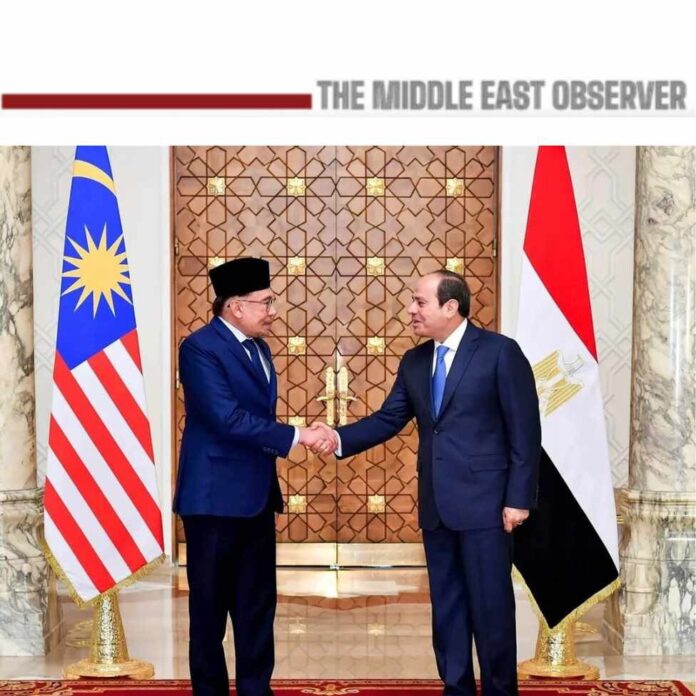
Egypt and Malaysia exchanged four memorandum of understanding covering investment, higher education, tourism and women’s empowerment during President Abdel Fattah El-Sisi’s two-day state visit to Kuala Lumpur on 9–10 October 2026. The agreements, witnessed by Malaysian Prime Minister Anwar Ibrahim, accompanied discussions on industrial manufacturing, technology, pharmaceuticals, energy and trade, as bilateral commerce surged 74.7% to $870 million in the first eight months of 2026.
The visit, El-Sisi’s first state visit to Malaysia since assuming office in 2014, followed his engagements in South Korea and preceded the Indonesian leg of his Asian tour. It also built on Anwar’s visit to Cairo in November 2024, as both governments sought to convert long standing diplomatic and educational ties into a broader economic partnership.
Strategic Partnership Moves onto the Agenda
El-Sisi’s official programme on 10 October began at Istana Negara, where King Sultan Ibrahim received the Egyptian president with a formal state ceremony and conferred upon him Malaysia’s highest state honour, the Order of the Crown of the Realm.
The president subsequently met Anwar at the Seri Perdana Complex in Putrajaya, where private discussions were followed by expanded talks involving both governments.
The leaders reviewed economic cooperation and regional developments while advancing discussions on elevating bilateral relations to a strategic partnership. The proposed upgrade would provide a broader institutional framework for trade, investment and sectoral cooperation.
Four Agreements Establish Cooperation Frameworks
The centrepiece of the economic programme was an investment cooperation memorandum between Egypt’s General Authority for Investment and Free Zones (GAFI) and the Malaysian Investment Development Authority (MIDA).
The agreement was exchanged by Egyptian Investment and Foreign Trade Minister Mohamed Farid Saleh and Malaysian Investment, Trade and Industry Minister Johari Abdul Ghani.
It establishes a framework for closer cooperation between the countries’ investment promotion authorities, potentially facilitating business contacts, project identification and the entry of Malaysian manufacturers into the Egyptian market.
The agreement is particularly relevant to Egypt’s ambitions to expand export-oriented manufacturing and attract investment capable of transferring technology, strengthening domestic supply chains and generating foreign-currency earnings.
Three additional agreements were exchanged by Egyptian Foreign Minister Badr Abdelatty with Malaysian counterparts.
The higher education agreement, exchanged with Higher Education Minister Zambry Abdul Kadir, provides a basis for closer academic cooperation, including potential university partnerships, research exchanges and specialised training.
A tourism cooperation memorandum, exchanged with Tourism, Arts and Culture Minister Tiong King Sing, establishes a channel for promoting tourism relations between Egypt and Malaysia, with potential benefits for cultural tourism, destination marketing and travel-industry partnerships.
The fourth agreement, exchanged with Women, Family and Community Development Minister Nancy Shukri, covers women’s empowerment and creates scope for cooperation on skills development, entrepreneurship and economic participation.
The four instruments constitute confirmed cooperation agreements. However, neither government disclosed binding project investment values, construction contracts or detailed implementation schedules associated with the signings.
Trade Growth Sharpens the Economic Case
The agreements come amid a substantial acceleration in bilateral merchandise trade.
According to figures released by Malaysia’s Ministry of Foreign Affairs, Egypt-Malaysia trade reached $870 million between January and August 2026, an increase of 74.7% from the corresponding period of 2025.
The eight-month total already exceeded the $720 million recorded throughout 2025, when Egypt exported approximately $120 million to Malaysia and imported $600 million.
Egypt’s commercial opportunities consequently extend beyond increasing merchandise exchange to attracting Malaysian manufacturers and securing greater participation in regional and international supply chains.
Electronics, Semiconductors and Pharmaceuticals Enter Focus
Industrial cooperation emerged as one of the most commercially significant elements of the summit.
At the joint press conference, Anwar identified semiconductors, electrical and electronic products, agriculture and pharmaceuticals among the sectors offering opportunities for closer cooperation.
Malaysia’s established electronics and semiconductor industries provide a potential source of manufacturing expertise, industrial partnerships and technical training for Egypt as it seeks to develop higher-value production.
For Malaysian companies, investment in Egyptian facilities could offer access to a sizable domestic market and export opportunities across the wider region, subject to the applicable trade rules and commercial requirements.
Pharmaceuticals presented a more immediate potential export opportunity.
Anwar indicated that Malaysia was exploring pharmaceutical sourcing from emerging economies, including BRICS countries, and identified Egypt as a possible supplier.
Such interest could open opportunities for Egyptian pharmaceutical manufacturers, particularly if followed by regulatory approvals, product registration and commercial procurement agreements.
El-Sisi also highlighted renewable energy, industrial production, electronics, agriculture and food processing as priority sectors for future cooperation.
Automotive Manufacturers Present Production Capabilities
Following the bilateral talks and joint press conference, El-Sisi inspected Proton Saga vehicles and motorcycles presented by Malaysian manufacturers Proton Holdings and Modenas.
Senior company executives briefed the Egyptian president on their manufacturing activities and products.
The presentation brought Malaysia’s automotive industry into the wider economic discussions and highlighted possibilities for future cooperation in vehicle distribution, assembly and component manufacturing.
Education, Aviation and Defence Broaden Cooperation
Beyond manufacturing, both leaders identified skills development and transportation as important components of the relationship.
Anwar emphasised the longstanding presence of Malaysian students at Egyptian institutions, particularly Al-Azhar, while advocating wider academic cooperation in engineering, medicine, artificial intelligence, digital technology and electronics.
El-Sisi expressed Egypt’s readiness to receive additional Malaysian students and religious educators, reflecting the continued educational and cultural importance of the relationship.
Improved aviation connectivity was another priority, with the Malaysian prime minister identifying more regular flights among the subjects requiring follow-up.
Additional services could support business travel, tourism and commercial exchanges, although no airline agreement, new route or timetable was announced.
Anwar also raised possible cooperation in defence procurement and joint training. These discussions broadened the potential relationship but were not accompanied by a disclosed defence contract or procurement commitment.
Regional Diplomacy and Economic Security
The summit also addressed developments in the Middle East, including Gaza, the Palestinian territories, the Red Sea, the Horn of Africa and tensions affecting the Strait of Hormuz.
Both leaders emphasised diplomatic solutions and de-escalation, while reaffirming support for a political settlement of the Palestinian question based on the two-state solution.
El-Sisi highlighted the need to maintain humanitarian assistance to Gaza and reiterated Egypt’s opposition to the forced displacement of Palestinians.
Anwar acknowledged Egypt’s role in facilitating Malaysian humanitarian assistance, including coordination concerning injured Palestinians.
The discussions reflected the intersection of economic and diplomatic interests, particularly as instability affecting energy markets and regional shipping routes continues to complicate international trade and investment.
Early 2027 Commission to Test Implementation
The summit concluded with an agreement to place the cooperation agenda before the Egypt-Malaysia Joint Commission, scheduled to meet during the first quarter of 2027.
According to the official statements issued by the Egyptian Presidency and the Malaysian Prime Minister’s Office on 10 October, the commission will provide a mechanism for pursuing agreements and examining further cooperation in trade, investment and transport connectivity.
This meeting will be particularly important because the summit’s industrial ambitions have yet to be translated into publicly identified capital commitments, manufacturing contracts or binding procurement agreements.
From Rising Trade to Industrial Investment
Egypt’s Malaysian initiative offers an opportunity to transform a rapidly expanding trading relationship into a more productive industrial partnership. The commercial potential is substantial: Malaysian expertise in electronics, semiconductors and advanced manufacturing could complement Egypt’s ambitions to expand industrial capacity, strengthen local suppliers and position itself as an export platform linking Asian production networks with African, Middle Eastern and European markets.
The four signed agreements establish a foundation, while prospective cooperation in pharmaceuticals, automotive components, renewable energy and food processing offers routes towards diversification. Yet the decisive opportunity is not simply to increase bilateral trade from its current level, but to change its composition through locally manufactured exports and investment that generates sustainable foreign-currency income.
The first-quarter 2027 Joint Commission will be the first major test of that ambition. If followed by committed Malaysian capital, industrial production, technology transfer and export contracts, the Kuala Lumpur summit could mark a substantive shift in Egypt-Malaysia economic relations—from a predominantly trading relationship towards a manufacturing and investment partnership.
Related news:
Egypt, Uzbekistan Explore Industrial Investment Zones to Boost Trade
Private Investment Takes the Lead in Egypt’s Economic Shift
Read also:
Egypt’s Open-Blocks System Draws 403 Offers in First Major Investor Test