Qatari business leaders call for manufacturing and private investment as energy disruptions expose the case for a wider industrial resilience strategy.
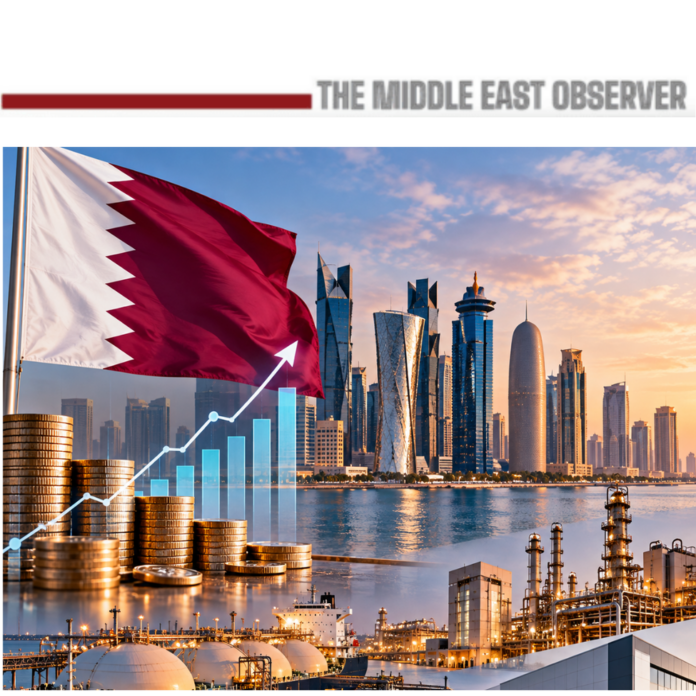
Qatar’s Emir Sheikh Tamim bin Hamad Al Thani has unveiled a QAR 221 billion ($60.7 billion) five-year portfolio of projects and investment opportunities, seeking to accelerate economic diversification as disrupted LNG exports expose the country’s dependence on energy revenues and international supply routes.
Addressing the Shura Council on October 13, the Emir said government revenues fell 42% in the first half of 2026, while expenditure declined 14%, following the closure of the Strait of Hormuz and damage to energy facilities at Ras Laffan. Fiscal reserves, lower public debt and spending discipline helped preserve essential services and development priorities, according to the Amiri Diwan.
The investment portfolio includes infrastructure, public-private partnerships, real estate and hospitality. The Emir called for legislation strengthening private-sector participation, more efficient public spending and institutional accountability. He also reaffirmed plans to expand North Field LNG production, alongside investment in petrochemicals, solar energy, water security and human capital.
Qatari business leaders have begun identifying how these ambitions could translate into productive investment.
Qatar Chamber Chairman Sheikh Khalifa bin Jassim Al Thani advocated stronger public-private partnerships, higher-value industries, support for domestic businesses and international commercial cooperation, according to The Peninsula. Businessman Ahmed Al Khalaf, speaking to Lusail, called for more factories, food industries, strategic-goods production and entrepreneurship to diversify both output and exports.
Their proposals reinforce an existing government priority. The Emir highlighted Qatar’s progress in food security, including agricultural production, storage, transport and waste reduction. Ministry of Municipality figures reported by The Peninsula on October 2 indicated near-total self-sufficiency in fresh milk and poultry, while acknowledging that climate and resource constraints make imports indispensable.
The next opportunity is to extend those achievements into a coordinated industrial strategy covering food processing, heavily imported essential consumer products and the technologies needed to manufacture them.
In the short term, investment could strengthen food processing, packaging, cold-chain logistics, strategic inventories and alternative import routes. Over the medium term, private capital and technology partnerships could support commercially viable manufacturing of household essentials, pharmaceuticals, medical supplies and selected consumer products.
Longer-term priorities could include automated manufacturing, advanced food technologies, water-efficient agriculture, research capabilities and export-oriented industries. Given Qatar’s relatively small domestic market, regional demand and competitive production costs would be essential to making such investments sustainable.
This would complement the country’s two immediate economic challenges: restoring LNG export earnings and developing a broader investment base capable of withstanding future energy and shipping disruptions.
The QAR 221 billion figure represents a pipeline of projects and opportunities, not entirely committed government expenditure. Its contribution to diversification will depend on financing, project selection and measurable commercial returns.
For Qatar, the measure of economic resilience will be not simply how much it invests, but how effectively those investments reduce strategic import vulnerabilities, develop competitive industries and generate sustainable income beyond LNG.
Related news:
Qatar’s LNG Wealth Delivered World-Class Living Standards. Now Comes the Productivity Test
Qatar Opens $60bn Investment Pipeline for Next Growth Phase
Read also:
Qatari Diar Revives Long-Delayed Red Sea Development
Suez Return Could Flip Container Shipping From Capacity Shortage to Surplus