
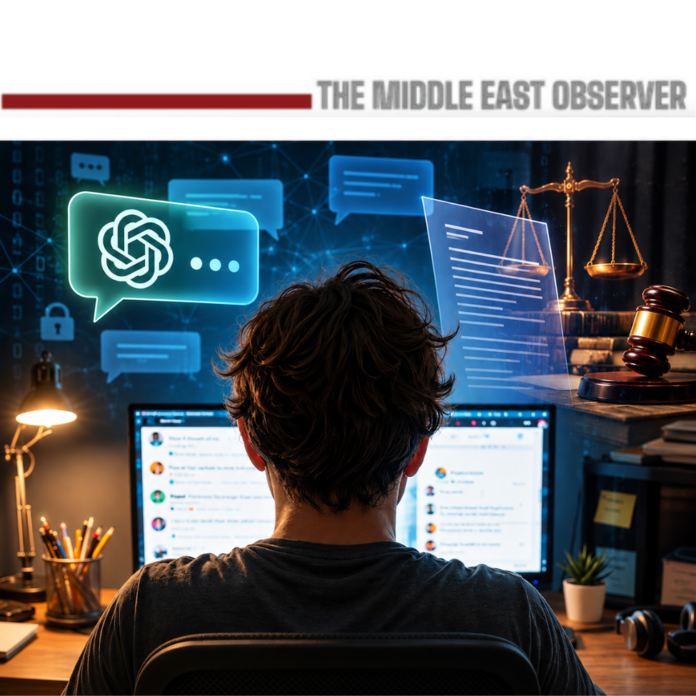
A conversation with AI can feel more private than a conversation with another person. There is no face across the table, no friend listening and no obvious audience.
But once that information enters an AI system, a harder question begins: who else can access it, and when would the user know?
When Private Chats Reach Court
The question became real in the case of R.K.C., a teenager who sued Meta, Snapchat, TikTok and YouTube. In October 2024, he asked ChatGPT what his father meant when he said he could receive a $1 million settlement.
Months later, that conversation appeared in the public court record.
The Washington Post found 12 cases over the past two years in which chatbot conversations appeared in criminal or civil proceedings. But the number cannot be known in full because police and parties in civil litigation do not have to make every piece of evidence they obtain public.
What makes R.K.C.’s case more revealing is what the public record does not tell us.
The Washington Post reported that defense attorneys obtained his ChatGPT history during the lawsuit and placed the conversations in court filings. But the public reporting does not explain exactly how they obtained that history.
That leaves a bigger question: if a user does not know how their conversation was accessed, how can they know who else can see it?
There is more than one route. A chatbot conversation can be found on a device during a search. In civil litigation, it can become part of the discovery process. And in some cases, the AI company itself can alert law enforcement. The Post documented examples involving searches of devices, civil evidence-gathering and reports from AI companies.
Who Can Actually Read Your Chats?
So when someone asks, “Who can see my ChatGPT conversations?”, the answer is not simply “OpenAI.”
OpenAI says a limited number of authorized personnel and trusted service providers may access user content for specific reasons, including investigating abuse or security incidents, providing support, handling legal matters and improving model performance when permitted. The company says access is restricted on a need-to-know basis, monitored and logged, and that authorized personnel must receive security and privacy training before accessing user content.
But OpenAI does not publicly identify those employees by name.
That does not mean every employee can open a user’s conversations whenever they want. It means that human access exists under defined circumstances, while the identities of the people with that access are not publicly disclosed.
OpenAI also says it does not sell user data or share ChatGPT conversations with advertisers.
When Security Moves Into the Street
The same privacy question appears outside chatbots.
Across the United States, autonomous security robots are already being used to patrol some public and private spaces. For example, the 420-pound K5 robot carries 360-degree HD video, LiDAR, thermal imaging and night vision, with license-plate reading available as an option. It can move through an area while sending what it sees back to a monitoring center.
The stated purpose is security. But another question follows: are these robots on the street simply to make places safer, or are we also creating systems capable of collecting more information about the people moving through them?
There is no evidence that K5 is designed to build an AI version of every person it encounters. But the technology shows how much more data a security system can collect when cameras become mobile and connected. Knightscope’s specifications list live streaming and 30 days of raw video storage.
That raises another question: who decides what data is collected, who can access it and what prevents information gathered for security from becoming useful for something else?
More Than a Conversation
The same distinction matters with AI conversations.
A chatbot does not need to be designed as a surveillance system for information inside a conversation to become valuable somewhere else. A person may tell AI about a relationship, a workplace problem, a business idea, a health concern or something they would never tell another person.
One conversation may reveal little. Hundreds can reveal much more: recurring worries, plans, interests, habits and the subjects a person repeatedly returns to.
The result can become more than a collection of questions.
It can become a picture of a person.
The Question That Remains
The cases surrounding AI privacy are a reminder to be more careful about what we choose to tell these systems. A conversation that feels private can end up in a court filing, an investigation or somewhere else far beyond the original chat.
OpenAI says access to user content is limited, monitored and logged, but it does not publicly identify the people who may have access.
So the question remains: if someone can read what we tell AI, shouldn’t we know who can read it, when they can access it and what they can do with it?
Because they may not just be reading our questions.
They may be reading a picture of us.
Related news:
India’s AceCloud Pioneers DeepSeek Gen AI Models
Australia’s Social Media Law Could Rewrite the Rules of the Digital Economy
Read also:
US Military Blocks Ad IDs After Commercial Data Exposes Troop Movements
Beyond More Factories: Egypt’s Investment Challenge Shifts From Quantity to Quality