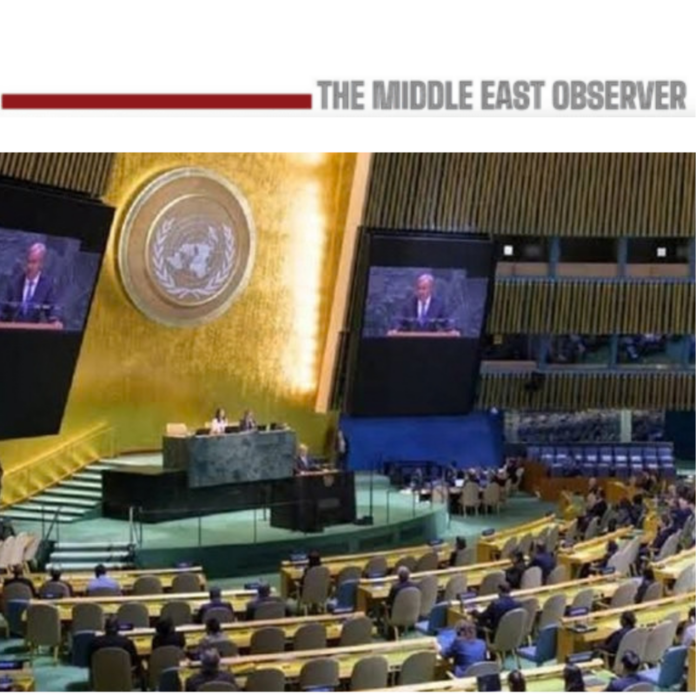
NEW YORK — Nearly 130 heads of state and government converged on United Nations Headquarters for the 81st UN General Assembly High-Level Week, with the General Debate running from September 22 to 28 under the theme “Restoring Trust, Managing Transformation: A United Nations That Delivers for All.” Chaired by General Assembly President Khalilur Rahman of Bangladesh, the gathering brought together the UN’s 193 member states alongside international institutions, regional organisations, business and civil society at a moment of exceptional economic and geopolitical strain. High-level discussions ranged from development finance and artificial intelligence to climate, sea-level rise, pandemic preparedness and war, with a nuclear-disarmament meeting scheduled for September 29.
The timing could hardly have been more consequential. The world did not arrive in New York confronting one conventional downturn or isolated conflict, but an accumulation of shocks: wars, disrupted energy and shipping routes, weak investment, renewed inflation, expensive borrowing, heavy sovereign debt, falling development assistance, climate costs and accelerating technological disruption.
The UN forecasts global growth of only 2.6% in 2026, against a pre-pandemic pace of 3.2%. Brent crude had risen about 40% since February to around $100 when the UN issued its September assessment. Developing countries carried $12.3 trillion of external debt at the end of 2025 and paid about $1.6 trillion in debt service, while official development assistance from OECD donors fell roughly 23% to $175 billion, according to figures cited by Rahman, even as global military expenditure approached $3 trillion.
Secretary-General António Guterres framed the moment around four interconnected tests: war and peace, inequality, climate and artificial intelligence. His proposed response was “networked multipolarity” — several centres of power operating through common international rules rather than allowing the world to fracture into competing economic, technological and security systems.
The test for UNGA81 was therefore straightforward: did world leaders merely diagnose the crises, or did they identify mechanisms capable of addressing them?
Economic Stress: Growth, Debt and the Financing Gap
The economic challenge confronting UNGA81 was not a single downturn but a reinforcing cycle of weak growth, heavy debt and geopolitical fragmentation. High borrowing costs and subdued investment threaten longer-term productivity, while debt service consumes fiscal space needed for infrastructure, health and education. Trade barriers, strategic rivalry and disrupted shipping are raising supply-chain costs; energy, fertiliser and food shocks add inflationary pressure; and climate adaptation and currency volatility require still more public resources. The danger is circular: slower growth weakens revenues, debt crowds out investment, underinvestment suppresses productivity, and repeated external shocks force governments to spend scarce capital managing crises rather than building future growth.
Much of the proposed remedy predates UNGA81 and sits within the 2025 Sevilla Commitment and its Platform for Action. The strategy is to expand multilateral-development-bank capacity and use guarantees, blended finance and hybrid capital to mobilise private investment against an estimated $4 trillion annual SDG financing gap, while strengthening domestic revenues and reducing illicit financial outflows. Debt reforms include the Sevilla Forum on Debt, a Borrowers’ Platform, Debt Pause Clauses for severe shocks and a Global Hub for Debt Swaps intended to redirect liabilities towards development and climate investment. Existing food and trade mechanisms add WTO reform, fewer export restrictions, FAO market monitoring, supplier diversification and alternative trade routes. UNGA81 largely added political urgency rather than a new financial architecture: Rahman pressed governments to restore development finance, while Guterres renewed calls for faster debt relief, greater MDB firepower, international liquidity for countries most in need and stronger adaptation finance. No new global stimulus, major SDR allocation or general debt moratorium emerged from New York. The machinery is increasingly defined; what remains missing is financing and execution at comparable scale.
AI: Productivity Gains, Job Risk and the Governance Race
AI poses four linked challenges: labour disruption, concentration of economic power, a widening technology divide and systemic security risk. The ILO estimates that roughly one in four jobs worldwide has some exposure to generative AI, while UNCTAD expects the AI market to reach about $4.8 trillion by 2033. Yet advanced computing capacity, capital and corporate research remain heavily concentrated, raising the prospect that the productivity gains accrue disproportionately to a small group of countries, companies and highly skilled workers.
The governance architecture began before UNGA81 through the Global Digital Compact and Resolution 79/325, which established the Independent International Scientific Panel on AI and the Global Dialogue on AI Governance. New York moved the debate towards practical risk management. Guterres proposed a multilateral AI Risk Management Framework backed by independent oversight, common testing and greater information-sharing, while Rahman pressed for developing countries to participate in both AI infrastructure and rule-making. More concretely, the US and China agreed to establish a formal AI-risk dialogue and work towards an “incident line” for critical safety events, with further discussions planned in Shenzhen.
Implementation is advancing, but the gap remains substantial: scientific and diplomatic institutions are forming, while binding international rules on worker adjustment, frontier-model accountability, corporate responsibility and military AI remain absent.
Diplomacy Confronts Multiple Wars
Guterres used his final General Assembly address as Secretary-General to argue for renewed Charter-based diplomacy, civilian protection, humanitarian access and respect for international law. But the principal conflicts discussed in New York showed how much easier it is to define the principles of settlement than to obtain agreement among the parties.
Iran and Hormuz: Diplomacy Stalls as Global Energy Risk Rises
The US-Iran confrontation has become a major source of global economic as well as geopolitical instability, with disruption to the Strait of Hormuz feeding directly into oil, freight and inflation. Iran used the UN gathering to propose reopening Hormuz within seven days and moving towards an end to hostilities if Washington eased military and economic pressure, lifted restrictions affecting Iranian ports and oil exports and addressed frozen Iranian assets. President Donald Trump rejected Tehran’s proposal on September 26, although both sides continue to speak of negotiations.
Trump had earlier told the General Assembly that an agreement might come only after the November 3 US midterm elections and warned of severe military consequences if diplomacy failed.
A parallel de-escalation effort is taking shape. Egypt, Saudi Arabia, Turkey and Pakistan backed dialogue and safe navigation during UNGA81, while France began work on a possible Security Council resolution for an international mission to safeguard commercial traffic through Hormuz.
The central risk is now prolonged armed stalemate rather than simply the absence of a treaty. Washington and Tehran remain divided over sanctions, the blockade, nuclear restrictions and the sequencing of concessions, leaving Hormuz vulnerable to recurring disruption and maintaining a geopolitical premium in energy and shipping. Brent rebounded to more than $106 a barrel after Washington rejected the Iranian proposal, illustrating how rapidly diplomatic deadlock can transmit into the global economy.
Gaza: Diplomatic Pressure Rises as the Two-State Path Narrows
Gaza became one of UNGA81’s clearest diplomatic fault lines as continuing Israeli operations and the humanitarian situation intensified international pressure for fuller implementation of the ceasefire and preservation of a two-state settlement.
At a high-level meeting convened by Canada, France, Saudi Arabia and the United Kingdom, Guterres said the political objective remained two sovereign states on the basis of pre-1967 lines, with Jerusalem as the capital of both, while warning that settlements, annexation measures and fragmentation between Gaza and the West Bank were eroding the physical basis of such an outcome. Canada, France and the UK have separately moved towards restrictions on goods from Israeli settlements as part of an effort to preserve that prospect.
The widening international divide with Israel was visible when Prime Minister Benjamin Netanyahu addressed the Assembly on September 24. Reuters confirmed that dozens of delegates walked out; an Israeli government tally later counted 77 delegations as either absent from the chamber or leaving during the address. Netanyahu suggested no resolutions, yet defended Israel’s continued actions and rejected accusations directed against its conduct.
Diplomatic pressure contrasts sharply with conditions on the ground. The October 2025 ceasefire halted full-scale war but has not stopped Israeli strikes, civilian killings, targeted assassinations or produced a final political settlement. Israel still controls more than 60% of Gaza, reconstruction remains severely limited and more than two million residents continue to live amid extensive infrastructure destruction. Gaza health officials say more than 1,300 Palestinians have been killed since the ceasefire, while Israel says four soldiers have been killed and argues that continuing operations respond to militant threats and ceasefire violations.
The principal operational dispute remains sequencing under Trump’s Gaza roadmap: phased Israeli withdrawal is tied to Hamas disarmament and Palestinian technocratic administration, while Israel says disarmament must come first and Hamas insists Israeli commitments and withdrawal must precede surrender of its weapons.
International support for two states has therefore strengthened just as implementation has become more difficult. The ceasefire, disarmament, Israeli withdrawal, Gaza governance, reconstruction and the political integration of Gaza with the West Bank remain unresolved — precisely the issues that determine whether the two-state framework can remain viable.
Ukraine: Limited De-escalation Looks Easier Than Final Peace
Ukraine now has three overlapping diplomatic tracks: a UN framework based on sovereignty and international law, a US effort focused on practical de-escalation, and a European debate over the continent’s eventual security settlement.
UN officials continue to call for an immediate, full and unconditional ceasefire and a just peace consistent with Ukraine’s sovereignty and territorial integrity. Ahead of the September 23 Security Council meeting, 51 UN member states issued a joint statement calling on Russia to accept such a ceasefire and enter meaningful negotiations. Significantly, the United States was not among the listed signatories, underscoring the distinction between the European-led diplomatic position and Washington’s more flexible negotiating track.
Washington is pursuing narrower measures intended to reduce the immediate costs of war without settling its final outcome. Kyiv has promoted a mutual halt to attacks on energy infrastructure, and Zelenskyy used his New York meeting with Trump to push the proposal. Broader US concepts have also explored renewed trilateral talks and possible military pullbacks linked to an economic or demilitarised arrangement in parts of Donbas.
The final settlement is considerably harder. Kyiv and its European partners insist on sovereignty and credible security guarantees, while Moscow continues to seek restrictions on Ukraine’s future NATO alignment and recognition of territorial changes. Europe has resisted negotiations over Ukraine without Kyiv, but a durable settlement will eventually require European-Russian engagement because sanctions, force deployments and the continent’s future security architecture cannot be determined solely by Washington, Moscow and Kyiv.
Implementation is therefore more plausible for limited de-escalation than comprehensive peace. Energy arrangements, protected Black Sea commerce and confidence-building measures could reduce immediate economic and humanitarian damage; they do not resolve the underlying disputes over territory, security guarantees and Ukraine’s geopolitical alignment.
Sudan: A Clearer Peace Roadmap, but Little Enforcement
Sudan produced one of the more structured diplomatic frameworks around UNGA81. At the first combined meeting of the Quad and Quintet, AU Commission Chair Mahmoud Ali Youssouf and US Africa adviser Massad Boulos backed a sequence beginning with an immediate humanitarian truce, followed by cessation of hostilities, a durable ceasefire and an inclusive Sudanese-owned political process restoring constitutional order while preserving the country’s unity and sovereignty. The participants also called for preparations for monitoring and verification and an end to external military support fuelling the conflict.
Washington has separately pressed a proposed 90-day ceasefire, but the Sudanese army has resisted terms it believes could advantage the Rapid Support Forces.
The framework is therefore clearer than the enforcement mechanism. The diplomatic actors increasingly agree on the sequence; peace still depends on whether the armed camps and their external supporters can be induced to accept, verify and sustain it.
A Global System Struggling to Adapt
Beyond individual wars, UNGA81 repeatedly returned to a more structural question: whether institutions designed around the geopolitical settlement of 1945 can manage a world of multiple power centres, sanctions, technology competition and regional blocs.
US-China: Guardrails Expand as Strategic Rivalry Deepens
The US-China relationship remains central to trade, technology and global fragmentation. The AI incident mechanism discussed in New York provides one example of managed competition: Washington and Beijing remain strategic rivals but are creating limited channels designed to reduce the risk that an AI accident or security event becomes a broader confrontation.
That is close to Guterres’s concept of networked multipolarity: competition without the complete collapse of common rules or communication. Whether such guardrails can extend into trade, advanced semiconductors, military technology and security disputes remains unresolved.
International Law: Rules Exist, Compliance Remains Uneven
Guterres repeatedly argued that the key question is whether power operates through law or beyond it. The UN Charter, international humanitarian law and international courts already provide extensive rules covering territorial integrity, civilians, occupation, humanitarian access and the conduct of war.
The institutional deficit is therefore primarily one of compliance and enforcement. International law can establish the standard; states and international institutions must still possess the political capacity to apply it consistently.
Security Council Reform: Agreement on the Problem, Division on the Cure
The Security Council’s difficulty in responding consistently to major wars again became part of the UNGA debate. Guterres argued that a 21st-century Council without permanent African representation is increasingly indefensible, while Rahman has made institutional reform one of his priorities.
But agreement largely ends there. Turkish President Recep Tayyip Erdoğan has questioned both the permanent-member system and veto, while Russia supports enlargement of permanent membership but insists the veto remain.
Reform therefore confronts a built-in political obstacle: meaningful change requires the cooperation of states whose existing privileges would themselves be diluted.
Africa: Representation Moves From Symbolism to Power
The African Union used the gathering to press for stronger African representation not only in the Security Council but across the international financial system. The underlying demand is no longer merely recognition that Africa is under-represented; it concerns actual influence over permanent seats, voting power, financing and institutional priorities.
Political momentum for reform is growing. Redistribution of institutional authority remains much harder.
Economic Statecraft: Sanctions and Export Controls Harden Rival Blocs
Sanctions, export controls, technology restrictions and financial access are increasingly instruments of national-security policy. The danger identified by Guterres is a progressive division of the world into rival systems with separate technology, finance and supply chains.
There is no serious prospect of eliminating economic statecraft. The more realistic challenge is preventing strategic rivalry from destroying common rules altogether. UNGA81 offered a framework for managed competition, but no binding mechanism restricting the use of sanctions or export controls.
Maritime Security: Regional Conflict Becomes Global Economic Risk
Hormuz, Bab el-Mandeb and the Red Sea demonstrate how rapidly local conflict can reach consumers thousands of kilometres away. Disruption raises oil prices, freight rates, insurance premiums and ultimately food and manufactured-goods costs.
During High-Level Week, governments from the Middle East and beyond converged around one principle: commercial navigation must be restored and protected. Russia and Saudi Arabia separately called for safe passage through both Hormuz and Bab el-Mandeb, while the French Security Council proposal seeks to translate that principle into a defensive multinational mechanism.
The limitation is clear: maritime forces can mitigate shipping risk, but only political de-escalation can remove it.
Climate, Humanitarian and Nuclear Risks
Climate Security: Commitments Advance Faster Than Finance
Climate change is increasingly an economic and security problem involving migration, food production, coastal infrastructure, insurance and public finances. UNGA81’s sea-level-rise discussions emphasised adaptation, resilient infrastructure and protection of low-lying coastal and island states.
For vulnerable economies, however, the binding constraint remains capital. Adaptation plans, early-warning systems and coastal protection can be designed today; many governments cannot finance them at the scale required.
The climate-policy architecture is therefore advancing faster than climate finance.
Humanitarian System: Reform Advances as Resources Shrink
Simultaneous wars and falling donor budgets are putting the humanitarian system under exceptional pressure. Guterres’s New Humanitarian Compact is attempting to make the system less fragmented through simpler planning, integrated supply chains, shared services, better data and stronger humanitarian diplomacy.
Unlike several broader UNGA proposals, implementation has begun. The model is being piloted in Afghanistan, Haiti, the Occupied Palestinian Territory, Somalia and Sudan.
Efficiency, however, cannot substitute indefinitely for resources or access. A better humanitarian system still cannot deliver aid where financing disappears or combatants prevent it from operating.
Nuclear Risk: The Final High-Level Test Remains Ahead
Nuclear disarmament remains an unfinished part of this year’s High-Level Week. The principal high-level plenary meeting marking the International Day for the Total Elimination of Nuclear Weapons is scheduled for September 29, meaning its 2026 outcome cannot yet be incorporated into an assessment of what the gathering delivered.
The wider environment is nevertheless clear: renewed major-power rivalry and regional wars make arms control more urgent while simultaneously making agreement more difficult.
UN Reform: Administrative Change Moves Faster Than Political Reform
The institution hosting the gathering is itself undergoing reform. The UN80 Initiative is reducing duplication, consolidating administrative functions and reviewing how mandates are created and implemented. General Assembly Resolution 80/251, adopted in March by 168 votes to four, established a stronger framework for mandate creation, implementation and review.
Some reforms are already operational: the UN reports a 21% reduction in Secretariat staff positions in 2026, administrative consolidation, relocation of posts to lower-cost locations and new delivery models under the Humanitarian Compact.
That makes institutional reform one of the areas where implementation is visibly under way. Yet the contrast is instructive: administrative reform can move through budgets, management changes and General Assembly resolutions; reforming political power in the Security Council requires states to surrender or share influence.
The Gap Between Roadmaps and Delivery
Taken together, UNGA81 presents a more complicated picture than either success or failure.
The international system does not lack proposals.
For debt, the machinery exists — but creditors must use it. For development, the Sevilla framework exists — but capital must move from platforms and pledges into actual projects. For food, monitoring and diversification tools exist — but governments must resist protectionism when domestic pressures rise. For climate, technological and policy solutions exist — but adaptation and loss-and-damage finance remain below requirements. For AI, scientific institutions, safety dialogue and risk-management mechanisms are emerging — but binding safeguards have yet to catch up with the technology.
For wars, the gap is wider still. International law exists. Peace frameworks exist. Mediators, ceasefire formulas and humanitarian mechanisms exist. Sudan has a defined sequence from humanitarian truce to civilian political transition. Palestine has an extensively documented two-state framework. Ukraine has both Charter principles and more limited de-escalation proposals. In the Middle East, governments broadly agree that navigation must be protected and diplomacy restored.
What remains missing is agreement among the actors with the power to execute those solutions.
That is perhaps the most consequential conclusion from New York.
The world’s shortage is increasingly not one of ideas. It is a shortage of coordinated political execution, finance and enforcement.
Related news:
From Private Chat to Court Evidence: Who Can See What You Tell AI?
Arab AI Boom Could Add $375bn as 25% of Jobs Face Exposure
Read also:
China Studies Major Upgrade of Cairo’s International Conference Center
Digital Governance Gains Ground Across Egypt’s Strategic Sectors