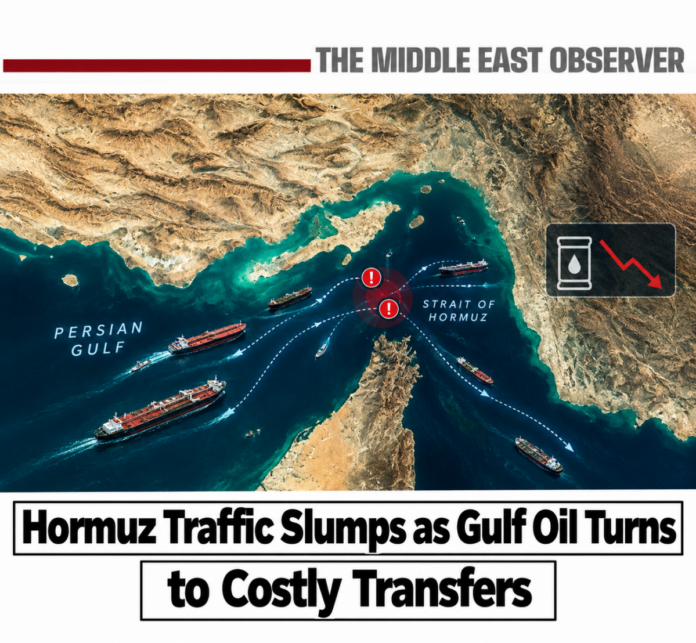
The Strait of Hormuz has become dramatically quieter. Gulf oil exports have not fallen nearly as far.
Visible commodity traffic totalled just 17 vessels over the last weekend, down from 37 a week earlier, according to shipping data. The scale of the wider disruption is greater: before the conflict began on February 28, Hormuz typically handled about 125 large commercial vessels of all types each day. Some tankers are now travelling with their transponders switched off, meaning visible traffic understates actual movements.
Yet Saudi crude exports have recovered to more than 4mn barrels per day so far in September, from about 2.4mn bpd in August. In the week of September 13 alone, 22 tankers, mostly very large crude carriers, moved 42mn barrels of crude out through Hormuz, with Saudi Arabia and Iraq each accounting for 43% of the volume.
That divergence between vessel traffic and export volumes is increasingly important for global oil prices.
Brent crude fell about 1.7% to around $102 a barrel on Monday, September 21, while US West Texas Intermediate dropped almost 2% below $100. Renewed diplomatic expectations surrounding the Iran conflict contributed to the decline, but stronger-than-feared Gulf exports are also reducing concerns that disruption to shipping will translate directly into equivalent losses of physical supply.
The market is effectively discovering that fewer ships do not necessarily mean proportionately fewer barrels.
Exports through Hormuz have reached about 6.5mn bpd so far in September, their highest level since the temporary surge following the June ceasefire, according to Kpler data cited by Reuters. That remains far below pre-conflict levels, but demonstrates that the Gulf energy trade is adapting rather than stopping.
The distinction matters because there is no adequate replacement for Hormuz.
The Strait carried an average 20.9mn bpd of crude, condensate and petroleum products in the first half of 2025—about one-quarter of global maritime oil trade. Saudi Arabia and the UAE’s principal bypass pipelines together could provide about 4.7mn bpd of alternative capacity, equivalent to less than one-quarter of those normal Hormuz volumes. Around 89% of the crude and condensate crossing the Strait went to Asian markets.
With pipeline alternatives limited, producers have increasingly turned the Gulf of Oman into a floating logistics hub.
Ship-to-ship transfers allow dedicated tankers to shuttle crude through the highest-risk section of the route before transferring cargoes to larger vessels outside the Strait for longer voyages to Asian refineries. The system improves utilisation of scarce long-haul tanker capacity, but every additional transfer requires more vessels, handling, time and money.
ADNOC helped develop the current shuttle model earlier in the conflict, and Saudi Aramco and other Gulf producers have increasingly adopted it. Around 2.5mn bpd of crude is expected to be loaded through ship-to-ship transfers in the Gulf of Oman during September, up from 1.4mn bpd in August. That is equivalent to roughly 40% of the oil currently moving through Hormuz.
Saudi Arabia is deploying the model on an industrial scale.
Aramco has sold about 60mn barrels of crude from Ras Tanura for September and October loading through ship-to-ship transfers near Oman’s Sohar port, according to traders cited by Reuters. Buyers include refiners in China, South Korea, India and Japan, while Japanese refiners say they have secured sufficient crude supplies through November partly through offshore transfers.
The system is therefore no longer merely an emergency experiment. It is becoming temporary export infrastructure.
That resilience, however, is being purchased at an exceptional cost.
Benchmark freight for a VLCC carrying Gulf crude to China has risen above $30 a barrel, according to LSEG data cited by Reuters. With crude trading around $105, transportation alone now represents more than one-quarter of the underlying barrel’s value, compared with roughly 2%-3% before the conflict.
The result is an unusual divergence: benchmark crude prices can decline even while the cost of physically delivering Gulf oil remains extraordinarily high.
More available barrels reduce the scarcity premium embedded in Brent and WTI. But producers must absorb part of the higher transport cost through deeper crude discounts, refiners face elevated landed feedstock costs, and tanker owners benefit from exceptional demand for vessels and longer, more complicated logistics.
That distinction is also visible further down the energy chain. Refined-product markets remain considerably tighter than crude. European jet fuel inventories have fallen sharply and diesel markets remain under pressure even as additional Gulf crude reaches international buyers, showing that improved crude availability does not immediately resolve refinery and product-supply constraints.
The vulnerability extends beyond oil.
Hormuz carried about 11.4bn cubic feet per day of LNG in the first half of 2025—more than 20% of global LNG trade—primarily from Qatar. Asian gas consumers therefore remain exposed to the same maritime bottleneck even as oil exporters develop increasingly sophisticated workarounds.
Global markets have avoided an even larger supply shock through inventory drawdowns, alternative routes and suppliers, emergency stock releases and rapid changes in refinery sourcing. The International Energy Agency has described the adjustment as an important factor in limiting the economic impact of what became the largest oil-supply disruption on record.
The emerging picture is therefore not one of normalisation.
Supply resilience has recovered faster than transport efficiency.
Hormuz has shifted from an immediate question of whether Gulf barrels can reach world markets towards a continuing problem of how much can move, through which routes and at what cost.
That helps explain why crude prices can retreat even while the Strait remains severely disrupted. Markets are becoming more confident that producers can keep substantial volumes flowing, removing part of the supply-risk premium from oil prices. But the underlying cost has not disappeared; it has migrated into tanker freight, offshore transfers, crude discounts and increasingly complex trade routes.
The global energy system is functioning—but its resilience is being bought at a much higher price.
Related news:
DP World Expands Gulf Land Bridge as Hormuz Risks Reshape Trade
Iraq Is Escaping Hormuz. Its Next Oil Constraint Could Be OPEC
Read also:
Sokhna Trials Advance Egypt’s Red Sea–Mediterranean Freight Corridor