Saab AB, the Stockholm-headquartered Swedish defence and aerospace group and one of Europe’s leading defence manufacturers, is strengthening its position in the global airborne surveillance market as growing demand for advanced intelligence, surveillance and reconnaissance (ISR) capabilities drives international adoption of its GlobalEye airborne early warning and control (AEW&C) platform. Listed on the Nasdaq Stockholm exchange, Saab’s largest shareholder is Investor AB, the Wallenberg family’s investment company, while its shares are otherwise widely held by institutional and private investors.
The company’s latest success came with the announcement of a SEK10.1 billion (approximately US$1.04 billion) contract to supply two GlobalEye aircraft to an undisclosed customer in the Middle East, with deliveries scheduled for 2030. Saab did not identify the buyer, citing customer confidentiality.
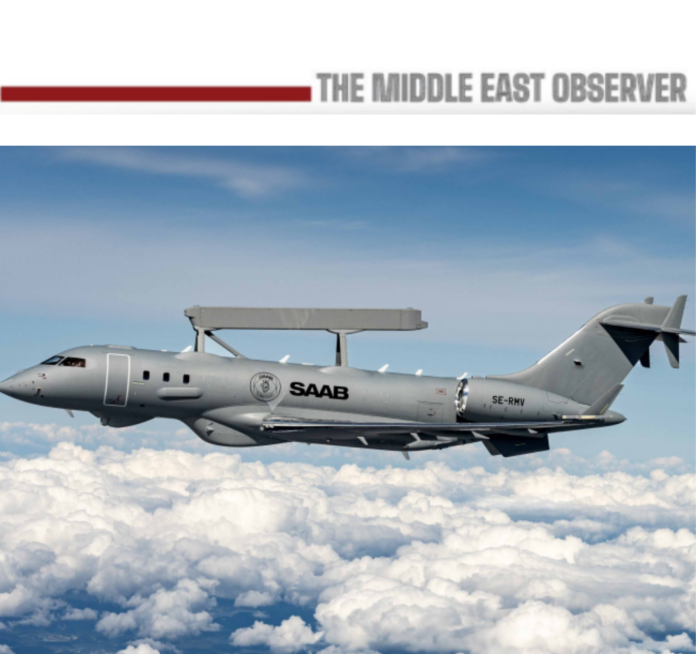
According to Saab, GlobalEye is an advanced multi-domain airborne surveillance solution designed to provide continuous situational awareness across the air, maritime and land domains from a single platform. Built on the Bombardier Global business jet, the aircraft integrates Saab’s Erieye Extended Range (ER) active electronically scanned array (AESA) radar, maritime surveillance radar, electro-optical sensors and electronic support measures to detect, identify and track a broad spectrum of airborne, maritime and ground threats simultaneously over long distances.
The platform enables armed forces to conduct airborne early warning, intelligence, surveillance and reconnaissance, airspace management and command-and-control missions while supporting integrated air and missile defence operations. By fusing data from multiple sensors into a single real-time operational picture, GlobalEye enhances decision-making, extends threat detection beyond conventional radar coverage and improves coordination across joint military operations. Its long endurance, extensive operational range and multi-domain architecture allow a single aircraft to perform missions that have traditionally required multiple specialised platforms, improving operational flexibility while reducing lifecycle costs.
Unlike many legacy airborne early warning aircraft that focus primarily on airspace surveillance, GlobalEye was designed from the outset as a multi-domain ISR platform, enabling simultaneous monitoring of air, sea and land environments. The aircraft competes with systems such as Boeing’s E-7 Wedgetail, widely operated by NATO members and key allies, and Israel Aerospace Industries’ EL/W-2085 Conformal Airborne Early Warning (CAEW) aircraft. While each platform offers advanced airborne surveillance capabilities, GlobalEye has increasingly differentiated itself through its integrated sensor suite, extended endurance, lower operating costs associated with its business-jet platform and its ability to perform both strategic surveillance and tactical command-and-control missions within a single system.
In its official announcement, Saab President and Chief Executive Officer Micael Johansson said the latest order reflects growing international confidence in the platform.
“We are proud to continue supporting our customers in strengthening their national security. GlobalEye continues to attract international recognition from customers seeking a leading multi-domain surveillance solution. Saab’s ability to integrate, deliver and support advanced capabilities means customers can rely on GlobalEye to help safeguard their national interests.”
The Middle East contract follows a series of major international milestones for the programme. Earlier this year, NATO selected GlobalEye under its Alliance Future Surveillance and Control (AFSC) programme as the Alliance’s next-generation airborne surveillance capability, replacing its ageing E-3A AWACS fleet. The decision represented one of Saab’s most significant strategic successes, signalling confidence in the platform’s ability to meet evolving operational requirements for multi-domain surveillance, intelligence gathering and command-and-control across allied forces.
Interest in advanced airborne surveillance systems continues to accelerate as governments modernise integrated air and missile defence networks in response to increasingly complex regional security challenges. Military planners are placing greater emphasis on platforms capable of combining long-range detection, persistent surveillance and real-time information sharing across multiple operational domains, making AEW&C aircraft an increasingly important component of modern defence architectures.
The latest Middle East order further strengthens GlobalEye’s position in the rapidly expanding global AEW&C market, reinforcing Saab’s emergence as a leading supplier of next-generation airborne surveillance capabilities. Combined with NATO’s endorsement and growing international demand, the programme reflects a broader shift towards multi-domain intelligence platforms that enhance situational awareness, improve operational interoperability and support faster, more informed decision-making across increasingly complex security environments.
Related news:
NATO Ankara Summit Strengthens Collective Defence as Allies Accelerate Military Modernisation
AI Warfare Is Rewriting the Logic of Military Power
Read also:
Egypt Wins World Fencing Bronze After Golden-Touch Victory Over Israel
US–Saudi Consortium Advances $5bn Gulf Refinery Beyond Hormuz