EGX70 jumps 4% as market capitalisation reaches EGP 4.16tn, while new hedge-fund rules add to Egypt’s capital-market reform agenda
CAIRO — Egyptian equities opened the week with broad gains on Sunday, pushing the benchmark above 55,000 for the first time while another sharp rise in small- and mid-cap shares extended their substantial recent outperformance.
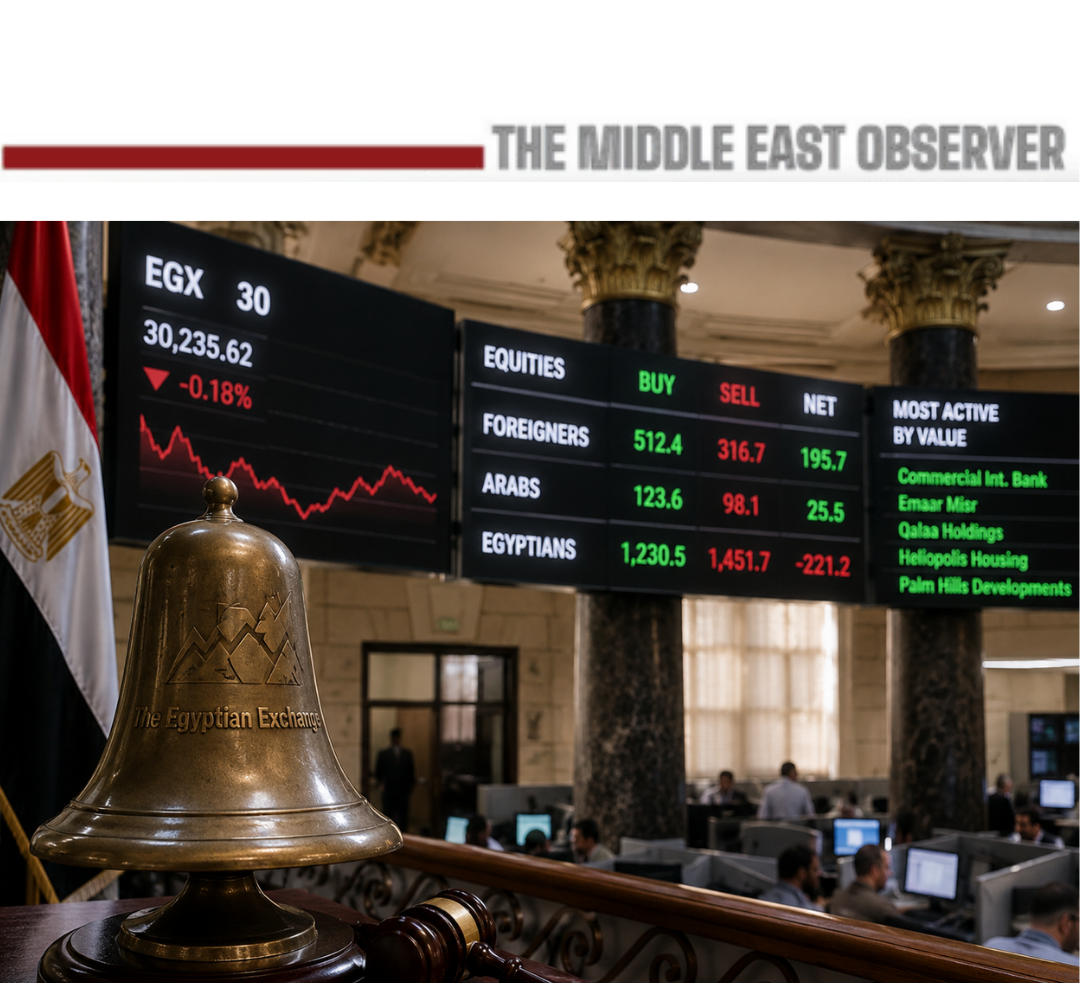
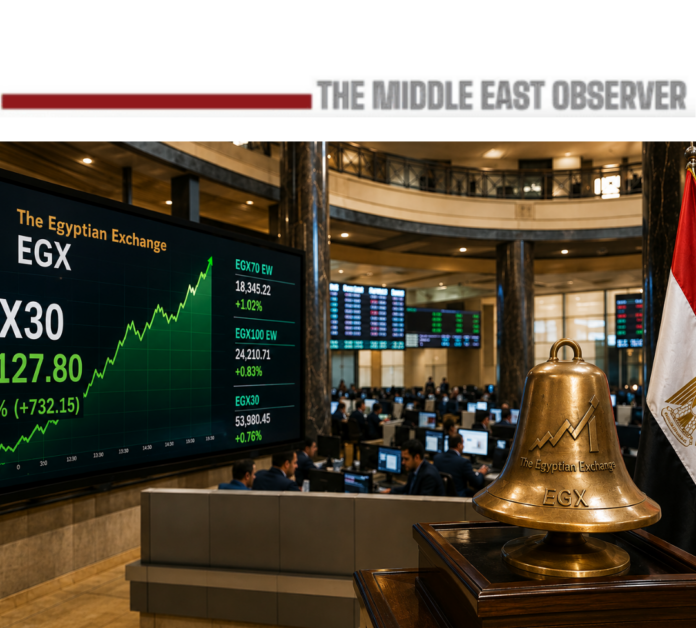
The EGX30 gained 0.82% to close at 55,125.43 points. The EGX33 Shariah Index advanced 1.49% to 6,426.09 points, while the lower-volatility EGX35-LV rose 1.37% to 6,770.10 points.
The strongest gains again came outside the benchmark. The EGX70 Equal Weight Index surged 4.04% to 20,798.21 points, crossing 20,000, while the broader EGX100 Equal Weight Index gained 3.36% to 26,983.04 points.
Market capitalization increased by about EGP55bn during the session to EGP 4.159tn.
The EGX30’s move above 55,000 provides a headline milestone, but the much larger gains in the equal-weighted indices remain the more important market development. Trading activity and price gains have been particularly strong among companies outside the benchmark’s largest constituents.
Small-Caps Extend Their Lead
Sunday extended a pattern that dominated the previous trading week.
Between July 30 and August 6, the EGX30 gained approximately 2.3%, while the EGX70 advanced 9.6% and the EGX100 rose about 8.6%. Market capitalization increased by almost EGP167bn over the period.
Sunday widened that divergence further. Since August 2, the EGX30 has risen approximately 1.5%, compared with gains of more than 9% for the EGX70 and about 8.1% for the EGX100.
Equal-weighted indices reduce the influence of the exchange’s largest companies, making their outperformance a useful indicator of activity across a broader range of shares.
The speed of the advance nevertheless warrants attention. Repeated daily-limit movements in individual companies show that parts of the market are experiencing unusually rapid price appreciation alongside expectations for corporate performance.
Second-quarter earnings will therefore become increasingly important in determining whether recent price gains are accompanied by corresponding growth in profits.
Domestic and Arab Investors Offset Foreign Selling
Egyptian Exchange nationality statistics showed Egyptian investors as net buyers of approximately EGP35.4mn, while Arab investors recorded net purchases of about EGP34.3mn.
Non-Arab foreign investors were net sellers of approximately EGP69.7mn.
The figures indicate that Sunday’s advance was supported primarily by domestic and regional capital rather than a significant overseas equity inflow.
That does not establish a broader retreat by foreign investors. Non-Arab foreigners returned to net buying during July after selling during the second quarter, while daily flows can fluctuate substantially.
Foreign portfolio investors also continue to weigh Egyptian equities against high-yielding government securities. As a result, international demand for Egyptian assets can appear in Treasury bills and bonds without producing equivalent foreign buying on the stock exchange.
Sustained overseas equity inflows over several weeks would therefore provide a more meaningful indication of institutional re-engagement than any single session.
Glaxo Volatility Highlights Price-Movement Risk
GlaxoSmithKline Egypt again reached its 20% daily limit, closing at EGP 477.26 after an exceptionally volatile run that included a 20% decline on August 5 and a 20% rebound the following session.
The company has previously said it was unaware of undisclosed material developments explaining the price movements, making the stock a prominent example of the unusually sharp price movements seen in parts of the market.
Other leading gainers included Ismailia National Food Industries, up 19.99% to EGP 163.18, and Golden Textiles & Clothes Wool, which also gained 19.99% to EGP 119.67.
The largest decliners included El Ahram Co. for Printing and Packing, down 4.95%, Nasr Company for Civil Works, down 4.70%, and Egyptian Gulf Marseilia for Real Estate Investment, which fell 3.73%.
The sharp movements reinforce the distinction between broad market participation and company-specific price action. A rising index does not necessarily imply that movements in individual shares are supported by new corporate information.
Hedge Funds Expand the Reform Agenda
Egypt’s Financial Regulatory Authority has introduced the country’s first framework governing the establishment and operation of hedge funds, allowing qualifying funds to use a wider range of strategies than conventional investment funds.
The framework permits investment in equities, debt instruments, derivatives and borrowed securities used for short selling, subject to regulatory limits and approved investment mandates. Existing investment funds may also seek approval to conduct hedge-fund activities under specified conditions.
FRA chairman Islam Azzam said the initiative is intended to increase investment flexibility, attract additional categories of investors and support development of Egypt’s derivatives market.
The reform complements efforts to develop securities borrowing and short selling, potentially giving institutional investors greater scope to hedge portfolios, pursue relative-value strategies and take negative positions. Its effect on market depth and price discovery will depend on implementation, including the availability of lendable securities, brokerage readiness and appropriate risk controls.
EGYCO Adds to Potential Listing Pipeline
The Egyptian Exchange has also received an application to list El Nasr Company for Buildings and Construction — EGYCO on its main market, covering issued capital of approximately EGP211mn.
The application remains under review and should not be treated as an approved listing or an imminent public offering.
Egypt is seeking to increase the number and scale of listed state and private-sector companies as part of efforts to deepen its capital market. A larger pool of sizeable, liquid listings could broaden the institutional investable universe and reduce the market’s dependence on a relatively small number of heavyweight companies.
From Market Momentum to Earnings
The EGX enters the new week with momentum intact.
The EGX30 has crossed 55,000, the EGX70 has moved above 20,000, and market capitalization has reached almost EGP4.16tn. Yet the much faster rise in small- and mid-cap indices means the next stage of the rally will increasingly depend on fundamentals rather than index milestones.
Corporate results now provide the most important test. Second-quarter earnings will show whether recent share-price appreciation is being accompanied by sufficient growth in profits.
Foreign participation will provide another measure. Sustained overseas buying would indicate that the rally is attracting longer-term institutional capital alongside the domestic liquidity that has supported much of the recent advance.
At the same time, the introduction of hedge funds, progress on securities lending and short selling, and a wider potential listing pipeline show that regulatory reform is advancing alongside rising equity prices. Its effect on the structure and depth of the market will depend on implementation.
The EGX30’s move above 55,000 is therefore an important milestone, but not the decisive question for investors. After the much faster rise in smaller companies, the more important test is whether earnings and institutional participation can keep pace with liquidity and share prices.
Related news:
Small-Caps Lead Weekly Rally as Blue-Chip Profit-Taking Caps EGX30
El-Sisi Accelerates Suez Canal Shipbuilding Strategy as Exports Reach Europe