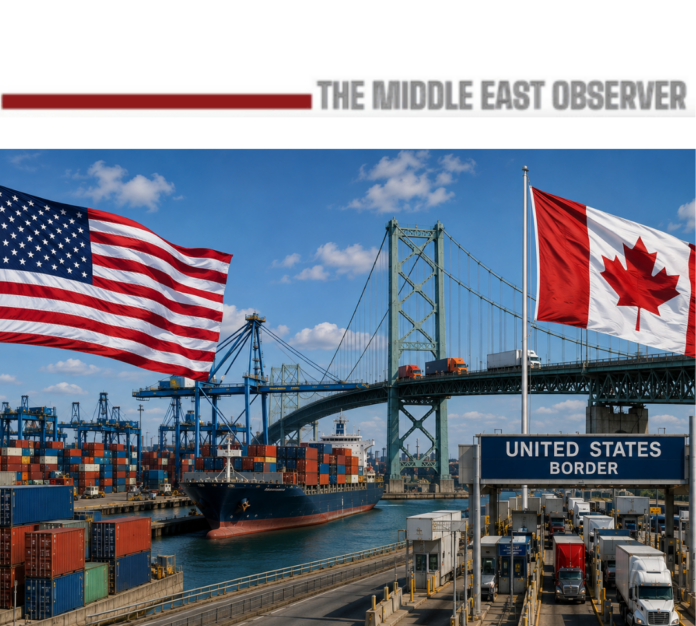
The Peace Arch straddling the U.S.-Canada border carries an inscription intended to capture more than a century of peaceful relations between the neighbours: “May These Gates Never Be Closed.” The gates remain open. But the terms of entry are changing. The inscription is part of the monument marking the border between Washington state and British Columbia.
Washington imposed 50 per cent tariffs on about $20bn of Canadian goods on August 22 after last-minute negotiations failed, prompting Prime Minister Mark Carney to announce dollar-for-dollar retaliation from September 8. The U.S. measures affect roughly 5 percent of Canadian exports to its largest trading partner.
The tariffs cover products including wine, cement, hockey equipment, honey, paper, textiles and some electronics. Energy, potash, fish and certain critical minerals are exempt, while existing U.S. measures affecting steel, aluminium, autos and lumber remain separate.
Carney said Canada’s countermeasures would target U.S. products including steel, dairy, appliances, agricultural equipment, pulp and paper and electronics. Further details are due before the measures take effect. No new negotiations were immediately scheduled following the collapse of talks.
The immediate economic exposure is relatively contained. The more consequential issue is whether the confrontation erodes the predictability on which companies have built cross-border investment and production under the U.S.-Mexico-Canada Agreement.
USMCA Predictability Comes Under Pressure
Washington imposed the latest tariffs using Section 338 of the Tariff Act of 1930, a rarely invoked provision that allows the U.S. president to respond to discriminatory treatment of American commerce.
For companies operating across North America, the move calls into question an important assumption underpinning investment and procurement decisions: that preferential trade rules provide relatively predictable access across the continent.
The exposure is particularly relevant to automotive, metals and manufacturing industries, where components and raw materials routinely cross the U.S.-Canada border as part of integrated production networks.
The near-term consequences are more likely to emerge through import costs, procurement and inventory changes and pressure on corporate margins than through wholesale relocation of production. Reconfiguring established North American supply chains would require substantially more time and capital.
Repeated tariff interventions, however, could eventually force companies to attach greater weight to political and trade-policy risk when deciding where to invest and source components.
Beef Relief Shows Inflation Constraint
The escalation coincides with a contrasting move elsewhere in U.S. trade policy.
President Donald Trump said on August 21 that the U.S. would allow up to 300,000 metric tonnes of beef used for ground-beef production to enter during the following 90 days without the higher out-of-quota tariff, as his administration seeks to increase supply and lower elevated prices. Trump said there was a commitment for the affected beef to be sold at 25 per cent below prevailing market prices, although details of how that commitment would translate into retail prices were not disclosed.
The measure should not be interpreted as a concession to Canada. The new action concerns tariff-rate quota restrictions affecting other foreign supplies rather than opening the U.S. market specifically to Canadian beef.
The two policies nevertheless illustrate the different objectives Washington is pursuing through trade measures: tariffs are being deployed against Canada as commercial leverage while an import barrier is being temporarily relaxed in the beef market, where tight domestic supply has contributed to elevated consumer prices.
The latter move has drawn opposition from U.S. cattle producers, who argue that additional foreign supply could pressure domestic livestock prices and undermine incentives to rebuild American herds.
The administration’s claim of beef being sold 25 per cent below current market prices should also not be read as a forecast that overall U.S. retail beef prices will fall by the same amount. The eventual consumer impact will depend on the volume entering the market, distribution and wider supply conditions.
September 8 Is the Next Test
Canada faces the greater immediate economic exposure because of its dependence on the U.S. market. But the effects will not necessarily stop at the border: Canadian materials and components are inputs for U.S. manufacturers, meaning tariffs can also raise costs within American supply chains.
U.S. imports from Canada totalled about $383bn in 2025, making the roughly $20bn covered by the latest tariffs a relatively limited share of bilateral commerce. Their significance lies partly in the precedent created for a trading relationship that companies have spent decades treating as preferential and highly integrated.
The dispute also arrives at a sensitive moment for USMCA. The agreement has provided the institutional framework around which manufacturers have organised continental production, particularly in automobiles and other industries where intermediate goods can cross borders repeatedly before reaching consumers.
That makes September 8 the immediate test.
If Ottawa implements its promised dollar-for-dollar retaliation, the dispute will broaden further. A resumption of negotiations before then could still contain the escalation.
The longer-term consequences will depend less on the initial $20bn tariff package than on whether unilateral measures become a recurring feature of commerce between the two countries.
The Peace Arch’s gates are not closing. Goods, capital and people will continue to cross one of the world’s most economically important borders. But for companies that built their North American strategies around predictable preferential access, the terms of entry are becoming considerably less certain.
Related news:
Egypt and Syria Prepare to Restore Cairo–Damascus Air Link
How China-US Competition Is Rewriting the Rules of Globalization
The Global Price of America’s $40tn Debt
Read also:
Trump Raises Global Tariff to 15% After Supreme Court Rebuke