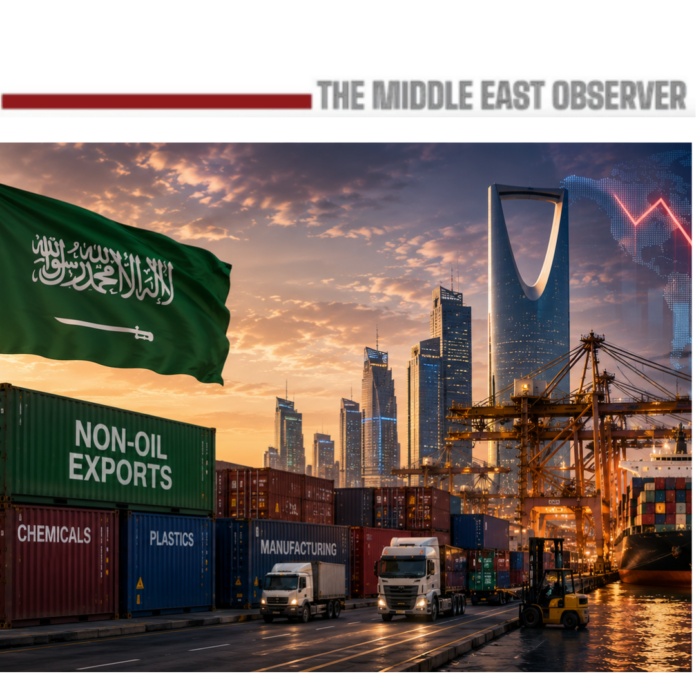
Saudi Arabia’s trade surplus fell to SAR17.3 billion ($4.6 billion) in June, its lowest level in five months, as weaker oil receipts and a sharper contraction in domestically produced non-oil exports highlighted the uneven progress of the Kingdom’s export diversification.
The surplus declined 10% year on year and about 21% from May, according to preliminary data from the General Authority for Statistics. Merchandise exports fell 4.5% to SAR87.8 billion, while imports declined 3% to SAR70.4 billion.
Oil exports slipped 2.3% to SAR63.2 billion. Yet oil’s share of total exports rose to 72%, from 70.4% a year earlier, as non-oil shipments fell faster — an uncomfortable monthly reversal for an economy investing heavily under Vision 2030 to reduce its dependence on hydrocarbons.
The more important diversification signal came from national non-oil exports excluding re-exports, which dropped 11.4% to SAR15.3 billion. Re-exports declined by a smaller 6.7% to SAR9.3 billion, leaving combined non-oil exports down 9.7%.
Re-exports were particularly affected by a 41.7% decline in machinery, electrical equipment and parts, illustrating the volatility of a trade segment that has become increasingly important to Saudi Arabia’s ambitions as a regional logistics hub.
June nevertheless presents only part of the picture. Petroleum exports rose 9.1% year on year to SAR203.4 billion during the second quarter, helping total merchandise exports increase 4.1% to about SAR286 billion. National non-oil exports, by contrast, fell 9.6%, while re-exports declined just 2.1%.
The comparison with last year also matters. Saudi non-oil exports had been expanding strongly during 2025, creating a tougher base for this year’s figures. As recently as February 2026, combined non-oil exports were still 15.1% higher year on year, including 6.3% growth in national non-oil exports and a 28.5% increase in re-exports.
The divergence points to a more nuanced test for Vision 2030. Re-exports strengthen Saudi Arabia’s position as a regional distribution and logistics centre, but largely involve goods produced elsewhere. Growth in Saudi-produced non-oil exports is a more direct measure of whether investment in manufacturing and industrial capacity is creating internationally competitive production.
Regional shipping and energy-market disruption adds uncertainty to the outlook, although the June trade figures alone do not establish geopolitics as the primary cause of the export decline.
The June data therefore do not suggest Saudi diversification has gone into reverse. Instead, they expose one of its harder challenges: building a regional logistics hub is proving easier than generating sustained growth in Saudi-produced exports. Oil, meanwhile, continues to exert an outsized influence over the Kingdom’s trade balance.
Related news:
When the Grid Becomes Global: Can Egypt Become a Regional Electricity Trading Hub?
Foreign Direct Investment in Saudi Arabia rises to $215bn
Read also:
Can Egypt Turn Its Talent Pool Into a Digital Export Industry?
Houthi Threat Opens Second Front in Regional Shipping Crisis