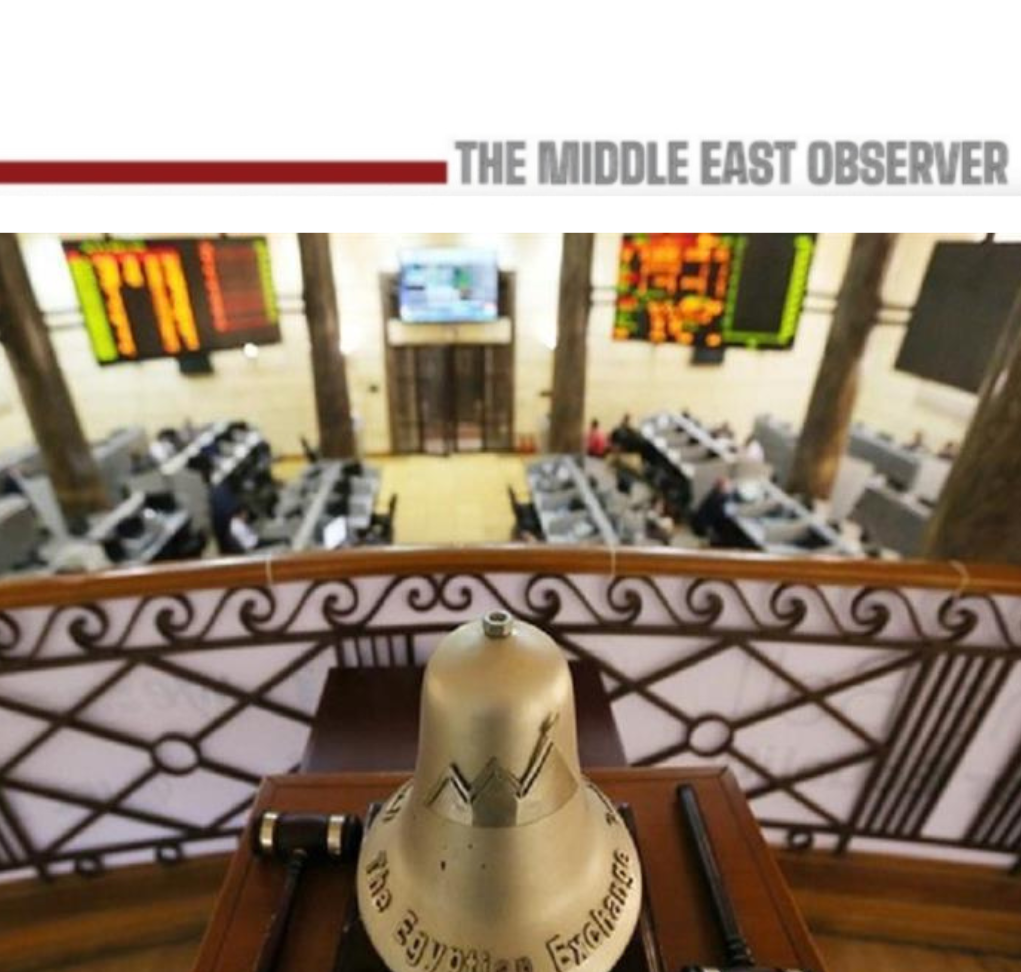
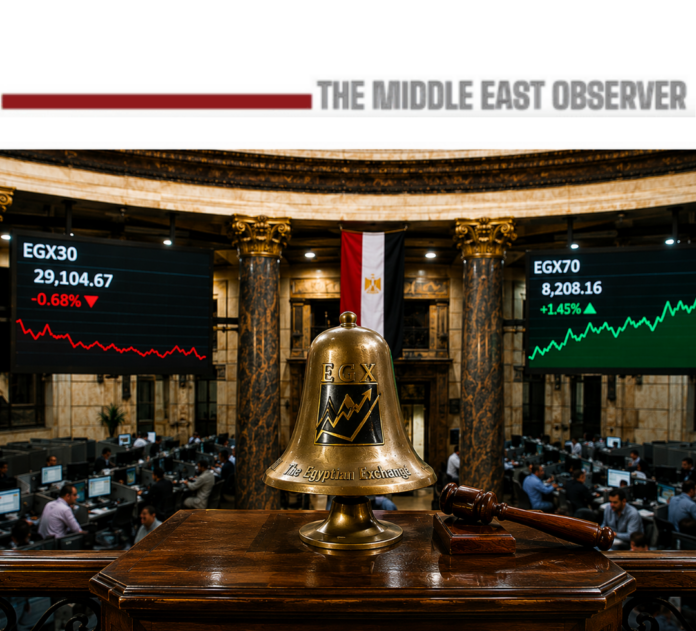
Egyptian stocks opened the week mixed on Sunday, with the EGX30 slipping below 55,000 while smaller shares advanced and market capitalization rose, extending a shift in market leadership after the benchmark’s strong 2026 rally.
The EGX30 fell 0.31% on August 30 to 54,937.34 points, while the EGX70 rose 0.30% to 21,332.45 and EGX100 gained 0.37% to 27,681.48. EGX35-LV advanced 0.95%, while the EGX33 Shariah index fell 0.41%.
Market capitalization increased by about EGP10.7bn to EGP 4.293tn, while turnover reached EGP12.205bn, with 4.25bn shares changing hands through 280,166 transactions.
The combination points to rotation within the market rather than broad risk reduction: the large-cap benchmark fell, but smaller stocks and aggregate market value advanced.
Smaller Stocks Regain Ground
Sunday extended the breadth recovery that emerged at the end of the previous shortened week.
EGX70 fell 1.15% on August 24 and another 1.27% the following day before rebounding 0.79% on Wednesday and a further 0.30% on Sunday. EGX30, by contrast, has declined in three of its past four sessions and stands about 1.6% below its August 16 record close of 55,854.74.
Two positive sessions are insufficient to establish a new small-cap trend. But they show that the earlier deterioration in breadth has not developed into a general market correction.
The previous shortened week also ended positively. EGX30 gained about 0.7%, while EGX70 advanced roughly 2.2% and EGX100 about 1.9%. Market capitalization rose from approximately EGP4.218tn to EGP4.282tn.
The market is therefore becoming more selective rather than uniformly weaker — an increasingly important distinction after the EGX30’s strong year-to-date advance.
Foreigners Return — but Only Tentatively
Sunday’s equity flows provided a modestly positive signal.
Regular-session data show non-Arab foreign investors as net buyers of EGP43.4mn, alongside about EGP 197.3mn of Egyptian net buying. Arab investors were net sellers of approximately EGP240.8mn.
This requires an important data qualification. Another published dataset gives Egyptian buying of EGP536.2mn and Arab selling of EGP579.6mn, while retaining the same EGP43.4mn foreign figure. The discrepancy indicates a difference in transaction classification; the larger numbers should therefore not be presented as ordinary equity net flows without reconciliation.
The direction is more useful than the amount: foreigners returned as equity buyers on Sunday after being net sellers during the previous week.
EGX weekly data show that non-Arab foreign investors accounted for 6.6% of listed-equity trading in the shortened week and recorded net sales of about EGP988mn, excluding deals. Arab investors accounted for 3% and were net sellers of roughly EGP223mn. Egyptians represented 90.4% of trading.
Against that backdrop, Sunday’s EGP43.4mn of foreign buying is encouraging but far too small to establish a reversal in international positioning.
A sustained return would require repeated foreign net buying across subsequent sessions.
The Pound Remains Central to the Foreign-Investor Case
Currency conditions provide another important test.
The dollar closed Sunday at about EGP50.45 for buying and EGP 50.59 for selling at the Central Bank of Egypt. Despite intraday movement, contemporaneous banking data showed the dollar ending lower against the pound across several major banks than earlier in the session.
That corrects the interpretation that Sunday’s move represented a renewed bout of pound weakness.
One session is nevertheless insufficient to establish a currency trend. What matters for international equity investors is whether exchange-rate flexibility can coexist with sufficient stability to preserve dollar returns and allow capital to enter and exit without disruption.
A weaker pound can improve local-currency earnings for exporters and companies with foreign-currency revenues, while depreciation simultaneously reduces dollar-denominated returns for overseas shareholders.
The relevant investment question is therefore not whether the pound strengthens every session, but whether currency risk remains orderly and investable.
High Rates Raise the Equity Hurdle
Interest rates remain another constraint on equity valuations.
The Central Bank of Egypt kept its overnight deposit rate at 19%, lending rate at 20% and main-operation rate at 19.5% at its August 20 meeting. July urban inflation stood at 14.9%, while core inflation was 14.7%.
For equities, high rates cut both ways.
They have supported earnings at listed banks through interest income and returns on government securities. But high fixed-income yields also raise the opportunity cost of owning equities, particularly after the EGX30’s substantial advance this year.
The impact is increasingly company-specific. Banks can benefit from elevated rates; leveraged businesses face higher financing costs; exporters can benefit from foreign-currency revenues; and import-dependent companies remain exposed to exchange-rate movements.
That makes earnings quality, balance-sheet strength and revenue composition more important as the market matures.
The next phase of the rally will therefore need more than liquidity. Companies increasingly have to justify valuations against the returns available in Egypt’s fixed-income market.
Market Reform Improves the Infrastructure
Egypt is meanwhile continuing to deepen its capital-market infrastructure.
The EGX’s revised market segmentation takes effect on September 1, introducing dedicated classifications including a Short Selling Board and aligning eligibility for specialised trading activities more closely with index criteria.
The regulatory groundwork for revamped short selling is advancing, but full implementation should be distinguished from rule-making. The reform is better treated as an upcoming structural improvement rather than a current market catalyst.
If implemented effectively, deeper securities lending and short selling could improve price discovery, hedging and institutional participation. But market infrastructure can facilitate investment; it cannot substitute for earnings or valuation.
The Rally Faces a More Demanding Test
Sunday’s session therefore argues against interpreting the EGX30’s fall below 55,000 as evidence of a market-wide reversal.
EGX70 and EGX100 advanced, market capitalisation reached EGP4.293tn and non-Arab foreigners returned as modest equity buyers.
But the evidence remains mixed. Foreign investors were substantial net sellers over the previous week, Sunday’s buying was small, and high domestic fixed-income returns continue to compete with equities for capital.
The next stage of the EGX therefore rests on three tests: whether broader participation persists, whether foreign buying becomes sustained alongside orderly currency conditions, and whether corporate earnings can justify valuations against Egypt’s high interest-rate environment.
Market reforms have improved the infrastructure. Breadth has recovered from its earlier deterioration. Neither substitutes for fundamentals.
After a powerful rally, another EGX30 record would matter less than evidence that broader participation, earnings growth and sustained foreign demand are strengthening together.
Related news:
US Dollar Strength Tests Egyptian Pound as Markets Navigate Managed Adjustment Cycle
Telecom Egypt Moves Into FTSE Mid-Cap Segment as Market Value Reaches $3.9bn
Read also:
Cairo’s Monorail Gamble: Can Egypt’s New Transit Vision Justify Its Cost?
EGX30 Climbs Above 53,000 as Domestic Buying Offsets Foreign Selling