Egypt Faces a Narrow Window to Secure Alternative Scrap Supply
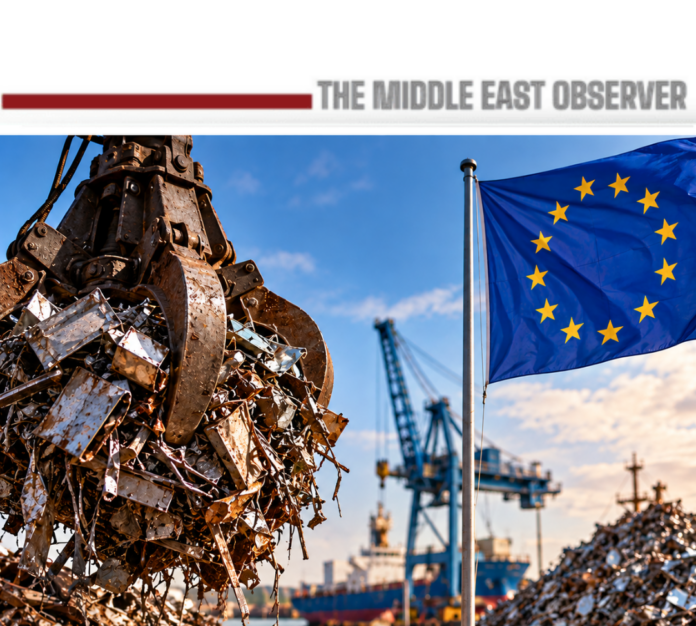
Europe is moving to retain a greater share of its recycled metals as electric-arc steelmaking expands, defence production rises and major economies compete more aggressively for strategic raw materials.
A European Commission draft published on September 18 proposes excluding several major non-OECD buyers — including Egypt, India, Pakistan and Bangladesh — from receiving certain EU ferrous and non-ferrous metal waste when revised Waste Shipment Regulation provisions take effect on May 21, 2027.
The legal basis is environmental. Non-OECD countries may continue receiving covered EU waste only where Brussels determines that it can be managed according to required environmental standards. The Commission is receiving comments until October 16, with its first authorised-country list due by November 21.
But the measure also captures a wider industrial shift: scrap is increasingly being treated not as surplus waste, but as strategic feedstock.
S&P Global estimates the proposed exclusions could displace 4.0-4.1mn tonnes of annual EU steel-scrap exports, around 25%-26% of current shipments, together with approximately 970,600 tonnes of aluminium scrap.
That could trigger one of the most significant redistributions of recycled-metal trade in years.
From Waste to Strategic Feedstock
Europe’s scrap policy is unfolding alongside — not necessarily because of — its rearmament drive, critical-minerals strategy and push to rebuild strategic industrial capacity.
Governments are competing for copper, lithium, rare earths and other materials required for power networks, advanced manufacturing, defence and clean technologies. Europe is simultaneously seeking to reduce dependence on concentrated external supply chains.
The Commission’s Steel and Metals Action Plan places circularity and access to secondary raw materials at the centre of industrial policy, while its Critical Raw Materials framework seeks greater domestic extraction, processing, recycling and reuse.
That gives metals already circulating inside Europe greater strategic value.
The logic is particularly important for steel.
Europe is expanding electric-arc-furnace capacity as producers move away from more carbon-intensive production. EAFs can consume substantially more recycled steel, creating a growing domestic market for material that Europe has historically exported in large volumes.
A Surplus First, Tighter Supply Later
The transition creates a timing mismatch.
Restricting several million tonnes of exports from May 2027 would initially leave more scrap competing for European buyers. If domestic mills cannot immediately absorb the displaced tonnage, prices could weaken.
That would improve feedstock economics for European EAF producers.
But it would not automatically strengthen recyclers. Lower scrap values can squeeze collection and processing margins and weaken incentives to recover material — one reason European recycling groups have opposed parts of the proposal.
The surplus may also be temporary.
Industry estimates suggest additional European EAF production and substitution of imported steel could require millions of extra tonnes of scrap later this decade.
The likely sequence is therefore:
2027: export outlets contract and domestic availability rises.
2027-2030: additional EAF capacity progressively absorbs more secondary metal.
Later in the decade: material initially viewed as surplus becomes increasingly valuable to European mills.
Brussels may therefore be retaining future industrial feedstock before future demand has fully arrived.
The Cost Pressure Moves Outside Europe
The displaced demand will not disappear.
Egypt, India, Pakistan and other affected buyers will instead compete harder for material from the UK, US, Canada, Japan, Australia and other available markets.
The economic effect could therefore diverge sharply.
Inside Europe, greater availability may initially place downward pressure on scrap prices.
Outside Europe, displaced buyers could face tighter competition, longer supply routes and higher freight costs.
The regulation could therefore improve metallic-feedstock economics for some European steelmakers while increasing landed costs for producers elsewhere — even though that is not its stated purpose.
Egypt Cannot Wait Until November
Egypt provides one of the clearest examples.
EU-27 exporters shipped approximately 1.86mn tonnes of recycled steel to Egypt in 2025, making Europe one of the country’s most important external scrap sources.
For Egyptian mills and traders, however, the critical date is not November 21.
That is when Brussels expects to adopt its first authorised-country list. Commercial sourcing decisions need to move earlier.
Egypt could still provide additional regulatory and environmental evidence capable of changing the Commission’s assessment. But large-volume procurement programmes cannot sensibly begin only after a final ruling.
Other affected importers will be approaching the same alternative suppliers.
By November, the issue may no longer be simply whether material is available, but which buyers have already secured supplier relationships, credit facilities, shipping programmes and contractual volumes.
The months before May 2027 are therefore likely to become a diversification window rather than a period for regulatory waiting.
UK and Atlantic Markets Offer the Immediate Hedge
The UK is the natural first alternative.
Britain is outside the EU and remains one of the world’s largest ferrous-scrap exporters, shipping roughly 7.5mn tonnes in 2025. Egypt already buys substantial quantities from the market, giving importers established specifications, supplier relationships and logistics.
That makes the UK the most immediate market in which Egyptian buyers can deepen volumes and longer-term supply programmes.
The US, with roughly 21.4mn tonnes of ferrous-scrap exports in 2025, offers a much larger secondary pool.
Canada, Brazil and other Atlantic suppliers could provide additional tonnes, although competition will intensify if several major importers simultaneously shift away from European material.
Japan and Australia remain important exporters, but freight economics are less favourable for Egypt and Asian demand already competes heavily for those flows.
The realistic response is therefore not to find another “Europe”, but to construct a diversified portfolio of supply basins.
Africa: Strategic Supplement, Not Immediate Substitute
Africa should form part of that portfolio, but not as a near-term replacement for European tonnage.
The continent generates substantial scrap, but much of it remains fragmented, informally collected, domestically consumed or subject to export restrictions.
Several African governments are themselves moving towards retaining scrap for local processing. South Africa, Kenya and Ghana illustrate that trend.
For Egypt, the most credible opportunity lies instead in building supply chains upstream.
North Africa offers the strongest logistical case. Libya and Tunisia benefit from proximity and existing commercial links, although current exportable volumes remain limited.
The more important longer-term opportunity is for Egyptian traders and steelmakers to participate in:
collection and aggregation;
grading and sorting;
processing and baling;
long-term offtake agreements;
and dedicated maritime routes into Egyptian ports.
The commercial question is therefore not whether Africa contains sufficient scrap in aggregate, but whether individual markets can consistently produce exportable volumes of the required quality under stable regulations.
Africa is best viewed as a medium-term regional resource-security strategy, not an emergency substitute for European cargoes.
Domestic Scrap Becomes More Strategic
Egypt’s second response lies at home.
If European supply becomes less accessible, formalising domestic scrap collection becomes more valuable.
That increases the importance of better sorting, traceability and recovery, while strengthening the industrial case for ship recycling.
The planned Damietta ship-recycling complex could therefore become more than a maritime or environmental project. It could form part of Egypt’s raw-material security strategy.
Egypt also has an advantage through its substantial DRI-based steelmaking capacity, giving larger producers more flexibility than economies almost entirely dependent on scrap-fed EAFs.
The hierarchy is clear:
Immediate: diversify imported scrap.
Medium term: expand domestic collection and regional aggregation.
Longer term: deepen ship recycling and optimise the balance between scrap, DRI and other metallic inputs.
A Broader Change in Steel Economics
Europe’s proposal reflects a wider change in how recycled metal is valued.
A growing number of governments already restrict ferrous scrap exports in some form, seeking to preserve material for domestic steelmaking and downstream industry.
Europe’s scale could accelerate that shift.
In the short term, European mills may gain access to greater volumes of domestic scrap while affected importers compete harder for alternative supplies.
Over time, expanding European EAF capacity could absorb much of that retained material.
For Egypt, the implication is more immediate.
UK and Atlantic supply relationships will need to deepen before other displaced buyers crowd the same markets. Over the longer term, domestic collection, African aggregation, ship recycling and DRI will determine how far the country can reduce its exposure to imported scrap.
The May 2027 deadline is regulatory. The commercial adjustment has already begun.
Related News:
US and Japan Deepen Critical Minerals Alliance Around Lynas
Elsewedy Electric Invests $200m to Build an Integrated Metals Manufacturing Hub
Red also:
Egypt’s Steel Price Reset Raises Competition and Export Questions
Egypt’s €690mn Grid Upgrade Lays Groundwork for European Power Exports