Small-cap momentum cools as blue chips recover; Kuwaiti interest and selective Norwegian positioning sharpen the focus on Egypt’s institutional market depth
CAIRO — Egypt’s equity rally entered a more selective phase this week as leadership shifted between smaller companies and blue chips, while fresh indications of Gulf and international interest added a longer-term dimension to a market whose capitalization has moved firmly beyond EGP4tn.
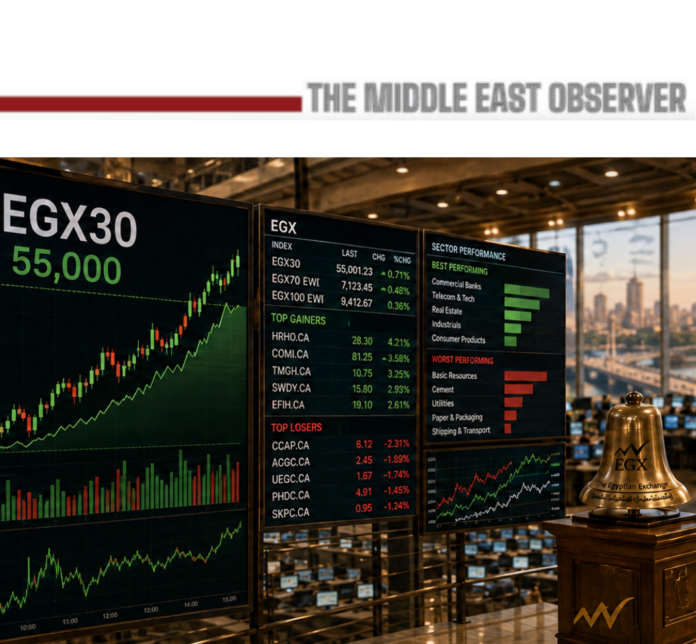
The EGX30 gained 0.38% on Wednesday to 55,039.76 points, reversing Tuesday’s marginal 0.09% decline and returning above the 55,000 threshold. The EGX33 Shariah Index advanced 0.22% to 6,475.04, while the EGX35-LV eased 0.12% to 6,824.36. The benchmark close is independently corroborated by current market data.
The broader market moved in the opposite direction. The EGX70 Equal Weight Index retreated 1.31% to 21,630.60 after climbing 2.71% on Tuesday, while the EGX100 fell 0.91% to 27,915.05 following a 2.36% advance in the previous session.
Market capitalisation nevertheless edged up to approximately EGP4.21tn, compared with EGP4.207tn on Tuesday, suggesting that Wednesday’s divergence was more a rotation of capital than a broad withdrawal from Egyptian equities.
Small Caps Remain the Week’s Clear Winners
Wednesday’s pullback erased only a fraction of the gains accumulated by smaller companies over the previous sessions.
Between August 6 and Wednesday’s close, the EGX70 gained roughly 8.2% and the EGX100 about 6.9%, compared with an increase of only around 0.7% for the EGX30. Over the same period, listed-market capitalisation expanded by approximately EGP106bn, or 2.6%.
The disparity has made market breadth one of the defining features of August trading.
Part of the divergence reflects index construction: equal-weighted benchmarks give smaller constituents greater influence than the EGX30. But the pace of appreciation raises a more fundamental question about how far prices can run ahead of corporate performance.
An advance of more than 8% in the EGX70 in less than a week becomes progressively harder to sustain through liquidity and momentum alone. If earnings fail to expand at a comparable pace, further gains would increasingly reflect higher valuation multiples rather than underlying profit growth, leaving recent winners more exposed to disappointing corporate results.
The next earnings cycle is therefore becoming more important than another numerical index milestone.
Kuwait Adds a Gulf Dimension to the Investment Story
The rally coincides with a broader effort by Egypt to convert stronger market activity into greater Gulf participation.
Kuwaiti investors have signalled interest in expanding their exposure to Egypt during a virtual seminar organised by Egypt’s Commercial Representation Office in Kuwait in cooperation with Kuwait’s Union of Investment Companies.
Abdullah Hamad AlTerkait, chairman of the Kuwaiti investment-industry body, highlighted opportunities across the Egyptian economy and praised efforts to improve trading mechanisms and market transparency, according to the Egyptian Exchange. The event formed part of continuing efforts to deepen economic and investment ties between the two countries.
The discussions come as activity on the EGX has accelerated. Exchange chairman Omar Radwan said more than 385,000 new investors had registered since the beginning of 2026, while daily transactions have exceeded 300,000 and trading values have moved above EGP15bn.
The Kuwait discussions should nevertheless be treated as evidence of prospective investor interest, rather than proof of capital already entering listed equities.
That distinction is important. Expressions of interest can widen the potential Gulf investor base, but their significance for market depth will ultimately depend on whether they translate into sustained portfolio allocations, strategic investment or new listings.
Norway Provides the More Concrete Institutional Signal
Norway’s Government Pension Fund Global offers a different form of evidence through its disclosed portfolio positioning.
The reported value of the sovereign fund’s Egyptian equity holdings rose to about $158.7mn at the end of June, roughly 22% above the level recorded at the end of 2025, with higher ownership in selected companies including Commercial International Bank and Fawry.
The increase in portfolio value should not be interpreted entirely as new capital entering Egypt. Share-price movements and exchange rates also affect reported valuations; changes in percentage ownership provide stronger evidence of where exposure was actually increased.
For the EGX, the importance lies less in the absolute size of Norway’s holdings than in what selective positioning says about institutional investability.
Large global investors must be able to build and exit meaningful positions efficiently. Liquidity, free float, governance and market accessibility therefore become central to whether an emerging market can accommodate substantial institutional allocations.
The Kuwaiti and Norwegian developments consequently carry different evidentiary weight: Kuwait points to potential future capital, while Norway provides evidence of actual institutional positioning.
Together, however, they reinforce a broader theme: international interest in Egyptian equities is becoming more visible, but remains selective rather than market-wide.
Bigger Is Not Yet the Same as Deeper
Rising valuations have increased the EGX’s nominal size, but market depth requires larger investable companies, sufficient free floats, sustained liquidity and broader institutional participation.
Egypt is seeking to address those constraints through new listings and a wider product architecture spanning bonds, sukuk, exchange-traded funds, derivatives and environmental markets. Radwan has linked the recent expansion in market capitalisation and investor registrations to structural efforts to make the exchange more attractive to domestic and international capital.
The Financial Regulatory Authority has also established Egypt’s first framework governing hedge funds, allowing investment strategies involving equities, debt instruments, derivatives and securities borrowed for short selling.
Short selling forms another part of the emerging architecture. The regulator has been developing a securities-borrowing framework intended to increase market efficiency, liquidity and investment options.
Such mechanisms can improve price discovery and give professional investors more tools to hedge risk rather than simply reduce exposure when markets weaken. Their contribution, however, will depend on adoption, liquidity and execution rather than regulation alone.
Sector Leadership Becomes More Selective
The change in leadership is already visible at sector level.
Cement producers were among Tuesday’s strongest performers, with several reaching their daily price limits. By Wednesday, pharmaceutical stocks that had driven earlier stages of the rally were among those facing the sharpest profit-taking. Misr Beni Suef Cement extended its advance by 10.45%, while EIPICO declined 7.19%.
The individual moves matter less than the pattern: capital is rotating between sectors rather than lifting the market indiscriminately.
That would mark a more selective stage of the rally, increasing the importance of earnings growth, balance-sheet strength and company-specific catalysts in determining returns.
The Next Test Is Earnings, Not Another Record
The immediate market picture therefore contains two distinct signals.
Small and mid-sized stocks have dramatically outperformed the benchmark, demonstrating risk appetite well beyond the largest companies. Wednesday’s reversal, however, shows that investors are increasingly prepared to crystallise gains and redeploy capital after rapid price appreciation.
The longer-term backdrop is also evolving. Kuwait offers another potential channel for Gulf capital, while Norway’s sovereign fund provides tangible evidence that major global institutions are prepared to increase exposure selectively.
But neither changes the central challenge facing the EGX.
A market capitalised at more than EGP4.2tn needs institutional depth to accompany its rising valuation. That means larger listings, greater free floats, stronger participation by long-term investors and sufficient liquidity across a wider universe of securities.
Regulatory reforms — including hedge funds, derivatives and securities lending — can help build that architecture. But market sophistication will ultimately be judged by their use, not their introduction.
For investors, the more immediate test is simpler.
Since August 6, the EGX70 has risen more than 8% and the EGX100 almost 7%, while the EGX30 has advanced less than 1%. The sustainability of that divergence will increasingly depend on whether earnings can catch up with prices.
Wednesday’s rotation therefore matters less because the EGX30 crossed back above 55,000 than because it may signal a change in the character of the rally.
After a period dominated by liquidity and momentum, fundamentals, valuation and institutional investability are moving back to the centre of the investment case.
Related news:
Europe’s Energy Bridge: How to Exit Dependence Without Falling Into a New One
Read also:
Kuwait Launches 15-Year Residency Programme to Attract Foreign Investment