Once known in the Nubian language as the “Land of Aromatic Plants,” Toshka has evolved from a remote stretch of the Western Desert into one of Egypt’s most ambitious agricultural development projects. Conceived nearly three decades ago, the initiative has become a cornerstone of the country’s strategy to strengthen food security, expand arable land, attract agricultural investment, and support long-term rural development. While the project has faced periods of slow progress since its launch, renewed government investment and modern engineering have transformed Toshka into one of Egypt’s largest reclaimed agricultural regions.
From Vision to National Development Strategy
The Toshka Project was first conceived in 1996 as part of Egypt’s long-term strategy to increase cultivated land beyond the Nile Valley. Formally incorporated into the country’s first horizontal agricultural expansion programme in 1997, the initiative originally targeted the reclamation of approximately 3.4 million feddans using a combination of Nile water diverted from Lake Nasser, groundwater aquifers beneath the Southern Valley, and non-conventional water resources where feasible.
As Egypt’s population continued to expand and concerns over food security intensified, the country’s agricultural strategy evolved. By 2017, national plans for horizontal agricultural expansion had been broadened to approximately 10.4 million feddans nationwide, with Toshka emerging as one of the flagship projects supporting this objective through modern irrigation systems and more efficient water management.
A decisive turning point came in 2020, when the government accelerated implementation under presidential directives. The renewed phase brought together the Ministry of Water Resources and Irrigation, the Armed Forces Engineering Authority, the National Service Projects Organization (NSPO), and numerous Egyptian contractors to complete long-delayed infrastructure and prepare additional land for cultivation.
Engineering a New Agricultural Landscape
The scale of Toshka reflects one of Egypt’s largest modern irrigation undertakings. According to official figures, the project currently includes:
| Infrastructure Indicator | Current Status |
|---|---|
| Main and branch canals | 491 km |
| Reclaimed and cultivated land | 517,000 feddans |
| Planned cultivated area | 720,500 feddans |
| Major lifting and pumping stations | 19 |
| Hydraulic engineering structures | More than 313 |
Water is pumped from Lake Nasser through the Sheikh Zayed Canal system before being distributed across extensive irrigation networks serving newly reclaimed farmland. The development also incorporates advanced pumping stations, pipelines and hydraulic control systems designed to optimise water efficiency in one of Egypt’s driest regions.
Unlike many long-established agricultural areas, much of Toshka’s reclaimed desert land has not been subjected to decades of intensive cultivation. This provides favourable conditions for producing high-quality crops, although any produce marketed as organic must still comply with recognised certification standards governing cultivation practices, fertiliser use and pesticide application.
Supporting Egypt’s Food Security
Beyond expanding cultivated land, Toshka is intended to strengthen Egypt’s strategic food supply by increasing domestic production of key crops including wheat, maize, vegetables, dates and export-oriented horticultural products. The project complements other national agricultural initiatives such as the Future of Egypt, East Oweinat, and the 1.5 Million Feddan Project, together forming part of a broader effort to reduce dependence on food imports while expanding agricultural exports.
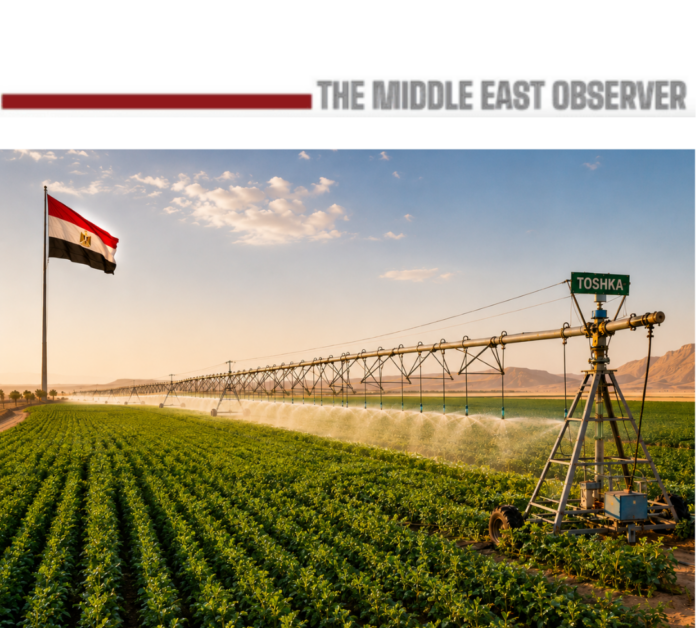
Modern irrigation technologies—including centre-pivot irrigation, automated pumping systems and digital water management—allow agricultural production in areas previously considered unsuitable for cultivation while helping improve water-use efficiency, a critical objective for one of the world’s most water-scarce countries.
Investment Potential Beyond Agriculture
Toshka has also become an emerging investment destination for agribusinesses, food processors and agricultural exporters. Improved transport infrastructure linking Upper Egypt with Red Sea ports has strengthened market access for producers, while new road networks have reduced transportation times between farms, processing facilities and export terminals.
The development is increasingly attracting investment across the agricultural value chain, including food processing, cold storage, logistics, seed production and agricultural technology, rather than focusing solely on primary crop cultivation.
Eng. Yassin Ahmed, owner of Al-Wadi Food Industries Factory, credits the agricultural research institutions supporting the region with improving access to higher-yield seed varieties.
“In the past, tomatoes were available for only a limited season. Today, production extends over much longer periods, reflecting the improvements in agricultural infrastructure and research support available to investors.”
His observation reflects broader efforts to improve crop productivity through modern farming techniques rather than representing nationwide production trends.
How Agricultural Land Is Allocated
Land allocation within Toshka is managed through several government entities, depending on the project phase and investment programme. These have included the Egyptian Countryside Development Company (under the 1.5 Million Feddan Initiative), the General Authority for Reconstruction Projects and Agricultural Development (GARPAD), the Ministry of Agriculture, and more recently the Future of Egypt for Sustainable Development agency.
Allocation mechanisms generally include:
- Long-term usufruct and lease agreements for large strategic agricultural developments.
- Installment-based ownership programmes for qualifying investors under selected government initiatives.
- Specialised investment schemes, including programmes designed for Egyptian expatriates and eligible foreign investors, subject to applicable regulations and project-specific conditions.
Rather than following a single nationwide framework, eligibility requirements vary according to each allocation round, land package and investment programme.
Typical Investor Requirements
Depending on the specific tender or allocation programme, applicants may be required to demonstrate:
- registration as an Egyptian corporate entity;
- agricultural or land development activities within the company’s registered objectives;
- adequate financial capacity;
- technical expertise and implementation experience;
- submission of a detailed development and cultivation plan;
- commitment to project execution schedules.
Additional conditions—including company tenure, ownership structure, minimum investment values or financing requirements—may differ between individual tenders and are determined by the relevant government authority.
Typical Investment Process
Although procedures differ between allocation rounds, investors generally follow a structured process:
- Monitor official land allocation announcements issued by the relevant government authority.
- Submit legal documentation, technical studies and financial qualifications.
- Conduct site inspections and technical assessments of allocated plots.
- Complete financial commitments, including deposits and contractual payments.
- Sign the allocation agreement and commence land development within the agreed implementation timetable.
From Early Challenges to Long-Term Opportunity
The Toshka Project has experienced a complex development journey since its inception. Early implementation faced challenges ranging from financing constraints and infrastructure gaps to evolving national priorities. The project’s revival over recent years reflects a broader shift towards integrating large-scale agricultural expansion with transport infrastructure, water management and food security planning.
Whether Toshka ultimately fulfils its long-term ambitions will depend not only on engineering achievements but also on sustained investment, efficient water management, competitive agricultural production and successful integration with domestic and international food markets. Nevertheless, the project has already become one of Egypt’s most significant examples of desert reclamation, illustrating how large-scale infrastructure and agricultural policy are increasingly being combined to address the country’s long-term economic and food security objectives.
Related news:EGX Ends Difficult Week as Foreign Buyers Offset Domestic Selling
OECD Urges Egypt to Shift from Food Subsidies to Innovation-Led Agriculture
Read also:ADNOC Targets $55bn Investment Push to Accelerate Oil Expansion
AfDB Approves €100mn Loan for Morocco’s First EV Battery Gigafactory