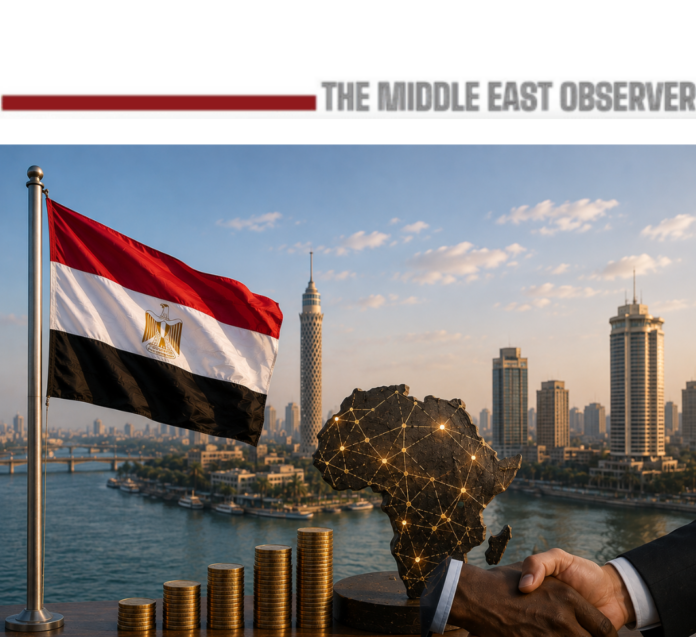
Cairo is moving to build a more organized route into African markets for Egyptian companies, planning a continent-wide database of priority projects and an investment coordination mechanism that would combine diplomatic access, project intelligence, development finance and risk guarantees to generate more contracts, investment and a larger commercial footprint across the continent.
The government plans a database of priority projects and investment opportunities, while Foreign Minister Badr Abdelatty has proposed a dedicated entity bringing together government agencies, banks and private companies.
Speaking at an expanded meeting with business representatives attended by Fahd Al-Dosari, chairman of the Arab Bank for Economic Development in Africa, or BADEA, Abdelatty said Egypt would work with African governments and institutions to help companies overcome regulatory and administrative barriers and improve market access.
The push builds on a sizable but still developing commercial presence. President Abdel Fattah Al-Sisi said in December that accumulated Egyptian investment in Africa had exceeded $12 billion, while trade with African countries had surpassed $10 billion.
The challenge is to broaden that presence beyond major contractors and established exporters, bringing more manufacturers, service providers and smaller businesses into African markets.
From Political Ties to Commercial Access
Cairo increasingly sees infrastructure, energy, logistics, agriculture, industry and technology as routes through which political relationships with African governments can translate into commercial opportunities.
The clearest evidence of Egyptian companies’ ability to compete is Tanzania’s $2.9 billion Julius Nyerere Hydropower Plant and Dam, implemented by a joint venture between Arab Contractors and Elsewedy Electric. The 2,115MW project demonstrates the capacity of Egyptian companies to execute large and technically complex infrastructure contracts abroad.
But the scale of Africa’s investment requirements also illustrates why project execution alone is not enough.
The African Development Bank estimates that the continent requires $130 billion-$170 billion annually for infrastructure, leaving a financing gap of $68 billion-$108 billion a year. The shortfall reflects not only limited capital but also a shortage of projects sufficiently prepared to attract financing.
For Egyptian companies, that creates opportunity — but also raises the importance of finance and project preparation.
Finance Becomes Part of the Bid
Large African infrastructure projects frequently require long-term capital, development-finance participation or sovereign support. Companies may also face currency constraints, payment delays and political or regulatory risks.
In that environment, financing increasingly becomes part of the competitive offer rather than an afterthought.
Egypt has established mechanisms intended to reduce those barriers, including an agency to guarantee exports and overseas investment and financing support for development and infrastructure projects.
BADEA’s participation adds another potential source of financial capacity. Development institutions can improve project bankability by providing longer-tenor finance, sharing risk and mobilising co-financing alongside commercial lenders.
That matters because Egyptian businesses are competing against Chinese, Gulf, European, Turkish, Indian and other international groups that can often combine engineering or industrial capability with financing.
Technical competitiveness alone may therefore be insufficient. The ability to bring credible financing to a project can help determine whether an opportunity becomes a contract.
From Project Lists to Bankable Deals
The proposed African investment database could address another constraint: reliable commercial intelligence.
Companies need more than lists of opportunities. They need to know whether financing exists, when procurement will begin, who the counterparties are and what local-content, regulatory and payment risks apply.
If structured around those requirements, the database could function as a commercial intelligence platform, using Egypt’s diplomatic network to identify government priorities and projects before they reach procurement.
This would be particularly valuable for smaller companies unable to maintain teams across multiple African markets.
The proposed investment coordination entity could complement that effort by bringing ministries, diplomatic missions, banks, development institutions and businesses together around specific opportunities.
Both mechanisms, however, remain proposals rather than fully operational institutions. Their value will be measured by whether they generate bankable projects and contracts.
The African Development Bank’s experience underlines the difficulty. Its president, Sidi Ould Tah, said in May that only about one in 10 African projects reaches financial close, highlighting the gap between identifying investment opportunities and turning them into investable assets.
That is precisely the gap Cairo’s proposed system will need to address.
Bringing More Companies Into the Market
The second test is whether Egypt can extend its African presence beyond its largest corporations.
Major contractors have the balance sheets and international teams needed to establish operations abroad. Smaller manufacturers and service companies face much higher barriers to finance, information and market entry.
The government’s Hafez financial and technical support platform is intended partly to bridge that gap by connecting businesses with financing instruments, technical assistance and opportunities offered by development partners. Officials said outreach across several Egyptian governorates had involved about 219 companies in sectors including agriculture, food processing, engineering industries, textiles, tourism, logistics and technology.
Large Egyptian projects could provide another route into African markets.
Power plants, transport networks and water projects require equipment, cables, pumps, construction materials, software, logistics and maintenance. Building Egyptian supplier networks around major contracts could allow more of that value chain to flow through domestic manufacturers and service providers rather than concentrating expansion among a handful of large contractors.
The African Continental Free Trade Area could widen that opportunity by reducing barriers to intra-African commerce and encouraging regional supply chains.
For Egyptian companies, the longer-term prize is therefore not simply higher exports. It is the ability to establish manufacturing, assembly, logistics and service operations in selected markets that can serve neighbouring economies.
That would represent a shift from an export-and-contracting model towards investment and partnership.
It would also respond to African governments’ growing emphasis on employment, local manufacturing, skills and technology transfer. Joint ventures, local production and regional distribution networks could consequently become increasingly important to Egyptian competitiveness.
Competition Raises the Stakes
Africa’s investment requirements are large, but the market is increasingly competitive.
Chinese companies have built extensive infrastructure and commercial networks across the continent, while Gulf investors have expanded in logistics, energy, agriculture, property and telecommunications. European, Turkish and Indian companies are also pursuing infrastructure and industrial opportunities.
Egypt’s advantages include proximity, established political relationships, a diversified manufacturing base and companies with experience executing African projects.
Its challenge is to combine those strengths with competitive finance, stronger market intelligence and sustained local presence.
The latest initiative could therefore prove more significant than another export-promotion programme if it moves Egyptian companies from responding individually to opportunities towards pursuing a coordinated pipeline backed by finance, information and risk mitigation.
The Test Is Execution
Egypt has already demonstrated that its companies can deliver major projects in Africa and has established a commercial base of more than $10 billion in trade and over $12 billion in accumulated investment.
The latest push addresses what comes next: turning diplomatic access and institutional support into repeatable commercial opportunities for a broader group of Egyptian businesses.
The opportunity is substantial, but the benchmark should be commercial rather than institutional.
A database or new investment entity will matter only if it produces more bankable projects, stronger financing packages, greater private investment and more Egyptian companies operating successfully across African markets.
The test now is whether Cairo can turn those tools into deal flow — translating Egypt’s political reach in Africa into a larger, deeper and more diversified economic presence.
Related news:
Egypt Engages US Tech, Energy and Retail Giants to Accelerate Investment Flows
Cairo University Launches AI Policy Bulletin to Support National Planning
Read also:
East Africa Eyes Joint Refinery as Dangote Signals Investment
Egyptian Companies Poised to Anchor Sudan’s Post-War Rebuilding