
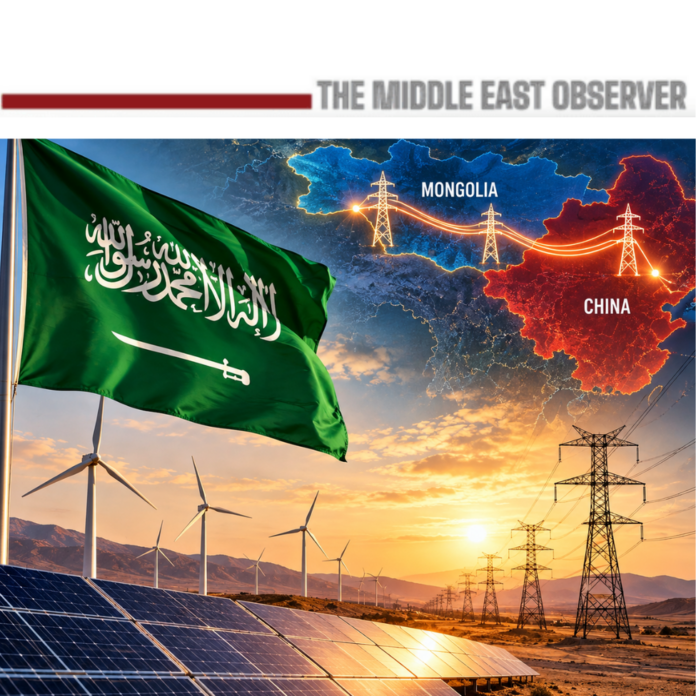
Saudi Arabia’s ACWA has signed a memorandum of cooperation with Mongolia’s Sun Steppe Power to explore a 4.5-gigawatt renewable electricity project aimed at exporting power to China, potentially opening a major new energy corridor across Northeast Asia.
The agreement, signed on October 13 during the 25th World Petroleum Congress in Riyadh, was witnessed by Saudi Energy Minister Prince Abdulaziz bin Salman and ACWA Chairman Mohammad Abunayyan. It marks an initial step towards converting Mongolia’s extensive wind and solar resources into commercially viable electricity exports.
A 4.5GW Project With Regional Ambitions
Under the memorandum, the companies will assess wind and solar generation facilities with a combined target capacity of 4.5GW, supported by a battery energy storage system with a capacity of 500 megawatt-hours.
The assessment will examine cross-border transmission infrastructure and the feasibility of supplying China or other markets agreed by the partners.
The proposed storage capacity is relatively modest compared with the planned generation portfolio, although its adequacy will depend on its intended function and power rating, which have not been disclosed.
No investment value, construction schedule or binding electricity purchase agreement has been announced.
Mongolia’s Export Potential Exceeds 100GW
Saleh Al-Khabti, ACWA’s regional president for China, told Asharq Bloomberg that Mongolia’s substantial wind resources and strategic location between China and Russia offer opportunities to develop large-scale electricity exports.
He estimated potential export opportunities to China at more than 100GW, with additional markets possible if transmission and government agreements eventually extend to South Korea and Japan.
The estimate represents a potential market opportunity, not an approved investment programme or committed ACWA project pipeline.
Mongolia’s ambitions are not new. Earlier Asian Development Bank-backed studies examined connecting renewable generation in the country’s Gobi region with electricity-consuming economies across Northeast Asia.
The commercial attraction lies in developing generation capacity far beyond Mongolia’s domestic market requirements, using cross-border infrastructure to reach larger industrial electricity consumers.
Mining and AI Could Expand Domestic Demand
Beyond exports, Al-Khabti identified mining, artificial intelligence and data centres as potential sources of additional electricity demand within Mongolia.
The country’s cold climate could reduce cooling requirements for data centres, while renewable electricity could support energy-intensive mineral processing and other industries.
Such developments could help Mongolia capture greater economic value domestically rather than relying exclusively on electricity exports. However, their scale will depend on industrial investment, infrastructure development and competitive energy prices.
Final Agreements Could Take Three Years
Speaking separately to Al Eqtisadiah, Al-Khabti indicated that final agreements for major Mongolian energy projects could take two to three years, potentially extending negotiations into 2028–2029.
He stressed that large export projects require coordination between governments, particularly over transmission infrastructure and long-term electricity arrangements.
For ACWA, the financial challenge extends beyond constructing generation facilities. Mongolia must deliver electricity to Chinese customers at prices competitive with domestic renewable generation and other sources of supply.
Transmission costs, grid access, financing, regulatory approvals and dependable long-term purchase agreements will determine whether the proposed corridor can attract investment.
Exports to South Korea and Japan would introduce further technical, diplomatic and infrastructure requirements.
The initiative could extend Saudi Arabia’s international energy investment footprint while offering Mongolia an opportunity to diversify its economy through electricity exports and associated industrial development.
China could gain another renewable supply option, while a wider interconnected market could eventually support regional energy security.
Related news:
When the Grid Becomes Global: Can Egypt Become a Regional Electricity Trading Hub?
Riyadh Energy Congress Exposes the Rising Cost of Securing Global Oil
Read also:
AI Investment Fuels Growth but Threatens Jobs and Traditional Tax Revenues
Saudi Al-Harfi Signs $1bn Syria Solar and Battery Agreements