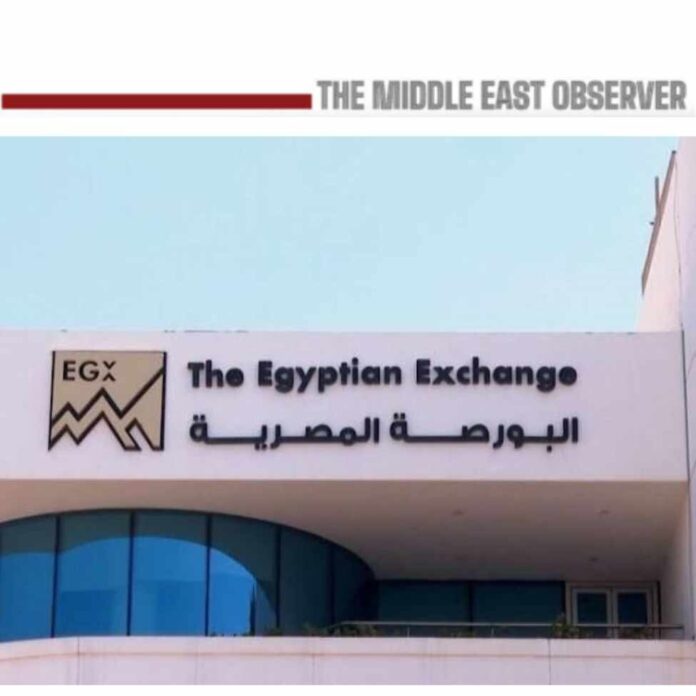
CAIRO — Egyptian equities extended their correction on Tuesday, wiping approximately EGP53bn from market capitalisation as smaller companies suffered disproportionate losses, despite renewed institutional buying and strong demand for MNT-Halan’s forthcoming stock-market listing.
Broad Selling Overshadows Benchmark Resilience
The benchmark EGX30 declined 0.68% to 51,265.27 points, following losses of 1.14% on Monday and 1.99% on Sunday.
The EGX70 Equal Weighted Index fell 2.74% to 17,917.04, while EGX100 declined 2.16% to 23,997.29. The Shariah-compliant EGX33 lost 0.58% and the lower-volatility EGX35-LV retreated 1.22%.
Market capitalisation slipped to EGP 3.999 tn, falling below the EGP4tn threshold.
Market breadth revealed the correction’s severity: 180 shares declined, 29 advanced and 12 remained unchanged. Declining stocks outnumbered gainers by more than six to one.
Since October 4, EGX30 has lost approximately 4.9%, compared with a 10.2% decline in EGX70. The widening gap suggests that investors remain considerably less willing to hold smaller companies than established blue-chip shares.
Foreign Institutions Buy as Retail Investors Retreat
Tuesday’s most important development was a change in the composition of investor flows.
Non-Arab foreign investors recorded net purchases of approximately EGP266mn, while Egyptian institutions bought EGP89.8mn. Egyptian individual investors, by contrast, sold approximately EGP311.3mn.
Overall, Egyptian investors were net sellers of EGP221.5mn, alongside EGP44.5mn in Arab net sales.
The shift suggests that institutional investors were selectively accumulating shares at lower prices, even as individual investors continued reducing exposure.
However, institutional purchases were insufficient to reverse the wider market decline. Tuesday’s partial intraday recovery limited the benchmark’s losses but did not prevent another sharp fall among smaller companies.
MNT-Halan Demand Exposes a Market Divide
Investor appetite was markedly stronger in the primary market.
MNT-Halan’s private placement attracted demand exceeding 11 times the shares offered, according to company and market reports. The tranche comprises 272 million shares, while the public offering covers another 48 million.
At EGP24.50 per share, the combined offering is valued at EGP7.84bn, implying a company equity valuation of EGP39.2bn.
The public tranche had attracted orders for approximately 252.5 million shares by Tuesday, equivalent to more than five times its allocation.
Commercial International Bank separately committed up to EGP2bn to the transaction.
The contrast is revealing. Investors were withdrawing from existing listed shares while competing for allocations in a new financial-technology listing.
Oversubscription does not, however, represent equivalent capital inflows into the wider exchange. The transaction largely involves the sale of existing shares rather than fresh financing for the company.
Its significance lies instead in demonstrating that investors remain prepared to commit substantial capital when they consider an individual investment attractive.
Short-Selling Reform Advances During Market Weakness
Egypt’s Financial Regulatory Authority also announced live testing of a centralised securities-lending system with the Egyptian Exchange and Misr for Central Clearing.
The initiative, developed under FRA Board Resolution No. 155 of 2026, is intended to support securities borrowing and regulated short selling.
Once operational, the mechanism could improve market liquidity, facilitate hedging and strengthen price discovery. Effective collateral management, transparent lending arrangements and supervision will be essential.
The system remained in testing on Tuesday, meaning the announcement should not be interpreted as evidence that short selling contributed to the decline.
Currency Weakness and High Yields Complicate Recovery
The Egyptian pound remained under pressure, with the dollar approaching EGP53 in official banking quotations.
Meanwhile, recent Treasury-bill auctions offered nominal yields exceeding 23%, reinforcing competition between government debt and equities for investment capital.
With the Central Bank of Egypt’s overnight deposit and lending rates standing at 19% and 20%, respectively, high fixed-income returns continue to raise the required return on riskier assets.
Currency depreciation presents an additional challenge for international investors, whose equity gains in Egyptian pounds may be reduced when translated into dollars.
Tuesday’s foreign buying therefore represents a constructive signal, but not sufficient evidence of a sustained return of international capital.
Recovery Requires Broader Institutional Participation
Selected shares resisted the decline. Orascom Construction gained 3.64%, Marsa Alam for Tourism Development advanced 4.85%, and Golden Textiles rose 3.57%.
Elsewhere, losses were substantial. KORRA fell 19.93%, Middle & West Delta Flour Mills declined 13.92%, and Misr Hotels lost 11.58%.
The session exposed an increasingly divided market: institutional investors showed interest in selected listed companies, MNT-Halan attracted substantial subscription demand, and smaller equities continued to lose value.
The decisive development was not another decline in EGX30, but the emergence of selective institutional accumulation without a corresponding improvement in market breadth.
A sustainable recovery will require that demand to spread beyond individual opportunities, accompanied by stabilisation in smaller companies and reduced pressure from currency weakness and competing fixed-income yields.
Until then, Tuesday’s trading points to selective accumulation within an unresolved correction, rather than the beginning of a confirmed market recovery.
Related news:
EGX Erases October Recovery as Institutional Selling Hits Smaller Stocks
Egypt’s Open-Blocks System Draws 403 Offers in First Major Investor Test
Read also:
EGX Breaks Below 56,000 as Broad Selling Tests Record Rally
Behind Washington’s Yen Intervention: Why Currency Support Cannot Fix the Rate Gap