The UAE Cabinet approved a AED90.1 billion ($24.5 billion) federal budget for 2027 on 12 October, setting out how the government will finance education, healthcare, pensions, public services and investment while seeking to maintain essential services, improve spending efficiency and support long-term economic growth.
Although the annual budget is 2.5% smaller than the AED92.4 billion approved for 2026, spending on government affairs, infrastructure and other federal expenses is increasing. The biggest reduction is in financial investments, raising questions about the future of a AED12.4 billion government support programme introduced last year.
The Cabinet also approved a broader AED292.5 billion ($79.6 billion) spending plan for 2027–2029, an increase of 28.3% over the combined federal budgets of the preceding three years.
Where Government Spending Is Increasing
Other federal expenses record the largest annual increase, rising 40.5% to AED17.8 billion, equivalent to almost one-fifth of the 2027 budget. This category, which covers financial obligations, grants and other government commitments, has grown 147% since 2024.
Government affairs, covering federal administration, security and related public services, receives AED29.1 billion, up 7.4%, while infrastructure and economic resources gain 14.3% to reach AED3 billion.
Social development and pensions remain the largest spending priority at AED34.6 billion, virtually unchanged from 2026 and representing 38.4% of the budget. Of this, approximately AED16.9 billion is allocated to education and AED6 billion to healthcare.
Together, the four spending categories outside financial investments receive AED84.5 billion, an increase of AED7.48 billion, or 9.7%, over 2026, despite the reduction in overall federal expenditure.
Why Financial Investments Are Falling
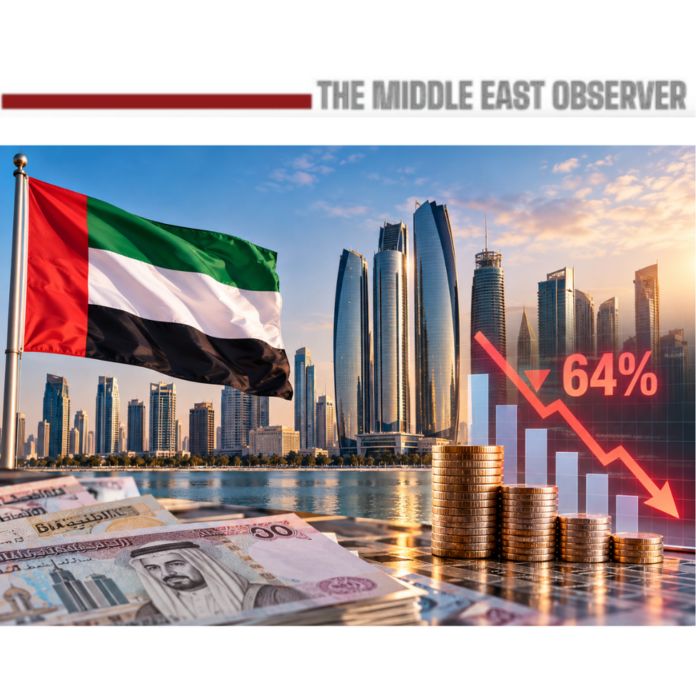
The sharpest reduction concerns financial investments, whose allocation falls 63.6%, from AED15.38 billion in 2026 to AED5.6 billion in 2027.
However, the Ministry of Finance’s detailed 2026 Budget Yearbook reveals an important explanation behind the unusually high 2026 figure.
Of the AED15.38 billion allocated to financial investments last year, AED12.4 billion, or more than 80%, was assigned to a newly established Federal Financial Support Programme designed to strengthen the financial position of federal government institutions.
The Cabinet approved the programme in October 2025, stating that it would receive annual budget allocations. However, this did not mean the same amount had to be provided every year.
The published 2027 budget does not explain whether the programme’s funding has been reduced, moved to another spending category or arranged through another financing mechanism.
Importantly, the AED5.6 billion allocated to financial investments in 2027 remains 95.5% higher than the AED2.87 billion budgeted in 2025. This suggests that the sharp annual reduction partly reflects an exceptional rise in 2026 rather than proving a continuing decline in investment.
Where Will the Additional AED5.13bn Go?
Another significant question concerns the AED5.13 billion increase in other federal expenses.
The Ministry of Finance’s 2026 budget estimates included AED8.13 billion in other expenses, AED3.33 billion in expenditure and bank interest, and AED1.21 billion in grants.
The 2027 announcement does not provide a comparable breakdown, making it unclear whether the additional funding is intended for higher financial obligations, new government programmes, existing commitments or reserves for unforeseen needs.
The distinction is particularly important as the UAE seeks to sustain public services, strengthen its finances and maintain economic growth amid regional and global uncertainties.
The federal budget also represents only part of the UAE’s wider public spending. Individual emirates, including Abu Dhabi and Dubai, maintain separate budgets and investment programmes, while government-owned companies finance major projects independently.
Consequently, the reduction in federal financial investments does not necessarily mean that infrastructure development or investment across the UAE is declining.
The 2027 budget therefore signals a change in how federal resources are distributed, rather than an established retreat from investment. The outstanding questions are how the AED12.4 billion support programme will be funded in 2027 and what accounts for the additional AED5.13 billion in federal expenses. Clarifying both will show whether the changes reflect a return to more normal spending levels after an exceptional 2026 or a longer-term change in government priorities.
Related News:
Kuwait’s Sukuk Reform Offers MENA a Blueprint for Financing Development
Qatar Opens $60bn Investment Pipeline for Next Growth Phase
Read Also:
Bonds, Inflation and the New Price of Money Across MENA
UAE Plans €40bn Germany Investment Push Across AI, Industry and Energy